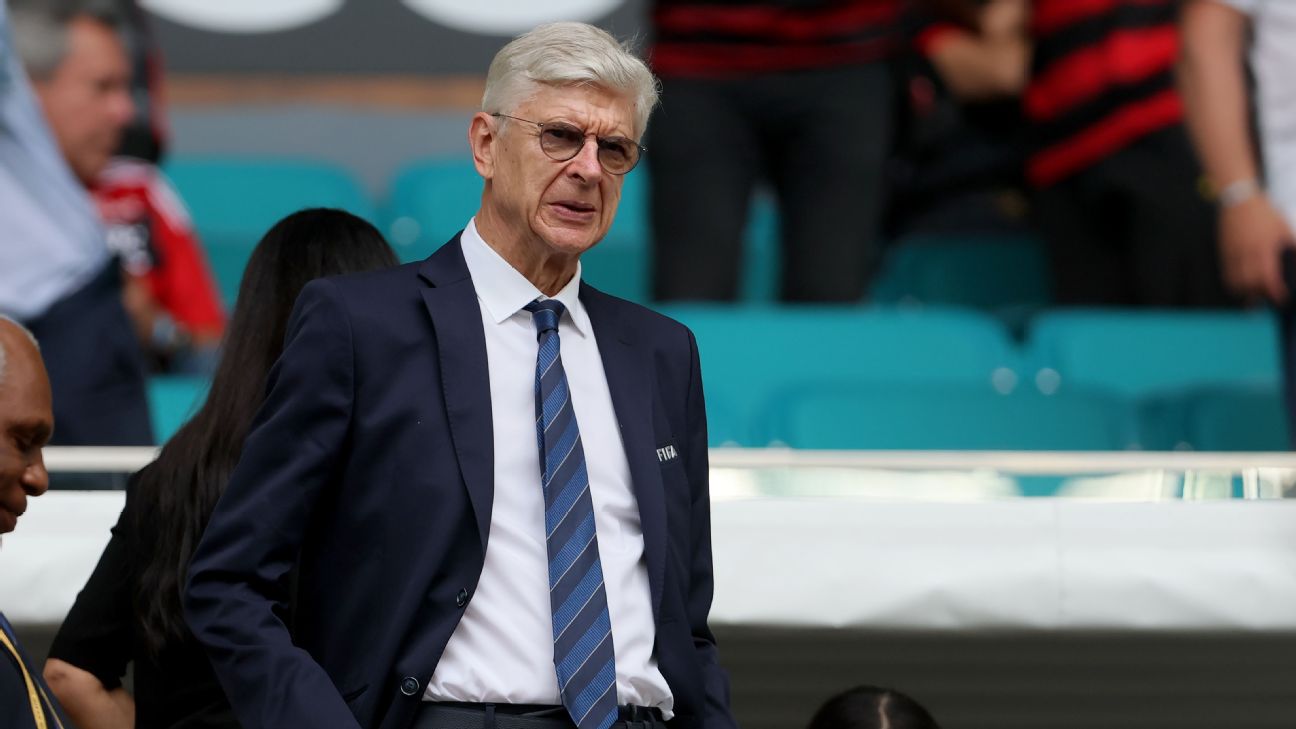
Arsène Wenger has strongly defended FIFA’s newly expanded 32-team Club World Cup following sharp criticism from former Liverpool manager Jürgen Klopp, calling it a “fantastic competition” that has received widespread approval from participating clubs and players.
Klopp, who recently stepped down from his role at Liverpool, described the tournament as “the worst idea ever invented” in an interview with Die Welt two weeks ago, citing concerns about player welfare and fixture congestion. However, Wenger—now FIFA’s Chief of Global Football Development—rejected those claims during a FIFA Technical Study Group (TSG) briefing in New York on Thursday.
“Everyone has the right to express their opinion, but I completely disagree with Jürgen Klopp’s view,” said Wenger. “There was a need for a true Club World Cup. Based on feedback from the clubs that participated, I believe close to 100% would welcome the opportunity to return. That is the clearest endorsement we can receive.”
Wenger also highlighted stronger-than-expected attendance as evidence of the tournament’s appeal, challenging the notion that fans were indifferent to the new format.
“The critical question is always: do fans care? While initial projections were modest, actual attendance has been significantly higher. That speaks volumes,” he noted.
Preparation Ground for the 2026 World Cup
Beyond its competitive goals, the Club World Cup has also served as a logistical and environmental test bed for FIFA as it prepares for the expanded 2026 World Cup across North America. Wenger acknowledged that the U.S. summer heat presented challenges, but said the tournament offered critical learning opportunities.
“The heat was a factor in some matches,” he admitted. “We responded with cooling breaks and pitch watering at key intervals. These experiences have provided valuable insights.”
Orlando was cited as a particularly problematic venue due to pitch conditions, although Wenger praised the overall quality of natural grass pitches throughout the tournament. He highlighted Philadelphia’s surface as a model for future events.
Looking ahead, FIFA is exploring ways to better manage environmental variables. Wenger revealed that more early-round matches may be hosted in roofed stadiums—such as those in Atlanta, Dallas, Los Angeles, and Houston—to minimize the impact of extreme heat and meet broadcast scheduling requirements.
“We’ve analyzed how heat affects player performance,” he said. “Temperatures above 35°C [95°F] significantly impact sprinting and high-speed running, though not total distance covered. We’ll continue to adapt to better protect players while delivering an elite-level tournament.”
Final Showdown at MetLife Stadium
The inaugural 32-team edition of the Club World Cup concludes on Sunday, when Paris Saint-Germain face Chelsea at MetLife Stadium in New Jersey. The match will cap off a competition that FIFA sees not only as a new pinnacle of club football, but also as a vital step toward operational readiness for the upcoming global showpiece in 2026.
While the debate over the Club World Cup’s long-term impact continues, Wenger’s firm backing underscores FIFA’s commitment to the tournament—and its belief that both the sporting and commercial foundations have been successfully laid.