"He just needs time. Give him time and he will get it right."
Rúben Amorim has already faced difficult moments in his short Manchester United reign, but needing public backing from the manager of League Two side Grimsby Town—after being knocked out of the Carabao Cup by them—may represent a new low.
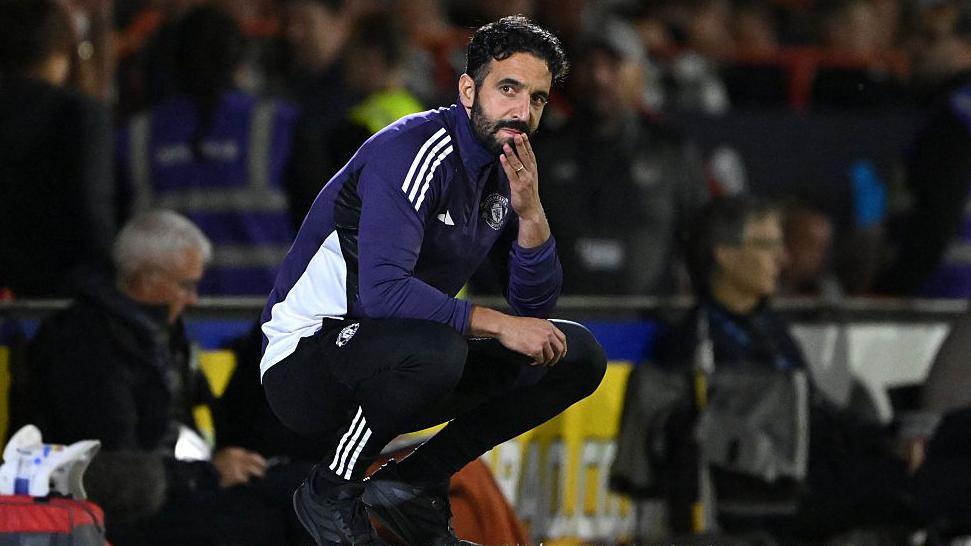
The defining image of the night was not the penalty shootout itself, but Amorim’s reaction to it. As BBC Sport’s Simon Stone described, the 40-year-old appeared to be “cowering” in the dugout, unable to watch as his players faltered.
After the defeat, Amorim delivered a stark assessment: “I think this is a little bit the limit. Something has to change. The team and the players spoke very loud today.” What exactly needs to change was left unsaid, but his remarks hinted at deep-rooted concerns. Last season, he admitted that if poor results persisted into this campaign, he would consider stepping aside.
Now, with United winless in their opening three matches, the question is whether Amorim can survive this latest crisis.
United’s exit to Grimsby reverberated far beyond the Lincolnshire coast. Having invested close to £200m in attacking reinforcements—Matheus Cunha (£70m), Benjamin Šeško (£60m), and Bryan Mbeumo (£65m)—this was not a game Amorim could afford to lose.
Yet the result reflects a broader pattern. His record reads 16 wins, 12 draws and 17 defeats from 45 games—a win percentage of just 36%. Among permanent United managers post-Ferguson, it is the lowest by some margin. Even interim coach Ralf Rangnick posted a stronger 38%.
This is why Saturday’s home fixture against Burnley already carries the weight of a “must-win.” United have not lost to a promoted side in 23 league matches. Breaking that streak could be fatal for Amorim’s tenure.
When Amorim was appointed last November, he admitted he would have preferred to wait until the summer. The board insisted it was “now or never.” Many excused him for last season’s 15th-place finish, believing a full pre-season and a revamped squad would offer a reset.
But fresh evidence of improvement has been scarce.
Former England striker Chris Sutton labelled the Carabao Cup defeat an “embarrassment,” criticising Amorim’s decision to rotate heavily: “If I was him, there’s not a prayer I would have made eight changes. Play your strongest team, get the game won, then make changes. That was an error. He will struggle to come back from this.”
The result also eliminates one of United’s few realistic paths back into European competition, increasing pressure on league results—where just one point from two matches has left them sitting 16th.
Managers lose football matches, but how they conduct themselves in moments of crisis shapes perception. The sight of Amorim avoiding the decisive penalties only reinforced a narrative of fragility.
It is hard to imagine a Sir Alex Ferguson or even an Erik ten Hag appearing so visibly defeated in a moment of tension. Leadership, especially at Old Trafford, demands resilience as much as tactical acumen.
Amorim’s comments after the match—hinting that “decisions” would follow Saturday’s fixture—sounded less like a coach fighting for his position and more like one contemplating an exit.
For United’s hierarchy, the dilemma is stark. Removing Amorim would be costly—not just financially, but strategically. The club expended significant effort to secure him, believing he was the long-term solution.
Sacking him after less than a year would reset the project yet again, continuing a cycle that has plagued the post-Ferguson era: manager churn, expensive player turnover, and no lasting identity.
As one frustrated fan put it: “If we change the manager then we are just back to square one again. He can’t replace 22 players, but something clearly isn’t working.”
Even with INEOS providing more structure and Jim Ratcliffe endorsing Amorim as recently as March—calling him “an excellent manager”—results now threaten to undermine that faith.
Manchester United’s problems run deeper than one man, but Amorim’s leadership is under the microscope. His preference for tactical overhaul, the disconnect between expensive signings and performances, and now the optics of defeat to Grimsby—all compound his precarious situation.
Saturday against Burnley may not be a season-defining match, but for Amorim, it could determine whether he has a season left to define.