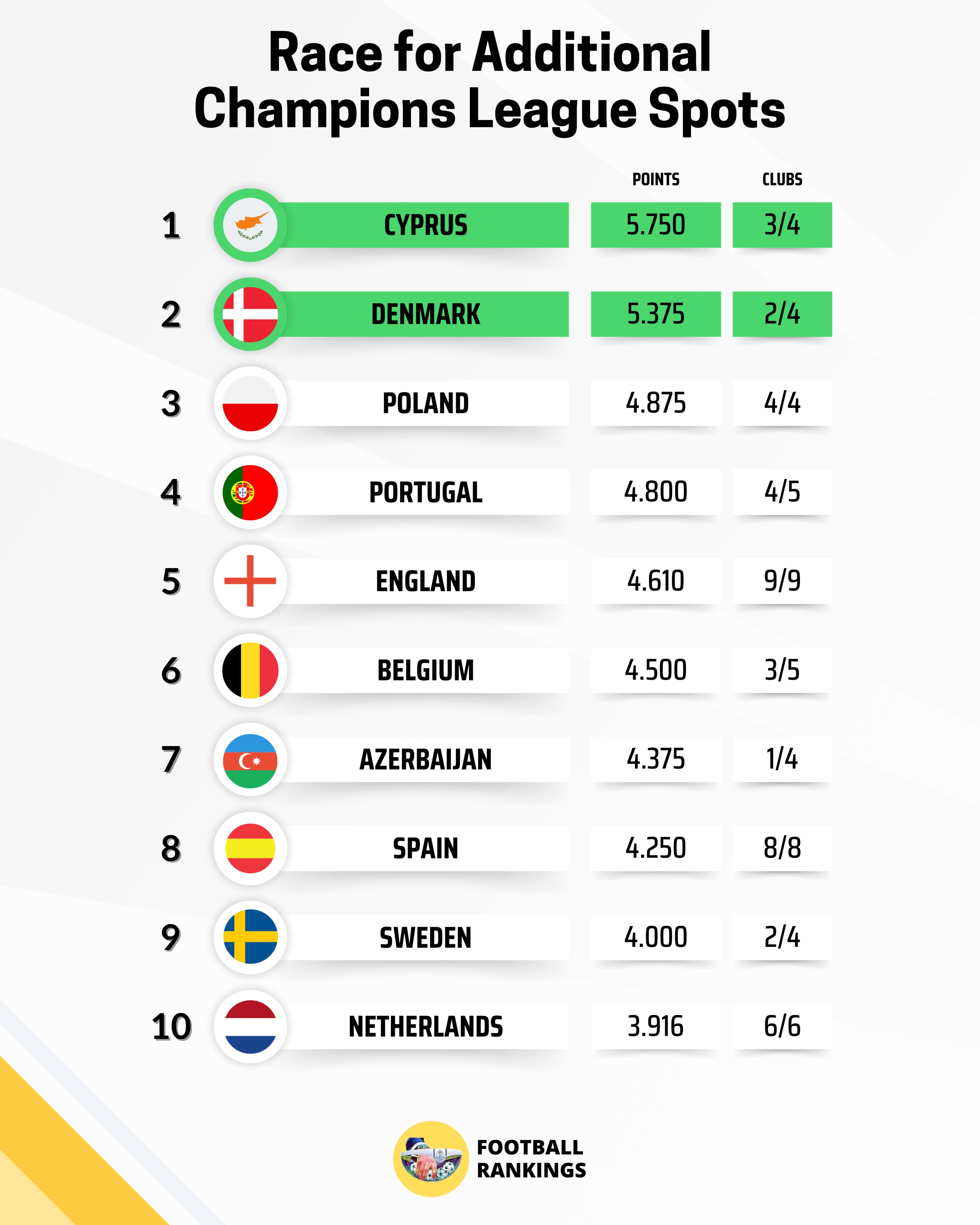
Cyprus and Denmark are currently in pole position to secure the two additional Champions League spots available for the 2026-27 season.
The allocation of extra places was introduced with the expansion of the Champions League in 2024-25, when the group stage grew from 32 to 36 teams. UEFA awards two European Performance Spots (EPS) each year to the nations whose clubs collectively perform best across all European competitions during the previous season.
The EPS are determined through UEFA’s association coefficient rankings. Points are accumulated by clubs in the Champions League, Europa League and Conference League, based on match results and progress through the rounds:
The total points collected by a nation’s clubs are then divided by the number of teams it entered into European competition that season. This ensures a fair comparison between leagues of different sizes.
For example, England began the 2025-26 season with nine European entrants, so its coefficient score is divided by nine, whereas Scotland, with five entrants, divides by five—even though two of their sides exited in qualifying.
The system has already altered qualification dynamics:
Because the Champions League has only just begun, with the Europa League and Conference League group stages yet to start, early rankings are often shaped by results in the qualifying rounds. This tends to favour mid- and lower-ranked associations whose clubs accumulate more opportunities for coefficient points.
With the group stages of the Europa League and Conference League yet to begin, the table is likely to shift significantly. Larger nations with more clubs in the latter stages of European competitions—such as England, Spain, Italy and Germany—traditionally climb the rankings as the season progresses. However, Cyprus and Denmark’s early advantage underscores how strong performances from a small pool of clubs can create a genuine opportunity to secure one of the coveted extra Champions League berths.