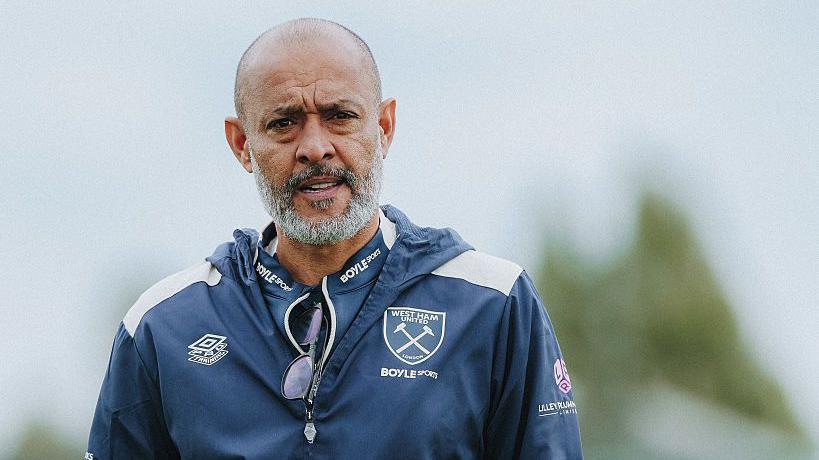
With West Ham languishing in 19th place in the Premier League, the club has turned to Nuno Espirito Santo as Graham Potter’s successor. The Portuguese coach arrives with a reputation for elevating squads beyond expectations, as seen at Wolves and Nottingham Forest, though his brief and disappointing spell at Tottenham remains a cautionary tale.
Ahead of his first match in charge against Everton on Monday, we assess Nuno’s recent work at Forest, examining his tactical principles and whether they align with West Ham’s current needs.
Modern football increasingly favours possession-oriented, attack-minded coaches, but West Ham’s recent attempts to adopt such an approach have fallen flat. Despite David Moyes delivering the Europa Conference League title in 2023, his pragmatic style was often criticised by supporters. Yet attempts by Manuel Pellegrini, Julen Lopetegui, and Potter to implement more expansive football also failed to deliver consistent success.
Nuno’s philosophy is closer to Moyes’ than those who followed him. His teams tend to cede possession — Forest averaged just 41% last season, the third lowest in the league — before striking swiftly on the counter. By defending deep and limiting space behind their back line, his sides restrict opponents to low-quality chances.
His appointment suggests West Ham’s hierarchy now recognise that a possession-heavy style does not suit the current squad, and a return to counter-attacking football may offer a more effective path forward.
While Nuno made his name at Wolves with a three-centre-back system, Forest frequently deployed a 4-2-3-1 last season. Out of possession, they shifted into a 4-2-4 shape when pressing, but more often they sat deep in a compact block near their own penalty area.
When protecting a lead, Nuno often introduced Morato to form a back five — a tactical tweak that proved highly effective, as Forest never dropped points in games where he did so. The trade-off was deeper defending and increased late-game pressure, an area where Forest struggled, conceding 12 goals in the final 15 minutes of matches.
In attack, Nuno’s teams prioritise direct progression. Forest often bypassed midfield, launching long balls into Chris Wood, whose hold-up play created opportunities for attacking midfielders like Morgan Gibbs-White. They also exploited wide overloads, quickly advancing the ball down the flanks rather than risking turnovers in central areas.
This high-tempo style saw Forest register the most direct play in the league, progressing the ball forward at an average of 2.04 metres per second.
Nuno’s low-possession, transition-based football could be an ideal fit for West Ham’s current squad. The Hammers have struggled to build from the back under pressure, and extended periods of possession have not yielded consistent chances. Their most dangerous moments still come on the counter, particularly through Jarrod Bowen.
Nuno’s tactics at Forest, which relied on quick transitions and pace in attack, should benefit players such as Crysencio Summerville, Lucas Paquetá, and Bowen. He may initially opt for a five-at-the-back system to shore up the defence but is likely to transition to his preferred 4-2-3-1 once stability is achieved.
One of Nuno’s strengths is his tactical adaptability. He tailors player roles to individual strengths — wingers Callum Hudson-Odoi and Anthony Elanga were deployed wide, while Elliot Anderson and Nicolas Dominguez were used more centrally when the situation demanded.
Expect El Hadji Malick Diouf’s attacking full-back qualities to be fully utilised, while players like Niclas Füllkrug, Soungoutou Magassa, Mateus Fernandes, Paquetá, and Max Kilman all appear well-suited to his transition-heavy system.
Nuno also showed tactical flexibility in key matches. In the FA Cup quarter-final win over Brighton, he fielded a five-man midfield to clog central areas and stifle Brighton’s passing game — a departure from his usual setup and proof that he is not limited to a rigid counter-attacking style.
While tactics are critical, the human element cannot be overlooked. Reports of Potter’s deteriorating relationships with players such as Füllkrug, Edson Álvarez, and Jean-Clair Todibo hint at a fractured dressing room. Nuno, by contrast, is widely respected by his former players.
Ex-Wolves captain Conor Coady praised him, saying:
“West Ham have got an unbelievable manager. How he speaks, how he works with players, and how he makes them better is great. The change in voice will really help. Under Nuno, you know exactly what you’re doing — West Ham are a counter-attacking team and will play on the transition.”
Nuno Espirito Santo represents a return to fundamentals for West Ham. His style of play not only matches the current squad’s strengths but also addresses their structural weaknesses. His willingness to adapt, combined with his strong interpersonal skills, could prove decisive in steering the Hammers away from relegation trouble.
While doubts remain following his Tottenham stint, Nuno’s track record suggests he can stabilise struggling teams and maximise their potential. For a West Ham side in crisis, that might be exactly what they need.