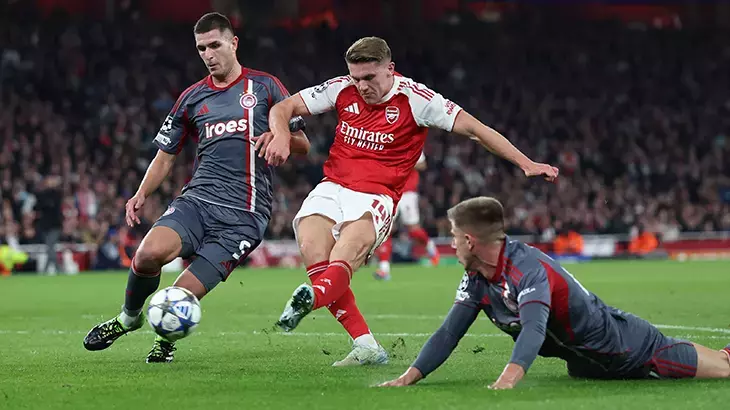
Arsenal have begun the season strongly, winning eight of their opening 10 matches and positioning themselves as early title contenders. Yet for Viktor Gyökeres, the club’s £64 million summer signing from Sporting CP, the opening weeks have been more complex.
After scoring three goals in his first four appearances, the 27-year-old striker has now gone six matches without finding the net. Manager Mikel Arteta praised his contribution despite the drought, revealing he gave the Swede “a hug” following Saturday’s 2-0 win over West Ham as recognition for his effort and work rate.
Gyökeres has featured heavily since arriving in north London, completing 90 minutes in six of Arsenal’s first 10 games — more than Arteta initially planned. A knee injury to Kai Havertz has limited the manager’s ability to rotate and manage the striker’s workload.
Havertz’s absence is significant. The German international is one of Arteta’s most trusted players and may have been preferred in certain high-stakes fixtures, such as the away matches against Liverpool, Newcastle, and Manchester United. Gyökeres also arrived at Arsenal without a full pre-season, having missed training at Sporting while pushing for the move — another factor affecting his early rhythm.
Despite the slow start, expectations remain high. Gyökeres was signed as a “win-now” player after scoring a remarkable 97 goals in 102 games over two seasons in Portugal. His primary task is to be the difference-maker Arsenal have lacked in decisive moments as they pursue their first major trophy since 2020.
Arteta has consistently praised Gyökeres for his contributions beyond scoring. After the Champions League win over Olympiacos, he described the striker’s performance as “exceptional” and highlighted his relentless “work-rate.”
His arrival was expected to complement Arsenal’s attacking midfielders — Martin Ødegaard, Bukayo Saka, Eberechi Eze, and Gabriel Martinelli — by creating space and stretching defences. There have been glimpses of this dynamic, though Gyökeres himself would have hoped for a stronger return as the team’s focal point. He has scored in just two matches: a brace in the 5-0 win over Leeds in August and one goal in a 3-0 victory against Nottingham Forest in mid-September.
Arsenal have evolved tactically this season, adopting a more direct and vertical style to exploit Gyökeres’ strengths — particularly his movement between centre-backs and his runs into space behind defences. Unlike Havertz, he does not drop deep to link play, instead focusing on stretching opposition lines.
The approach is visible in the numbers: Gyökeres has had 23 chances across 10 games but produced just seven shots on target, including one penalty. Arsenal are also crossing more frequently, an adjustment aimed at creating higher-quality opportunities for their new No. 9.
Penalty duties remain unsettled. Arteta labelled Gyökeres the “best penalty taker at the club” in an interview with ESPN Brazil, yet Saka took the spot-kick in the win over West Ham when both were on the pitch. Gyökeres’ only penalty goal so far came against Leeds, when Saka had already been substituted.
Saka, who recently made his 200th Premier League appearance, remains confident in his teammate:
“Viktor’s playing really well,” Saka said. “There’s no doubt he’ll score goals. What he brings to the team — his hold-up play, his runs, his threat — we’re grateful for it. He’s a big reason why we’re winning games. His goals will come. We believe in him.”
Gyökeres’ early struggles should be seen in context. He entered the season short of peak fitness due to his disrupted pre-season and has been thrust into the spotlight earlier than planned because of Havertz’s injury. Chemistry with the midfield behind him is still developing, and the striker is adjusting to the physical demands of the Premier League, where defenders are stronger and more aggressive.
His mentality and resilience, often highlighted by those around him, could prove vital. Despite the pressure surrounding his record-breaking transfer — his shirt sales set new club records — Gyökeres remains committed, constantly seeking space and providing an outlet for quick transitions.
There are visible signs that his teammates are eager to see him succeed. Against Olympiacos, Martinelli deliberately let a Gyökeres effort roll toward goal before it struck the post, allowing the winger to tap in. Such gestures reflect the collective desire within the squad to help their new striker find his scoring rhythm.
While Gyökeres may lack the finesse of the Premier League’s most technical forwards, he offers a powerful, direct option that fits Arsenal’s evolving tactical identity. With the system increasingly tailored to his strengths and more time to build partnerships, the conditions are in place for his form to improve.
The question is no longer whether Gyökeres will adapt — but how quickly he can transform promise into decisive performances as Arsenal push for silverware.