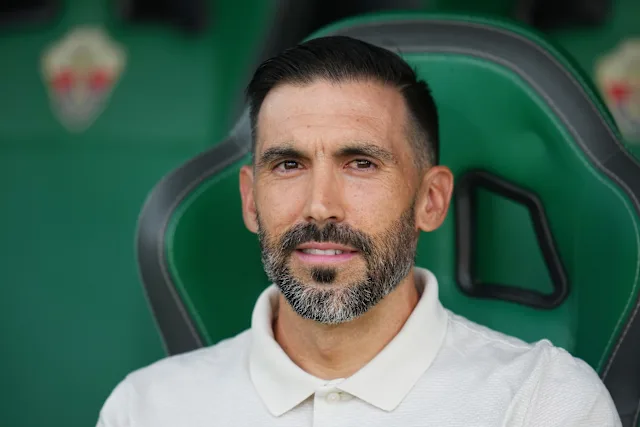
After two years away from Spain’s top flight, Elche marked their return to La Liga in emphatic fashion — a 4-0 victory over Deportivo La Coruña in June securing automatic promotion.
As the third-largest city in the Comunidad Valenciana and 20th largest in Spain, Elche cannot easily be cast as an underdog. Yet, heading into the season, most pundits pegged them — alongside Real Oviedo — as favourites for relegation.
So far, those predictions have been well wide of the mark. With more than a quarter of the campaign complete, Eder Sarabia’s side sit eighth in La Liga, boasting three wins, five draws, and only two defeats.
This weekend, Sarabia returns to Barcelona — the club where he endured a turbulent spell as assistant manager — now as the architect of one of the league’s most intriguing projects.
For Eder Sarabia, football runs in the family — though not necessarily in the same way. His father, Manu Sarabia, is an icon of Athletic Club, having helped the Basque giants to consecutive league titles and a league-and-cup double in the early 1980s.
Eder, however, never reached such heights as a player. He spent his modest playing career in Spain’s lower divisions before shifting his focus to coaching at just 24.
“I thought I’d become a footballer, but it didn’t work out,” he reflects. “Once I began coaching, I realised I’d found my purpose. My parents worried I’d be disappointed, but they saw I was happy.”
That grounding came with humility. Persuaded by his mother to study engineering, Sarabia balanced his education with part-time work — including stacking shelves and managing the fruit counter at a Bilbao supermarket.
“It taught me to value things, to understand what they really cost,” he says. “Those experiences shape how I see life and football today.”
Sarabia’s coaching journey began with youth teams at Cruces and Danok Bat, one of the Basque Country’s most respected development clubs. His tactical acumen soon earned him a move to Villarreal in 2011, where he climbed the youth ranks and eventually managed the C team.
A pivotal encounter came with Quique Setién, the man who would profoundly influence his career. Setién, a former teammate of Manu Sarabia, became Eder’s mentor and later his boss across three clubs — Las Palmas, Real Betis, and Barcelona.
“My father and Quique were like my two footballing fathers,” Sarabia says. “Quique saw something in how I coached, and when he joined Las Palmas, he gave me my first big opportunity.”
Their partnership would lead Sarabia into the spotlight — and, briefly, into the eye of a storm.
When Setién took over Barcelona in January 2020, Sarabia followed as his assistant. It was a whirlwind experience — one that exposed the young coach to the pressures of managing a club defined by global expectations and the brilliance of Lionel Messi.
Media scrutiny intensified after cameras captured tensions between the coaching staff and the players, notably when Messi appeared to ignore Sarabia during a match against Celta Vigo. Despite that turbulent episode, he now reflects on his time at Camp Nou with perspective and respect.
“Leo isn’t just the best of all time — he probably understands football better than anyone ever has,” Sarabia says. “He demanded the best from everyone because he wanted to keep winning. It was intense, but I learned so much.”
Setién’s tenure lasted only seven months, but for Sarabia, the experience was transformative. “It was a learning curve,” he admits. “You discover what it means to operate at that level — the pressure, the precision, the need for balance.”
After three seasons managing Gerard Piqué’s FC Andorra, Sarabia took over Elche in Spain’s second tier. Promotion followed swiftly, and with it, a new contract running until June 2027.
Elche’s style under Sarabia is bold and innovative — a departure from the cautious, defensive football often associated with newly promoted sides. Even amid a recent dip in form, his team’s attacking philosophy and tactical flexibility have impressed observers.
“We have a model, but we never play exactly the same way,” he explains. “What matters is being honest and authentic in how we compete.”
That authenticity extends beyond tactics. Central to Sarabia’s philosophy is a Basque concept — jatorra — meaning to do things the right way.
“Football is for clever people, but not for cheats,” he says firmly. “Winning is important, but how you win matters more.”
Sarabia’s approach to football is holistic. He views his role not only through the lens of competition but as part of a larger mission — to help clubs grow sustainably and leave a lasting impact.
“I think about the club’s short- and long-term growth,” he says. “If I stay six months or six years, I want to leave a legacy — something that endures beyond my time here.”
Under his leadership, Elche have become one of the season’s surprise packages — a team defined not by their limitations, but by their ambition and integrity.
And as Sarabia prepares to face his former employers at the Camp Nou, one thing is clear: the man once cast as a controversial assistant has evolved into one of La Liga’s most forward-thinking managers — intent on proving that doing things the right way can still lead to success.