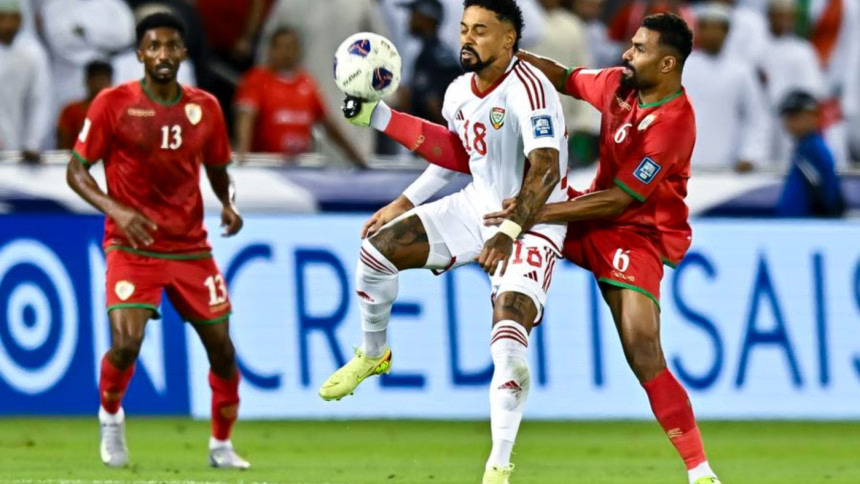
Iraq and the United Arab Emirates face decisive back-to-back encounters this week as both nations bid to keep their 2026 FIFA World Cup dreams alive after narrowly missing out on automatic qualification.
The two-legged playoff begins in Abu Dhabi on Thursday before the teams meet again in Basra four days later, with the aggregate winners advancing to an intercontinental playoff that will determine the 48th and final qualifier for next year’s expanded tournament in the United States, Mexico, and Canada.
Both sides enter the tie burdened by recent near-misses and long absences from the World Cup stage. Iraq, seeking their first finals appearance since their 1986 debut, saw their hopes dashed last month by Saudi Arabia, while the UAE — who last featured in 1990 — were eliminated by Qatar in the Asian qualifying playoffs.
For Iraq, much of the focus will be on the experience and leadership of head coach Graham Arnold, whose tactical nous proved pivotal in guiding Australia through a similar playoff route to the 2022 World Cup in Qatar. The 62-year-old Australian remains optimistic about Iraq’s chances, emphasizing discipline and improvement in attack as key to success.
“We’re doing everything we possibly can for Iraq to make sure we qualify,” Arnold said last week upon announcing his squad, which includes the return of Aymen Hussein after injury. “I know fans were disappointed after the Saudi game, but I was proud of the players’ work ethic. Defensively, we’ve been excellent — we haven’t conceded against Saudi Arabia or Indonesia — but we must improve in possession and convert our chances.”
Since Arnold’s appointment in May, Iraq have found the net only twice in four matches, a statistic the coach will be eager to change in the upcoming fixtures. Their opponents, meanwhile, have shown slightly sharper attacking form under Cosmin Olăroiu, who succeeded Paulo Bento earlier this year. The Romanian has overseen four goals in four games, stabilizing the UAE’s performances and instilling renewed belief within the squad.
The playoff represents one of the most significant moments in recent memory for both nations — a crossroads between lingering frustration and potential redemption. For Iraq, it is an opportunity to build on defensive solidity and harness Arnold’s proven playoff experience; for the UAE, a chance to reassert themselves as a regional powerhouse capable of returning to football’s biggest stage after more than three decades.
With a place in the World Cup intercontinental playoff at stake, the coming week promises drama, intensity, and the prospect of history for whichever side can seize the moment.