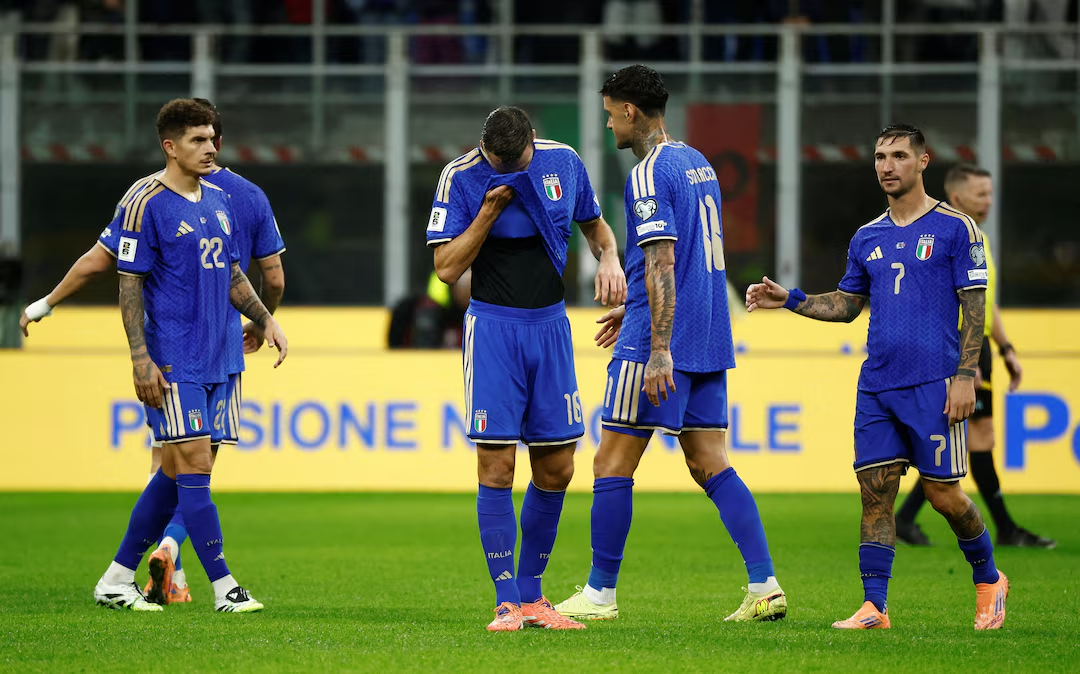
Italy’s supporters left San Siro on Sunday night in a mood of resignation and anxiety, preparing themselves for yet another dramatic World Cup playoff journey after the national team suffered a humbling 4–1 defeat to Norway in their final Group I qualifier.
Italy entered the match needing an implausible nine-goal victory to leapfrog Norway and secure automatic qualification for the 2026 World Cup in the United States, Canada and Mexico. The challenge was always unrealistic, but the scale of the defeat—and the manner of it—deepened fears across the fanbase as the Azzurri endured another bruising chapter in their recent qualifying history.
The four-time world champions, who last lifted the trophy in 2006, must now navigate the March playoffs to avoid missing a third consecutive World Cup. Their record in this format offers little comfort: Italy’s failures to reach both the 2018 and 2022 tournaments followed painful playoff exits.
“It would be devastating to watch a third straight World Cup without Italy,” said 54-year-old consultant Luca Raggi. “Almost five tournaments in a row, really, because in 2010 and 2014 we didn’t even get out of the group.”
Supporters’ concern intensified earlier in the campaign following a shock 3–0 defeat to Norway in June—a result that precipitated Luciano Spalletti’s dismissal and the appointment of Gennaro Gattuso. Despite the managerial change, Italy have struggled to rediscover the identity and competitive edge that defined their greatest generations.
Fans lamented a lack of world-class talent beyond goalkeeper Gianluigi Donnarumma, noting that the days of Italy routinely producing elite defenders, midfield maestros, and match-winning forwards seem increasingly distant.
“I brought my son for his birthday. He loved watching Italy, but he was more excited to see Haaland,” said Andrea Saronni, 57, highlighting the shift in star power and expectations.
Older supporters reflected sombrely on the generational divide: many Italian children have never watched the Azzurri at a World Cup. Others pointed to deeper structural issues, from scouting to youth development.
“Other countries have improved at spotting and developing talent,” Saronni added. “And for their players, representing the national team still means something. That motivation seems missing for ours.”
The painful memories of past playoff failures loomed large outside San Siro.
In 2022 qualifying, Italy were stunned in Palermo by North Macedonia, losing to a stoppage-time goal from Aleksandar Trajkovski. In 2018, they fell to Sweden over two legs in a defeat that left Gianluigi Buffon in tears and the entire country in disbelief.
“I was here when we missed out against Sweden,” recalled Raggi. “Back then, missing a World Cup was unimaginable. Now it feels almost normal.”
Between those two collapses came Italy’s euphoric Euro 2021 triumph—an achievement that now seems almost surreal in the context of their continued World Cup struggles.
Despite heavy rain and cold conditions, nearly 70,000 fans filled San Siro, offering strong support for much of the match. But as Norway pulled away in the final stages, the mood shifted dramatically. Norwegian supporters, celebrating their nation’s first World Cup appearance since 1998, began to drown out the home crowd.
“I’m here out of passion,” said 54-year-old Mariagnese Rossi. “If Italy fail again, it will be a huge disappointment. I just hope it doesn’t happen.”
Many fans acknowledged that this Italy squad cannot be compared to its historic predecessors. Yet there remains a belief that if the Azzurri can simply survive the playoffs and reach the tournament, their potential ceiling is higher than their qualifying form suggests.
“When we won the Euros in 2021, everyone played above their level,” said Pasquale Di Bello, 40. “That can happen again—but only if we actually make it to the World Cup.”
For now, Italy face another tense March, another playoff path, and another test of whether football’s most decorated national team can halt its slide into World Cup obscurity.