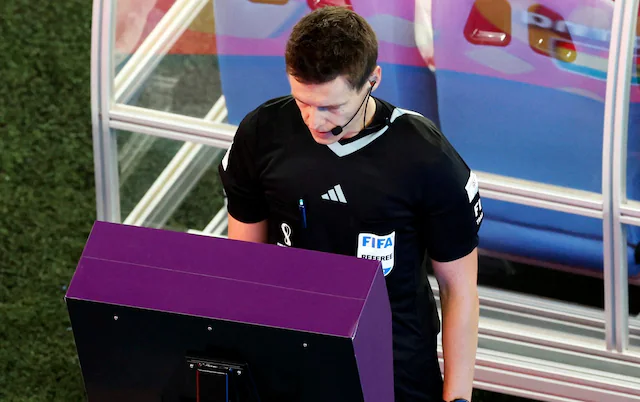
FIFA is preparing to move forward with its plan to implement VAR checks for the awarding of corner kicks at the 2026 World Cup, despite resistance from domestic leagues that have rejected the proposal for wider use.
During an International Football Association Board (IFAB) meeting in October, members agreed to expand VAR to include the review of incorrectly issued second yellow cards that subsequently result in a red. However, FIFA’s request to add corner-kick decisions to the VAR remit was dismissed, meaning world football’s governing body will need to establish its own trial during next summer’s tournament in the United States, Mexico, and Canada.
Further discussions are scheduled for the next IFAB meeting in January, but FIFA has a history of introducing innovations through competition-specific trials. Semi-automated offside technology and the public announcement of VAR decisions by referees were both rolled out this way, and corner-kick reviews may follow the same route.
Pierluigi Collina, FIFA’s head of refereeing, has been a vocal proponent of expanding VAR protocols as part of a broader modernisation effort. He has also signalled willingness to extend video review even further, arguing that any clear and quickly identifiable error should be relayed to the referee. Collina has cited high-profile examples, such as the mistaken free-kick awarded to Portugal in extra time during the Euro 2016 final, which nearly resulted in a goal.
Nottingham Forest manager Sean Dyche is among those frustrated by incorrect corner awards, having seen his side concede twice from such situations earlier this season. Yet unless IFAB alters its stance, leagues will not see corner decisions brought under VAR in the foreseeable future.
Domestic competitions remain under significant pressure to reduce stoppages caused by VAR interventions, and there is strong opposition to any measure that could increase delays. Football Association chief executive Mark Bullingham, an IFAB board member, has publicly stated his opposition to expanding VAR to include corner decisions.
In contrast, IFAB is likely to approve VAR involvement in correcting erroneous second yellow cards from next season, as such incidents occur far less frequently than corner kicks—of which there are, on average, around 10 per Premier League match.
A major challenge for leagues is the resource burden. Lower-tier competitions in particular lack the personnel and technological infrastructure that FIFA can deploy at its flagship tournament. At the 2022 World Cup, group-stage matches featured five officials in the VAR hub, compared with two in most domestic leagues. FIFA also deployed multiple specialised roles, including offside VARs and support VARs.
Additionally, FIFA ensures comprehensive camera coverage and uses the Adidas connected ball, which provides instantaneous data on the last touch—technology unavailable to leagues. These advantages allow FIFA to make swift and accurate decisions that clubs and competitions worldwide cannot replicate.
Even the Premier League, with its substantial resources, has faced camera-coverage gaps—most notably in the controversy surrounding Newcastle’s winning goal against Arsenal two seasons ago, when VAR lacked the angles needed to determine whether the ball had gone out of play.
If corner reviews were added to VAR protocol, every VAR-equipped league—from the Premier League to the Scottish Premiership, the Eredivisie, and second divisions across Europe—would be required to implement them. This would introduce substantial delays and inconsistency due to uneven access to technology and staffing. For these reasons, IFAB has repeatedly rejected FIFA’s proposal, prompting the organisation to pursue a World Cup-specific trial.
Under the Laws of the Game, once a restart—such as a corner—is taken, referees cannot retroactively change the decision after play has resumed, even if it is later shown to be incorrect. As a result, VAR would need to review every awarded corner before the ball is back in play.
In most situations, the decision is expected to be straightforward. FIFA believes its extensive resources—high-level VAR staffing, enhanced camera systems, and connected-ball data—will allow these checks to be completed rapidly, minimising disruption.
The change would mark a significant expansion of VAR’s original scope, which is currently limited to four categories: goals, penalties, direct red cards, and mistaken identity. At the 2026 World Cup, corner-kick decisions are poised to become the fifth category, representing a notable evolution in FIFA’s approach to officiating technology.