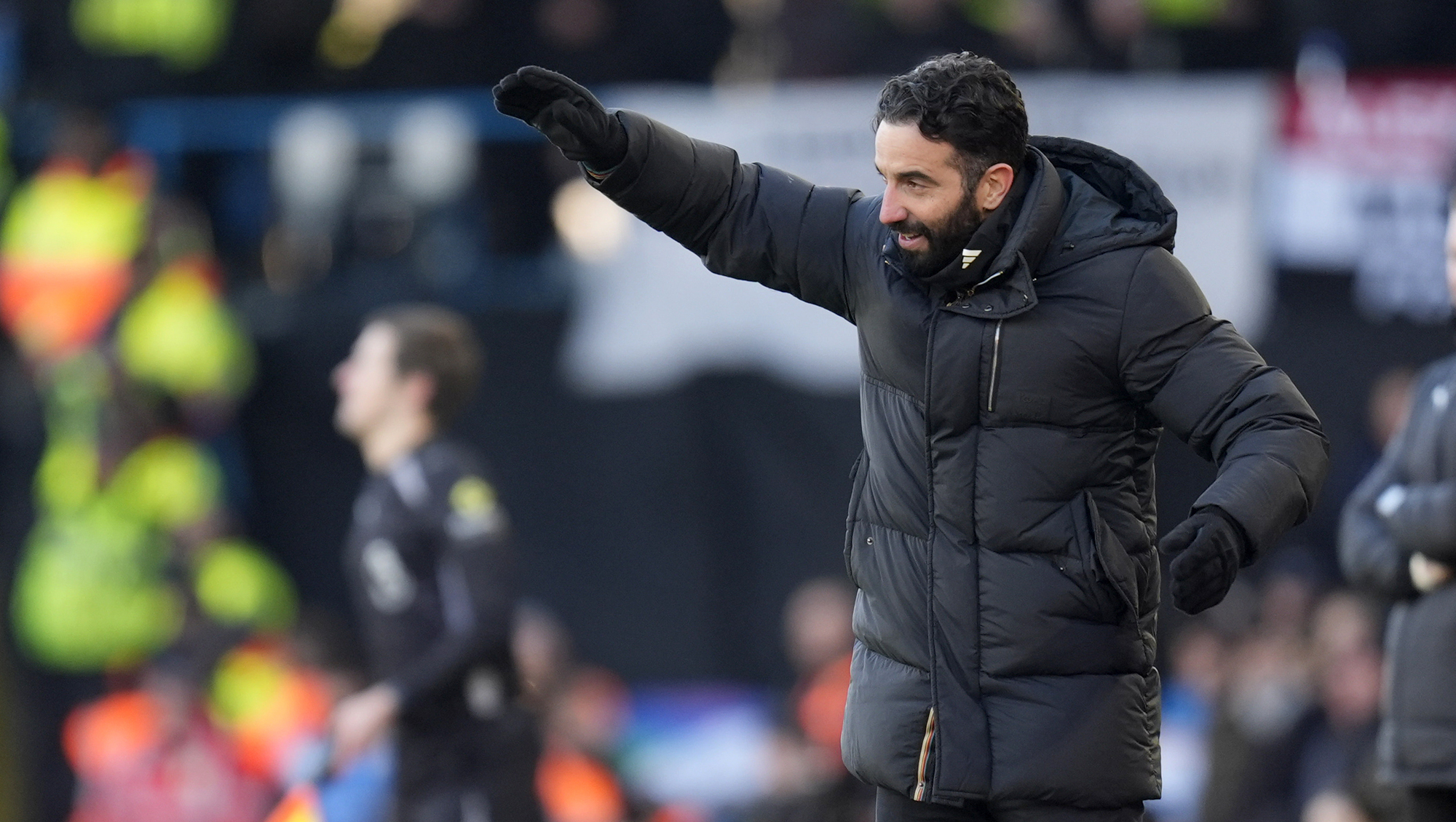
Ruben Amorim has publicly challenged Manchester United’s hierarchy, making it clear he expects autonomy in his role and warning against internal interference in his responsibilities.
After alluding to behind-the-scenes issues on Friday, Amorim used the closing moments of his post-match press conference following the 1-1 draw at Leeds United to underline his position. In doing so, he repeatedly referenced the finite nature of his contract — which expires in 18 months — and suggested that levels of interference he has encountered would be unacceptable at other elite clubs.
The United head coach also referenced several high-profile former Premier League managers, implying that figures of that stature would not be subjected to similar constraints.
“I just want to say I came here to be the manager, not to be the coach,” Amorim said.
“In every department — the scouting department, the sporting director — they need to do their job. I will do mine for 18 months and then we move on.
“I’m going to be the manager of this team, not just the coach. That was very clear. This finishes in 18 months and then everyone moves on. That was the deal.”
Amorim also suggested Manchester United have become overly reactive to external scrutiny.
“If people cannot handle the Gary Nevilles and the criticism of everything, we need to change the club,” he said.
Neville has been one of several former United players to voice sharp criticism in recent weeks, describing the home draw with bottom-of-the-table Wolves on 30 December as “the baddest of the bad”.
Responding on The Gary Neville Podcast, the former United captain said Amorim’s comments signalled deeper unrest.
“Something has happened in the last week,” Neville said. “It looks like he’s unhappy with something in the hierarchy. He’s not feeling supported and he’s starting to let go.
“When he says he came in as a manager, I thought he was appointed as head coach, quite clearly to coach the team.”
Last month, Paul Scholes questioned Amorim’s understanding of United’s traditions, criticising his preference for a back three with wing-backs — a system that contrasts with the club’s historic use of wingers.
Although Amorim briefly switched to a back four for the Boxing Day win over Newcastle, he reverted to a three-man defence in subsequent fixtures, including at Leeds.
Reports have suggested United’s head of recruitment, Christopher Vivell, urged Amorim to adapt his system after Fulham manager Marco Silva outlined in detail how his side planned to counter it during a 1-1 draw at Craven Cottage in August.
Amorim has already acknowledged disagreements over transfer strategy, while suggestions of growing friction with director of football Jason Wilcox have intensified.
Asked directly whether he still had the confidence of the club’s hierarchy, Amorim doubled down.
“I came here to be the manager of Manchester United, not the coach,” he said. “I know my name is not Thomas Tuchel, Antonio Conte or José Mourinho, but I am the manager of Manchester United — and it will be like this for 18 months or until the board decides to change.
“I’m not going to quit. I will do my job until another guy comes in.”
Despite club efforts to project unity, Amorim was officially announced as “head coach” when he replaced Erik ten Hag on 1 November 2024 — a distinction that now appears increasingly significant.
While results have been inconsistent — one win in five games and three in 11 — Amorim maintains United are moving in the right direction. Whether his comments accelerate a resolution remains to be seen, with his next media appearance scheduled for Tuesday ahead of Wednesday’s trip to Burnley.
Amorim had the opportunity to clarify his remarks at Elland Road but instead chose to leave questions unanswered. It followed a similar approach on Friday, when he cryptically referenced recruitment disagreements after a failed move for Antoine Semenyo.
What remains unclear is whether Amorim wanted the £65m allocated for Semenyo redirected elsewhere in a squad that clearly requires reinforcement.
What is clear is Amorim’s belief that managers must exert influence over recruitment — a stance he articulated after the 1-0 win over Newcastle on 26 December.
“Sometimes I have one idea, Jason [Wilcox] and the board have another,” he said. “Every decision needs common ground. The manager understands the way of playing.”
That divergence of opinion now appears more pronounced. The next question is who steps in — Wilcox, chief executive Omar Berrada, minority owner Sir Jim Ratcliffe, or the Glazers — and when.
Amorim’s repeated reference to “18 months” suggests a willingness to see out his contract, but modern football rarely allows tensions of this magnitude to linger.
United remain broadly on course for European qualification — the minimum target set for Amorim — yet it is difficult to envisage the current dynamic continuing indefinitely.
Amorim appears to believe the role he accepted differs from the reality he now faces. Berrada personally travelled to Portugal after Ten Hag’s dismissal to convince him to leave Sporting immediately rather than wait until the summer. The outcome, however, seems far from what Amorim envisaged.
The key questions are stark:
If Amorim cannot accept United’s current structure, are the club prepared to adapt? If not, regardless of league position, how long can this situation persist?
Amorim’s position has not been helped by the form of £73.7m striker Benjamin Šeško.
The Slovenian has scored just twice in 16 appearances and missed several chances against Leeds, including a glaring opportunity when he sent Joshua Zirkzee’s low cross wide from six yards.
Šeško has now gone nine games without scoring, while Rasmus Højlund — loaned to Napoli after two difficult seasons — has nine goals in 21 matches. The decision to replace him is increasingly under scrutiny.
Amorim, however, remains supportive.
“Ben has completely different characteristics to Rasmus and he is doing the right things,” he said. “To miss chances, you have to be there first. He just needs one goal and the weight will disappear.”