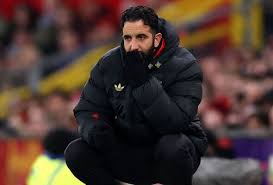
Manchester United have parted company with head coach Ruben Amorim after just over a year in the role, with Darren Fletcher set to oversee Wednesday’s Premier League fixture away to Burnley.
The decision follows a period of growing tension between Amorim and the club’s hierarchy. On Friday, the Portuguese coach hinted publicly at a strained relationship with senior figures, suggesting he would not receive full backing in the transfer market. Those frustrations surfaced again after Sunday’s 1-1 draw with Leeds, when Amorim stated he wanted to operate as a manager rather than merely a coach and indicated he was prepared to leave when his contract expired in 18 months’ time.
Less than 24 hours later, United confirmed that Amorim had “departed his role as head coach of Manchester United” after 14 months at Old Trafford.
“With Manchester United currently sixth in the Premier League, the club’s leadership has reluctantly concluded that now is the right time to make a change,” the club said in a statement. “This decision is intended to give the team the best possible chance of achieving the highest attainable league finish. “The club would like to thank Ruben for his contribution and wishes him well for the future.”
Amorim’s entire coaching staff have also left the club.
Sources told BBC Sport that United’s leadership felt there had been insufficient evidence of tactical evolution or overall progress this season. Appointed in November 2024, Amorim won 25 of his 63 matches in charge. His tenure is the shortest for a permanent United manager since David Moyes’ eight-month spell ended in 2014.
Former United midfielder Darren Fletcher will take interim charge. The 41-year-old, currently head coach of the club’s under-18s, previously served as technical director between 2021 and 2024 but has no senior managerial experience. Fletcher enjoyed a decorated playing career at Old Trafford between 2002 and 2015, winning five Premier League titles and the 2007–08 Champions League.
He is expected to face the media on Tuesday ahead of Wednesday’s trip to Turf Moor.
United’s appointment of Amorim was viewed internally as a progressive move. His title of “head coach” reflected a modern structure in which he would work within a broader footballing framework and evolve alongside it.
While Amorim maintained a strong rapport with players, frustration grew within the club over his tactical rigidity. Despite repeated assurances that he would adapt from the 3-4-3 system that defined his success at Sporting, meaningful change never materialised.
This came into sharp focus on 30 December. Four days after switching to a back four in a 1-0 win over Newcastle, Amorim reverted to a three-man defence against Wolves. Patrick Dorgu, who had impressed in an advanced right-sided role on Boxing Day, was moved to left wing-back. The decision bewildered supporters and raised concerns internally.
By that stage, United had already attempted to convince long-term target Antoine Semenyo to join from Bournemouth with assurances he would feature as a left winger — a clear indication that the club’s strategic vision extended beyond a 3-4-3 setup, particularly after more than £200m had been invested in attacking talent.
The Wolves match, which ended in a damaging 1-1 draw against a side that had collected just two points all season, was met with boos at full-time and was viewed extremely negatively behind the scenes. It marked another significant setback in Amorim’s relationship with the board, exacerbated by his increasingly critical public comments.
Senior figures were already unimpressed by his handling of academy players — he did not attend a single youth match — and by his blunt assessments of experienced squad members. Heading into the Leeds fixture, Amorim’s position was increasingly fragile.
His comments to the media on Friday were interpreted as a thinly veiled acknowledgement of internal divisions. Matters came to a head after the draw at Elland Road, when Amorim concluded his post-match remarks by insisting he “would not quit”.
That statement forced a decisive response. United either had to offer unequivocal backing or make a change. Amorim wanted autonomy and freedom from what he viewed as interference from director of football Jason Wilcox. The club, however, considered this involvement standard feedback — feedback they felt Amorim consistently resisted.
With United sixth in the table, broadly in line with pre-season expectations, the hierarchy believed the squad was capable of stronger performances with relatively minor tactical adjustments. The breakdown in trust meant the situation was no longer sustainable.
Amorim’s tenure was marked by volatility. In January 2024, he controversially described his own side as “maybe the worst” in the club’s 147-year history.
United finished last season 15th in the Premier League — their lowest top-flight position since relegation in 1974. Although they reached the Europa League final, a 1-0 defeat by Tottenham in May meant no European qualification for the first time since 2014–15.
Over the summer, Amorim sanctioned £216m of spending, with Bryan Mbeumo, Benjamin Sesko, Matheus Cunha and Senne Lammens among the key arrivals.
Despite that investment, the statistical record was stark. Amorim posted the worst Premier League win percentage (32%) of any United manager, conceded goals at the highest rate (1.53 per game), and oversaw the lowest clean-sheet ratio (15%) in the club’s managerial history.
United’s FA Cup campaign begins this weekend against Brighton, while August’s humiliating Carabao Cup exit on penalties to League Two Grimsby remains one of the lowest points of Amorim’s reign.