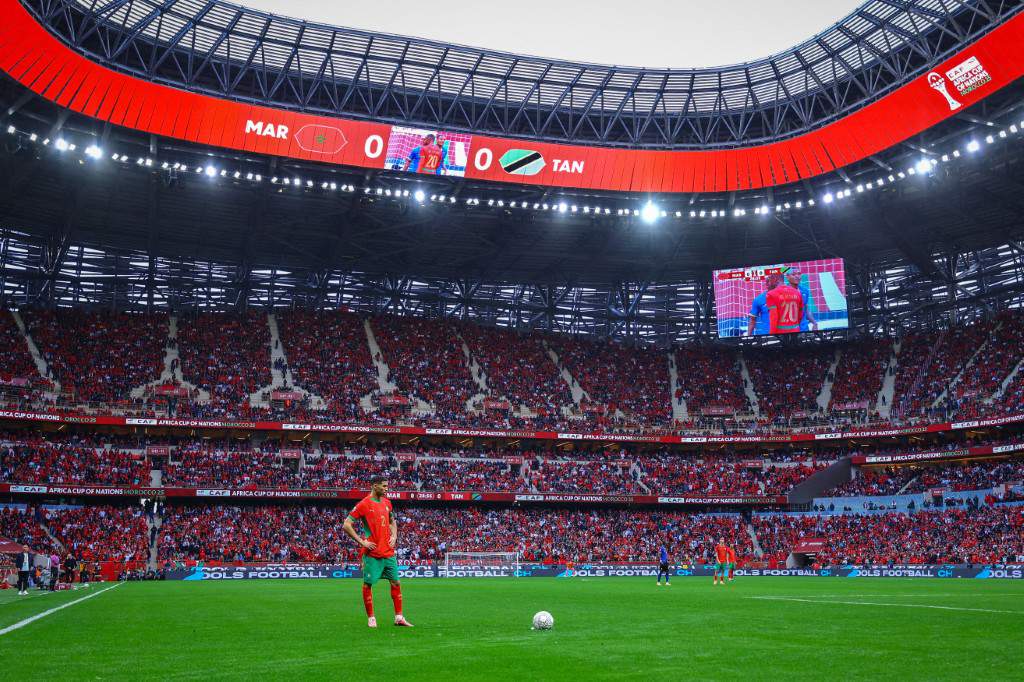
Morocco’s bid to win the Africa Cup of Nations on home soil has reached a defining stage, with the hosts under intense pressure ahead of Friday’s quarterfinal clash against Cameroon.
For Walid Regragui’s side, success at this tournament is widely viewed as binary: anything short of reaching the final on 18 January and lifting the trophy will be regarded as a failure. Managing that weight of expectation, rather than the opposition alone, may prove Morocco’s greatest challenge in the days ahead.
As Africa’s top-ranked nation, the Atlas Lions carry the hopes of a football-obsessed population of nearly 40 million. Yet performances so far have done little to fully convince their own supporters. A routine 2-0 opening win over Comoros on 21 December was followed by a laboured 1-1 draw with Mali that drew audible jeers from the home crowd.
Captain Achraf Hakimi publicly appealed for unity ahead of the final group game against Zambia. “It is not normal for them to boo us. We want to have the supporters behind us,” he said. “If the fans are behind us, we can be champions of Africa together.”
A commanding 3-0 victory in that match eased some of the tension, but Morocco’s subsequent last-16 performance raised fresh concerns. Ranked 11th in the FIFA world standings, just above Italy, Morocco required a second-half goal from Brahim Diaz to overcome Tanzania – a nation yet to win a single AFCON match in their history.
Given the depth of talent available, including several players from the squad that reached the 2022 World Cup semifinals, expectations were far higher. However, Regragui has consistently emphasised results over aesthetics, pointing to his side’s resilience and winning mentality. Prior to the draw with Mali, Morocco had assembled a world-record run of 19 consecutive victories.
“These are the kind of matches that in the past we would have somehow lost,” Regragui said after the narrow win over Tanzania. “We got through by the backdoor, but all that matters is that we qualified.”
The coach drew parallels with France’s 1998 World Cup triumph, recalling how that side also navigated difficult moments en route to lifting the trophy. His message was clear: tournament football is defined by survival as much as dominance.
Despite that perspective, sections of the fanbase remain unconvinced, with calls growing for Regragui to be replaced by Tarik Sektioui, the coach who recently guided Morocco to FIFA Arab Cup success, particularly with the next World Cup in mind.
Regragui, now 50, is focused solely on ending a 50-year wait for continental glory. His task is aided by the return to fitness of Hakimi, the reigning African Footballer of the Year, following an ankle injury. Diaz and Olympiakos striker Ayoub El Kaabi have provided attacking inspiration, while the overall squad depth remains among the strongest in the competition.
Yet as scrutiny intensifies around the hosts – despite this being the coldest AFCON in decades – Cameroon arrive with a contrasting sense of freedom. The five-time African champions were largely written off before the tournament and have exceeded expectations by reaching the quarterfinals.
For the Indomitable Lions, eliminated at the last-16 stage two years ago, progression to the last eight already represents a successful campaign. That comes after a turbulent build-up, during which federation president and national icon Samuel Eto’o dismissed head coach Marc Brys, appointing local trainer David Pagou in his place.
“The objective when I took over was simply to do better than last time,” Pagou said after his side’s victory over South Africa. “Realistically, we didn’t have much time to work together.”
With pressure and expectation firmly on Morocco, Cameroon’s relative lack of scrutiny could prove a decisive factor when the two sides meet.