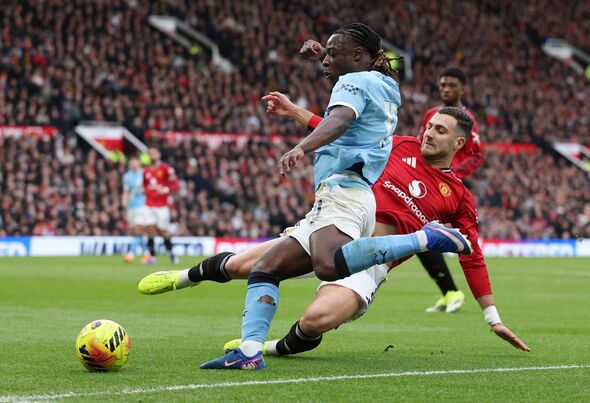
Manchester City manager Pep Guardiola chose not to dwell on Diogo Dalot’s early escape from a red card following his side’s 2-0 derby defeat to Manchester United at Old Trafford. Publicly, Guardiola pointed instead to City’s underwhelming performance, but privately he may feel the contest could have taken a very different course.
The pivotal moment came in the 10th minute, with the score still level. Dalot attempted to close down Jeremy Doku near the touchline and stretched to intercept the ball, but his studs made contact with the Manchester City winger’s knee. Referee Anthony Taylor issued a yellow card, a decision supported by VAR Craig Pawson, who judged the contact to be “glancing and not with excessive force”.
That explanation did little to satisfy the wider football community, particularly former players. Alan Shearer was forthright in his assessment on BBC Sport, arguing that VAR had “got that terribly wrong” and that the challenge met the threshold for a clear red card. While acknowledging that Taylor may not have had a perfect view in real time, Shearer questioned how two officials reviewing the footage could reach the same conclusion.
The Professional Game Match Officials Limited (PGMO), however, appear comfortable with the decision. Their stance reflects a long-standing concern about over-reliance on slow-motion replays, which can exaggerate the severity of contact. From PGMO’s perspective, viewing the incident at normal speed reduces the impression of excessive force.
Yet this defence highlights a broader issue: the divergence between Premier League interpretations of serious foul play and those applied in European competitions. In a Champions League context, UEFA’s guidance would almost certainly have led to a red card being shown. The contrast underlines how the Premier League’s preference for a more physical, high-tempo product creates grey areas that increase subjectivity in refereeing decisions.
This balancing act has proven problematic in recent seasons. Last year, the Premier League’s Key Match Incidents (KMI) Panel identified seven serious foul play errors — including missed red cards, incorrect VAR interventions, and overturned dismissals. Four players had red cards rescinded on appeal, the highest number recorded in a single season, a statistic that appears at odds with VAR’s intended purpose. Notably, there have been no serious foul play errors logged so far this season, which adds further context to the Dalot debate.
A useful comparison can be drawn with an incident involving Pape Matar Sarr in Chelsea’s match against Tottenham last April — also officiated by Pawson. Sarr won the ball from Moises Caicedo but made studs-first contact around the knee before scoring. VAR intervened to disallow the goal, yet Pawson ultimately issued only a yellow card after being advised that the challenge was reckless rather than excessive. Again, the contact was described as “glancing”, despite clear evidence of the opponent’s knee buckling.
In Dalot’s case, the argument for a harsher sanction is arguably stronger. His leg was straighter, a factor typically associated with greater force and danger. Nevertheless, PGMO chief Howard Webb later defended the yellow card decision, reiterating that the challenge lacked excessive force and therefore did not justify a dismissal.
Consistency is central to PGMO’s defence. With Pawson involved in both incidents, the organisation would argue that similar criteria have been applied. The absence of widespread controversy around the Sarr decision — and the fact that the KMI Panel did not classify it as an error — strengthens that claim.
Ultimately, the VAR’s scope for intervention hinges on the referee’s initial assessment. If Taylor clearly identified studs-on-knee contact and judged it reckless rather than excessive, the threshold for VAR to overturn the decision becomes much higher. Officials place particular emphasis on prolonged contact; where the boot comes off quickly, as with Dalot and Sarr, it is more likely to be deemed glancing.
This contrasts with the red card shown to Liverpool’s Curtis Jones in September 2023, when his studs slid down Yves Bissouma’s shin with sustained pressure. PGMO would argue that the prolonged nature of that contact was the key differentiator — though many observers remain unconvinced by the distinction.
In the end, the Dalot incident encapsulates the Premier League’s ongoing struggle to reconcile physicality, consistency and player safety. While the decision aligns with domestic interpretations, it reinforces the sense that the same challenge would be judged far more harshly on the European stage — a discrepancy that continues to fuel debate around VAR and refereeing standards in England.