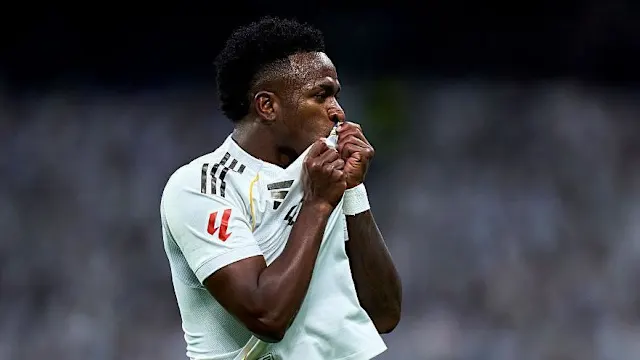
When Vinícius Júnior opened the scoring in Real Madrid’s 2–1 victory over Rayo Vallecano, his celebration felt carefully considered rather than spontaneous. Sprinting towards the stands, repeatedly kissing the club badge and urging the crowd to raise the volume inside the Bernabéu, the Brazilian appeared intent on making a statement.
Throughout the match, Vinícius continued to interact with supporters, directing his appeals particularly towards the ultras who drive the stadium’s atmosphere. It was a visible attempt to reconnect with a fanbase that has, at times, been openly hostile. In recent months, no Real Madrid player has been booed more consistently by sections of the Bernabéu, and Sunday was no exception.
Despite scoring a decisive goal, Vinícius remains a polarising figure among Madrid supporters. The reasons are rooted in performance levels, wider team frustration, cultural perception, and an unresolved contract situation.
There is a broader context behind the unrest. Real Madrid’s season has fallen short of expectations: an early Copa del Rey exit to a second-division side, failure to secure automatic qualification for the Champions League last 16, and a league position behind Barcelona. Even Sunday’s narrow win over a Rayo side hovering just above the relegation zone underlined ongoing instability, compounded by the club already being on its second manager of the campaign.
In such moments, the Bernabéu has historically sought a focal point for its frustration. Vinícius has increasingly become that figure.
Statistically, Vinícius’ output has not matched the standards set by his own previous seasons or by the club’s attacking hierarchy. His goal against Rayo was his first in La Liga since 4 October. While he has scored eight times across all competitions — making him Real’s second-highest scorer — the contrast with Kylian Mbappé’s 37 goals is stark.
For a player expected to be decisive in defining moments, that gap has amplified scrutiny. At Real Madrid, expectation is relentless, and attacking players are judged as much on end product as influence.
BBC Sport columnist Guillem Balagué suggests the criticism goes deeper than numbers. “Real fans direct their anger at the player they expect to carry them,” he explains, “but also at the player they feel is furthest from the traditional idea of what a Real Madrid player should be.”
Balagué adds that Vinícius’ on-pitch behaviour, emotional reactions, public disagreements with former coach Xabi Alonso, and perceived lack of engagement during the cup defeat to Albacete have all contributed to suspicion. Off-field gestures — such as changing his Instagram profile picture from a Real Madrid image to one of Brazil after being whistled — have been interpreted by some supporters as confrontational rather than expressive.
“Vinícius provokes and is seen as arrogant,” Balagué says. “Others doing similar things are often given the benefit of the doubt. That constant suspicion must be exhausting — and the Bernabéu does not tolerate volatility. It becomes a Catch-22.”
Any analysis of Vinícius’ relationship with Spanish football must also acknowledge the racial dimension. The winger has been subjected to repeated racist abuse during his time in Spain. In 2022, five individuals received suspended prison sentences for racially abusing him at Valladolid, while in 2023 three Valencia fans were jailed for similar offences.
Vinícius has consistently refused to remain silent. In 2024, following further convictions, he stated: “I’m not a victim of racism — I am a tormentor of racists.” While his stance has earned widespread support, Balagué notes that it has also unsettled sections of football culture that believe players should avoid activism.
“In Spain, many wrongly feel that everything is allowed in football,” Balagué says. “Vinícius challenged that, often without sufficient backing at the start. Some fans believe players should only play, not fight injustice. Vinícius will never accept that.”
His fifth yellow card of the La Liga season, which rules him out of the upcoming trip to Valencia, even sparked accusations on social media that he deliberately sought suspension to avoid returning to the Mestalla — claims that further highlight the distrust surrounding him.
Another factor fuelling tension is Vinícius’ unresolved contract situation. At Real Madrid, commitment is measured not only by performance but by visible loyalty to the badge. Delays in renewing contracts are often interpreted emotionally rather than pragmatically.
Real Madrid reportedly had a renewal ready before last summer’s Club World Cup, but talks were paused, partly due to Vinícius’ dissatisfaction working under Alonso. While new manager Álvaro Arbeloa has publicly expressed his desire to keep the winger, uncertainty has lingered.
Balagué believes renewal remains the most likely outcome, noting that Real would “renew his contract today” if possible. However, he raises a key question: “Why stay where you are not fully wanted, even if you are one of the best?”
Vinícius’ recent badge-kissing celebrations and affirmations of loyalty on social media suggest a player attempting to bridge a widening emotional gap. Yet his situation reflects a deeper tension — between individuality and tradition, activism and expectation, expression and conformity.
For some Real Madrid fans, Vinícius embodies defiance and brilliance. For others, he represents frustration and discomfort. Until performances, perceptions and trust realign, he is likely to remain one of the most divisive figures in modern Real Madrid history.