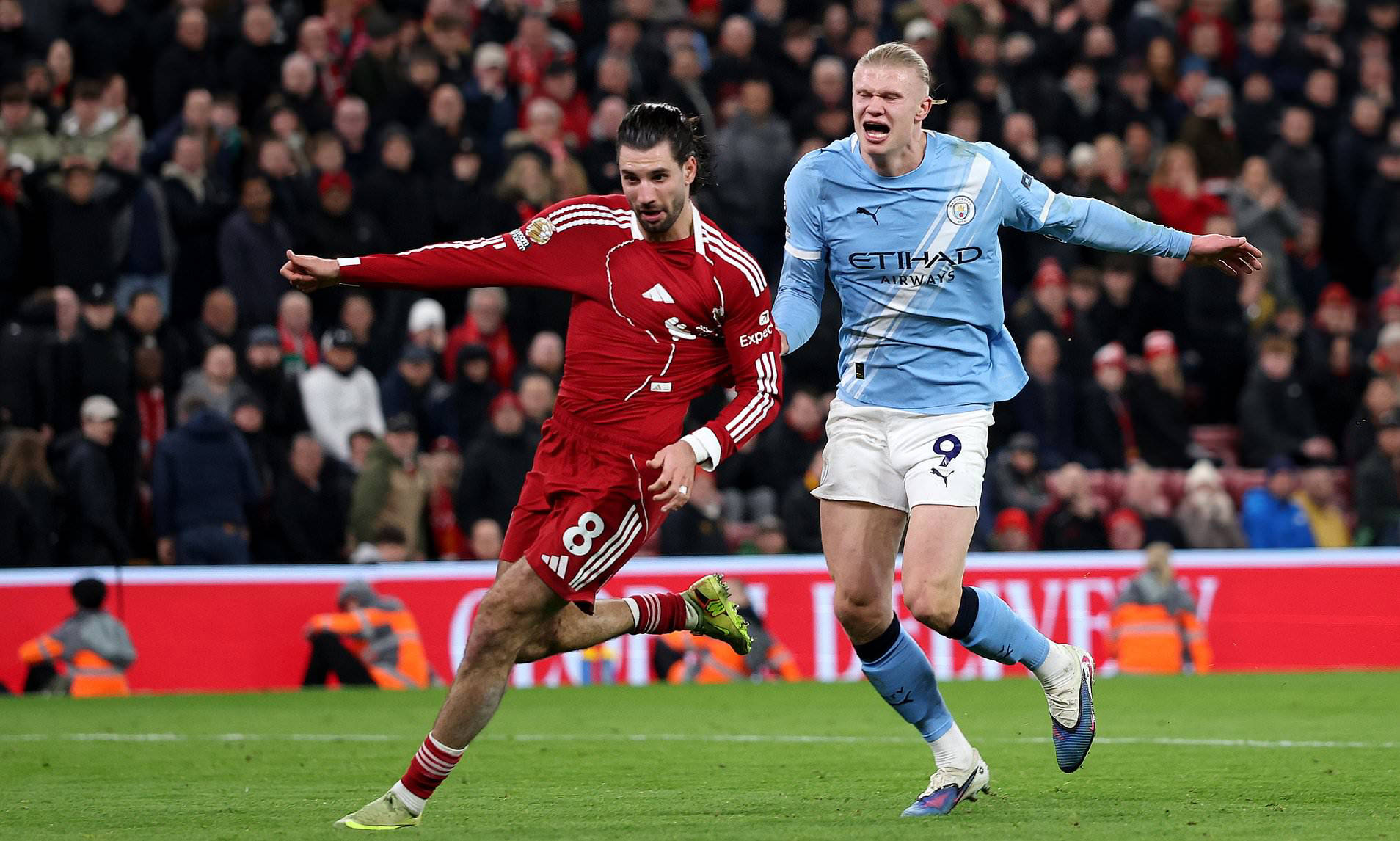
Few aspects of modern football expose the tension between emotion and regulation quite like the video assistant referee. Nowhere was that more evident than in the closing moments of Liverpool’s 2–1 defeat to Manchester City, when VAR intervened to overturn what appeared to be a dramatic late third goal for the visitors.
From a supporter’s perspective, the decision felt brutal. From a regulatory standpoint, however, it was unavoidable.
Manchester City believed they had sealed one of the most dramatic conclusions to a Premier League match this season when the ball rolled into an unguarded Liverpool net at Anfield. Instead, VAR official John Brooks advised referee Craig Pawson to disallow the goal following a foul in the immediate build-up — a decision that provoked frustration in the stands and animated debate among pundits.
Yet under the laws of the game, VAR had little choice but to intervene.
The sequence unfolded amid late chaos. With Liverpool goalkeeper Alisson committed upfield for a final set-piece, City regained possession and Rayan Cherki launched the ball goalwards from inside his own half. Erling Haaland quickly gained ground on Dominik Szoboszlai and appeared certain to reach the ball first.
As the City striker pulled clear around 25 yards from goal, Szoboszlai hauled him back — a foul that Pawson correctly identified, but from which he allowed advantage to play. The ball continued to roll towards the empty net, with both players still contesting the run.
Crucially, as Szoboszlai prepared to slide in and clear the ball off the line, Haaland pulled him back, preventing the Liverpool midfielder from making the intervention. The ball crossed the line moments later.
The incident is complicated by the initial foul on Haaland, which might suggest City were denied a straightforward scoring opportunity. However, the laws require each action to be judged independently. The second foul — committed by Haaland — directly prevented a defender from stopping the ball from entering the goal.
The central question VAR had to answer was simple: would Szoboszlai have been able to prevent the goal had he not been fouled? Given his proximity and body position, the likelihood was high. On that basis, the goal could not stand.
Pawson’s original decision to play advantage is also critical. Had Szoboszlai successfully cleared the ball, play would have been brought back and he would have been dismissed for denying an obvious goalscoring opportunity. The VAR outcome — no goal and a red card — ultimately mirrored the sanction that would have followed anyway.
Strip away the emotional weight of the moment, and the decision aligns squarely with the laws of the game.
That, however, did little to calm the reaction. Former Manchester United defender Gary Neville, analysing the incident for Sky Sports, described the decision as “unjust” and labelled VAR a “killjoy”.
“I know there are rules, but there’s the smell of the game,” Neville said. “You have just killed one of the great moments of the season. People watch football for entertainment and moments like that.”
In contrast, Roy Keane argued the opposite, suggesting the incident only heightened the spectacle. “It added to the drama,” he said, calling the sequence “great”.
Haaland himself struck a sympathetic tone, expressing regret for his former RB Salzburg team-mate.
“The referee has to follow the rules,” the City striker told Sky Sports. “I feel bad for him. Just give the goal and not the red card — simple as that. But those are the rules.”
Pep Guardiola’s verdict was delivered with typical brevity. “Come on referee,” he told BBC Match of the Day. “Give the goal and go home.”
Ultimately, the episode encapsulated VAR’s central dilemma. It can deliver technically correct decisions while simultaneously draining moments of spontaneous joy from the game. In this instance, the call was legally sound — even inevitable — but it served as another reminder that correctness and satisfaction are not always aligned in modern football.