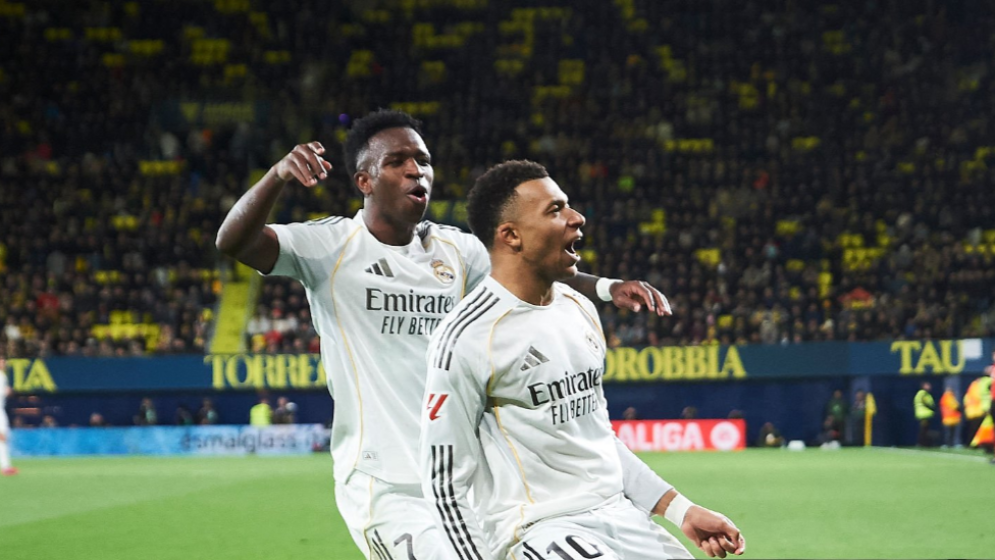
Real Madrid are set to welcome back Kylian Mbappe for Tuesday’s Champions League play-off clash away to Benfica, a timely boost after the French forward was rested at the weekend due to knee discomfort.
For head coach Alvaro Arbeloa, the return of Madrid’s top scorer and standout performer this season is unequivocally positive. Yet it also sharpens a long-running tactical dilemma: does Madrid’s overall balance suffer when Mbappé and Vinicius Junior are deployed together in the front line?
That equation is often further complicated by the presence of Jude Bellingham, though the England midfielder will miss the trip to Lisbon through injury. All three featured in Madrid’s group-stage meeting with Benfica in January, a chaotic 4-2 defeat that ultimately forced Los Blancos into the play-off round.
Despite Mbappé scoring twice in that loss—and extending his Champions League tally to a competition-leading 13 goals—Madrid were comprehensively outmanoeuvred by Jose Mourinho’s side. Benfica’s structure, intensity and transitional threat repeatedly exposed Madrid’s defensive frailties, culminating in a dramatic 98th-minute headed goal from goalkeeper Anatoliy Trubin that sealed their progression.
The match underlined a recurring theme: Madrid’s attacking firepower can overwhelm opponents, but without collective discipline, elite sides can dismantle them.
Mbappé’s absence against Real Sociedad offered a revealing counterpoint. With Vinícius as the primary attacking outlet, Madrid cruised to a 4-1 win, the Brazilian delivering one of his most authoritative performances of an uneven campaign.
Operating with greater freedom and space, Vinícius won and converted two penalties, consistently destabilising Sociedad’s defensive shape. Arbeloa was effusive in his praise, highlighting the winger’s influence beyond raw numbers—his ability to draw defenders, manipulate space and dictate the rhythm of attacks.
From a tactical perspective, Madrid appeared more cohesive, particularly in transition, with clearer roles and improved defensive coverage from the front.
Arbeloa has made no secret of his intent to rely heavily on Madrid’s elite talent, a shift from the rotation-heavy, meritocratic approach favoured by his predecessor Xabi Alonso. That philosophy, reminiscent of Carlo Ancelotti’s man-management blueprint, has helped stabilise dressing-room dynamics and sparked a resurgence in Vinícius’s form.
However, history offers a cautionary tale. Madrid’s original Galácticos era (2000–2006), featuring icons such as Luis Figo, David Beckham and Ronaldo Nazario, delivered moments of brilliance but limited collective success, largely due to structural imbalance.
While Mbappé and Vinícius now combine more fluidly than in the early months following the Frenchman’s arrival—when they often drifted into the same zones—neither is naturally inclined towards sustained pressing or defensive responsibility. That places increased strain on Madrid’s midfield and back line, particularly against opponents capable of exploiting space.
Midfielder Federico Valverde pointed to collective effort after the Sociedad win, praising Madrid’s willingness to defend as a unit. Replicating that intensity with both Mbappé and Vinícius in the starting XI remains the unresolved challenge.
Tuesday’s clash at the Estádio da Luz will serve as a litmus test. If Madrid can marry their extraordinary individual quality with collective discipline, they remain among Europe’s most feared sides. If not, Benfica—and others to come—may again expose the fine margins between star-studded brilliance and tactical vulnerability.