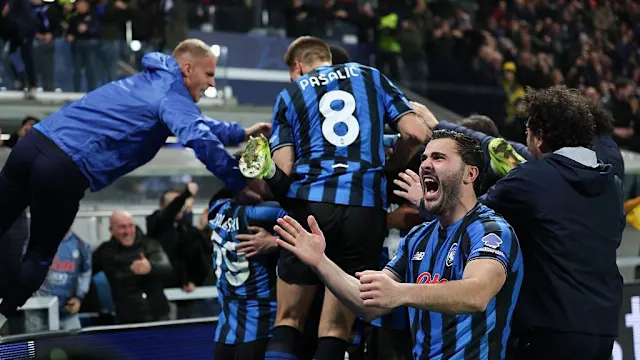
Italian football stood on the brink of an unwanted milestone this week.
After Inter Milan were eliminated by Bodo/Glimt, and with Juventus and Atalanta both trailing heavily in their respective ties, Serie A faced the prospect of having no representatives in the Champions League last 16 for the first time since 1987-88 — when the competition was still the European Cup.
Juventus ultimately fell short despite a spirited fightback against Galatasaray. But Atalanta delivered a comeback that not only preserved their own European campaign, it safeguarded Italian football’s continental credibility.
Trailing 2-0 after the first leg against Borussia Dortmund, Atalanta needed precision, courage and emotional resilience.
They found all three.
Three goals in 57 minutes overturned the deficit before a dramatic, last-second penalty sealed progression — moments after Karim Adeyemi’s strike had appeared to force extra time. The emotional swing was brutal; the response was decisive.
“Everyone had written us off,” defender Davide Zappacosta said. “This match showed once again how strong this group is — we always believe and we never give up.”
In pure footballing terms, it was a display of structural bravery: high pressing, controlled possession in key phases, and calculated risk in transition. In symbolic terms, it was far bigger.
Since the reintroduction of the round-of-16 knockout format in 2003-04, Italy has always had at least one club in the last 16. The potential absence of any Serie A side would have represented a historic low point.
Journalist Vincenzo Credendino described Inter’s elimination as “one of the worst pieces of history” for Italian football. Daniele Verri warned that all three clubs exiting would have constituted a “complete debacle.”
Atalanta’s qualification prevented that scenario.
More importantly, it reshaped the tone of the conversation. Rather than focusing on decline, the narrative shifted to resilience — and to a club that has quietly become one of Italy’s most progressive European operators.
Former defender Curtis Davies labelled them “the darlings of Italian football.” European football expert James Horncastle compared them to Serie A’s version of Bodo/Glimt — a club that has outgrown its traditional ceiling.
Eight years ago, Atalanta were a yo-yo side. Since then, they have:
For a club without the historical weight of Inter or Juventus — who share five European Cup/Champions League titles between them — this evolution is remarkable.
Atalanta had never overturned a two-goal first-leg deficit in European competition. That context underscores the scale of the task.
They first entered the Champions League in 2019, reaching the quarter-finals on debut. However, in their past two appearances before this season, they failed to progress beyond the group stage.
Against Dortmund, they combined tactical discipline with emotional control. Even after Adeyemi’s goal wiped out their aggregate advantage, panic never took hold.
Coach Raffaele Palladino called it “an unforgettable night, a dream come true.”
“We put everything into this performance: heart, soul, spirit and courage. We played an Atalanta-style match.”
Captain Marten de Roon echoed the sentiment: “We knew we had to play the perfect match and we did. We suffered when we had to, attacked when we had to, and in the end the result is deserved.”
The reward is daunting: a last-16 tie against either Arsenal or Bayern Munich.
Yet the Dortmund comeback demonstrated something critical — not merely tactical quality, but belief under pressure. That psychological resilience will be essential against elite opposition.
For Italian football, Atalanta’s progression is more than a qualification. It is a reputational buffer, a reminder that Serie A’s competitiveness is not confined to its traditional giants.
In a week that threatened to expose vulnerability, Atalanta delivered defiance.
They did not just advance. They preserved national pride — and, in the process, strengthened their own growing European identity.