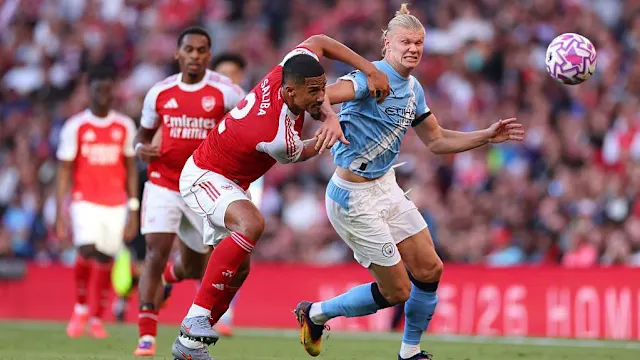
This season’s Premier League title race is delicately balanced, setting up a compelling run-in between Arsenal and Manchester City.
Arsenal, seeking a first league crown in 22 years, hold a five-point advantage with nine matches remaining. City, champions in six of the past eight campaigns, have a game in hand and will host the Gunners in April. Should either side win all remaining fixtures, the title will be theirs.
History, however, warns against certainty. In 11 of the past 30 seasons, the team leading after 28 matches has failed to secure the title. Arsenal themselves experienced that collapse in both 2023 and 2024.
The question is no longer purely tactical — it is psychological. Is it better to lead the race or chase from behind?
Alan Shearer, the Premier League’s all-time leading goalscorer and a title winner with Blackburn in 1994-95, believes the advantage lies with the team in front.
“It’s better to be chased,” Shearer said. “When you’re top, it’s in your hands. If you keep winning, the teams chasing you have no answers.”
Yet he acknowledges that experience shapes composure. Blackburn initially struggled with the emotional weight of leading when competing against a seasoned Manchester United side. A year later, armed with familiarity and belief, they held their nerve.
The implication for Arsenal is clear: leadership is powerful, but only if reinforced by emotional control and collective conviction.
Former Arsenal Women and Manchester City Women captain Steph Houghton echoes that sentiment.
“The pressure is massive in both situations,” she said. “But I prefer being the hunted. You’ve got the points on the board. It’s about performing under pressure.”
Her view reflects a fundamental truth of elite competition: pressure is unavoidable — but it is more manageable when outcomes remain within your control.
If Arsenal’s challenge is to maintain calm authority, City’s strength lies in relentless pursuit.
Under Pep Guardiola, late-season surges have become routine. Two years ago, City went unbeaten in their final 23 league matches, winning 19, to overhaul Arsenal and clinch the title by two points.
They are also adept at applying psychological pressure before rivals take the field. In the last 15 occasions City have played a day before Arsenal, Guardiola’s side have won 11, forcing the Gunners to respond under scoreboard stress.
For former Arsenal defender Martin Keown, how Arsenal cope with that mounting tension will define the campaign.
“When you want something so much, it can get the better of you,” he said. “You need to create a steely, calm determination.”
Keown’s emphasis on emotional reset — treating each game as a fresh campaign — underlines the mental recalibration often required at this stage.
Experience in decisive moments frequently proves decisive.
Former Manchester United captain Steve Bruce points to the importance of leaders stepping forward.
“What you want now is your big players to perform,” he said, recalling how Eric Cantona often delivered when United needed him most.
Similarly, former City goalkeeper Joe Hart highlights the inevitability of scrutiny.
“There will be noise around Arsenal — that’s life at the top. You have to live in your own world.”
For Arsenal, whose core group has fallen narrowly short in recent seasons, this period represents both burden and opportunity — a test of maturity rather than talent.
Title races, Bruce admits, “drive you mad.” The staggered scheduling forces players to watch rivals, denying them control. Hart describes it as all-consuming:
“It takes over your life. You live in a bubble. You can’t appreciate it at the time because you’re entirely focused.”
The paradox of elite sport is that the most coveted moments are rarely enjoyed in real time. The pursuit of perfection leaves no room for sentiment.
The psychological dynamic may shift on 22 March when Arsenal and Manchester City meet in the EFL Cup Final.
Keown draws parallels with 1999, when Manchester United defeated Arsenal in an FA Cup semi-final replay before completing a historic Treble. While Arsenal did not collapse that season, United’s victory generated momentum that carried into the title run-in.
A cup triumph does not guarantee league success, but it can reinforce belief — and belief often proves decisive in marginal contests.
Ultimately, the tactical margins between Arsenal and Manchester City are slim. The decisive factor may lie in psychological resilience: who handles expectation better, who manages setbacks calmly, and whose leaders rise in decisive moments.
Being chased offers control. Being the hunter offers freedom. The coming weeks will reveal which mindset proves stronger — and whether Arsenal can convert position into permanence, or whether City’s pursuit once again becomes inevitable.