Bill Shankly famously remarked that “football is a simple game, complicated by people who should know better.”
During his tenure as Liverpool manager between 1959 and 1974, the sport operated in a far less scrutinised environment—long before the era of rolling news, social media analysis and the introduction of the video assistant referee (VAR). Were Shankly managing in the modern game, he might argue that the sport has moved even further away from the simplicity he once described.
From debates around handball and offside interpretations to the influence of VAR, many supporters now find it increasingly difficult to understand the reasoning behind certain decisions.
This raises a broader question: has football genuinely become more complicated—and if so, who bears responsibility?
Few areas of the laws of football generate as much debate as handball.
Repeated revisions over the past decade have created widespread confusion among players, fans and even pundits trying to interpret the rule consistently.
Former England captain Alan Shearer voiced his frustration in an interview with BBC Sport.
“I just hate the handball rule. They’ve messed it up,” he said. “There are so many interpretations now—deliberate, proximity, natural position, unnatural position. It’s just not fit for purpose.”
The complexity extends further than those interpretations. One of the most controversial elements remains the accidental attacking handball rule, which automatically disallows a goal even when there is no clear intent—while a similar incident involving a defender might not result in a penalty.
Interestingly, although the application of the rule still frustrates supporters in England, the Premier League awards fewer penalties on average than any of the other major European leagues.
However, that statistical difference does not necessarily mean the rule is functioning well.
There is also a widespread misconception that the handball law was altered specifically to accommodate VAR. In reality, the International Football Association Board (Ifab) began redefining the rule in 2014—two years before VAR trials began.
The revised wording introduced multiple criteria for referees to assess potential handballs. Once VAR was introduced, however, those detailed clauses made it far easier to justify awarding penalties, contributing to a significant spike in spot-kicks across various competitions.
Since then, Ifab has repeatedly adjusted the law in an attempt to strike a balance between clarity and fairness.
While many fans would prefer a return to a simpler “referee’s judgement” approach, the complexity now embedded in the law makes that difficult to reverse.
Another area regularly criticised for its complexity is the offside rule—particularly decisions involving players who do not touch the ball but influence play.
One recent example came during Liverpool’s 3–0 defeat to Manchester City on 9 November. Virgil van Dijk appeared to score, but the goal was ruled out after Andrew Robertson ducked beneath the ball in an offside position and was judged to have interfered with goalkeeper Gianluigi Donnarumma.
The decision sparked widespread debate, with critics arguing that lawmakers had made the offside rule unnecessarily complicated.
However, the concept itself is far from new.
Historical versions of the laws—including the 1903–04 edition—already stated that a player could not “in any way whatever interfere with an opponent or the play.”
Without such a provision, attackers could deliberately position themselves near defenders or goalkeepers in order to obstruct them while remaining technically uninvolved in the play.
Given how tactical fouling and other “dark arts” have evolved in the modern game, removing such interpretations could create even more controversial situations.
While subjective offside decisions remain frustrating in close cases, the underlying principle is unlikely to change.
Perhaps one of the most misunderstood elements of the laws concerns the concept of “deliberate play.”
Introduced during the 2016–17 season, the rule was intended to clarify whether a defender’s touch should reset an offside phase.
Initially, referees applied the interpretation very strictly, allowing attackers in offside positions to benefit from even minor defensive touches.
The controversy reached its peak during the 2021 UEFA Nations League final when Kylian Mbappe scored France’s winning goal against Spain. Defender Eric Garcia had stretched for the ball and made minimal contact, which technically reset the phase of play and allowed Mbappe to be deemed onside.
Following the incident, Ifab clarified that defenders must have a realistic expectation of controlling the ball for it to count as a “deliberate play.”
Yet the terminology itself remains confusing.
In essence, a defender can deliberately attempt to play the ball—but if that attempt lacks control, it may still not qualify as a “deliberate play” under the law.
The distinction highlights how increasingly technical football’s rulebook has become.
The laws surrounding denying an obvious goalscoring opportunity (Dogso) have also been revised several times in recent years.
Previously, conceding a penalty while preventing a clear scoring chance typically resulted in a red card. However, to avoid what became known as “double jeopardy,” the rule was adjusted.
Now, if a defender makes a genuine attempt to play the ball while committing a foul inside the penalty area, the punishment is usually reduced to a yellow card. Only clearly cynical offences—such as deliberate pushes or pulls—are likely to result in a red card.
This shift means that incidents which once warranted dismissals may now only lead to cautions.
Another example involves the application of advantage.
During Arsenal’s recent match against Chelsea, Gabriel Martinelli was fouled by Pedro Neto but quickly regained possession and continued the attack. Referee Darren England stopped play instead and issued Neto a second yellow card.
Many Arsenal supporters were frustrated that advantage had not been played. However, the laws state that advantage should not be applied when a red card offence must be issued—unless an immediate scoring opportunity exists.
The rule is clear within the lawbook, but not always widely understood by supporters inside the stadium.
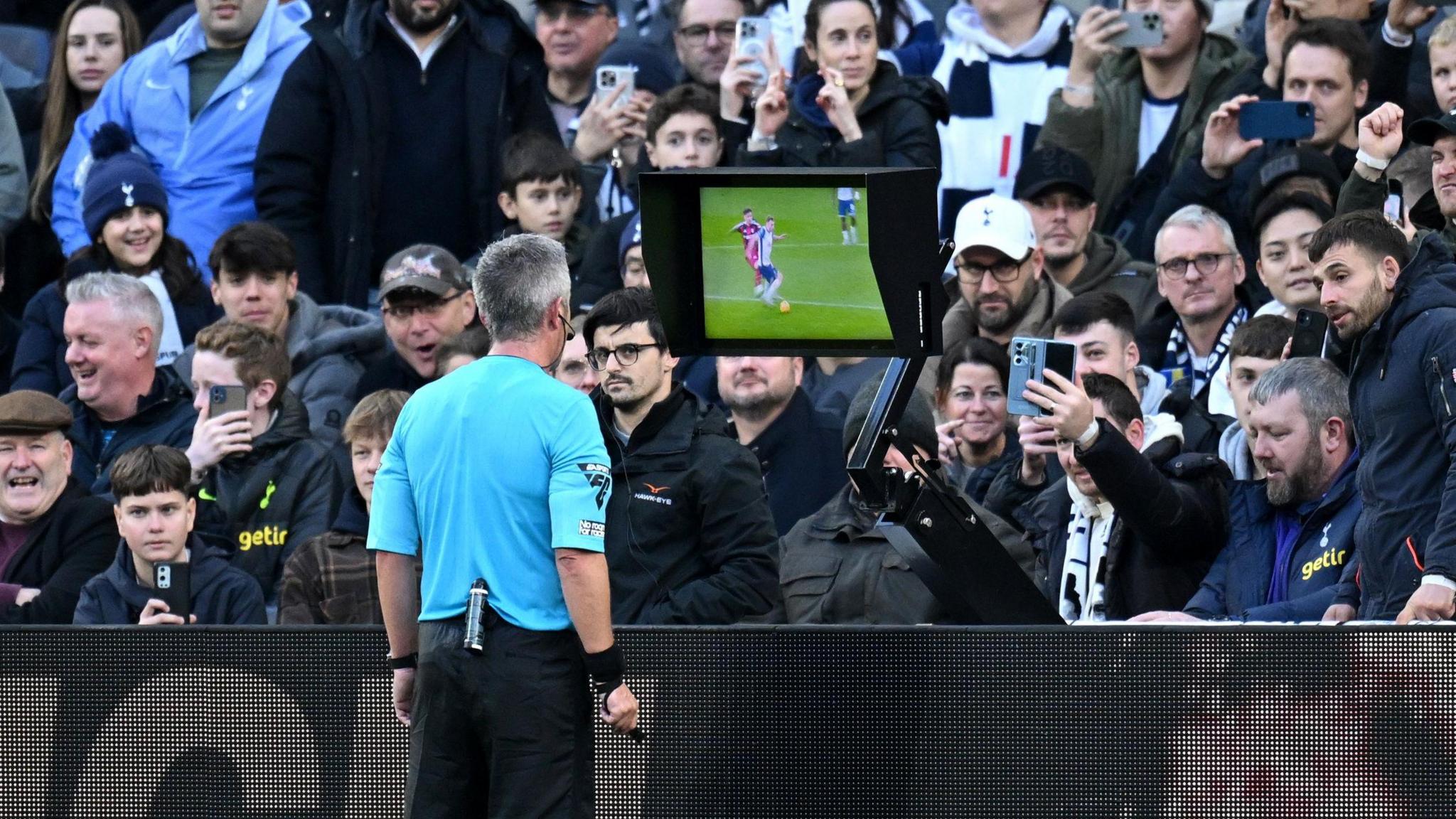
While many of these laws predate VAR, the technology has intensified scrutiny of every decision.
VAR reviews have slowed the pace of matches and led to extremely fine offside calls—often measured by centimetres—that many supporters feel undermine the spirit of the game.
More significantly, VAR has transformed how decisions are explained.
In the past, fans might disagree with a referee’s judgement and move on. Today, every incident is analysed through a complex framework of definitions: arm positions, potential violent conduct, interference with play, and other detailed considerations.
Supporters who rely on decades of watching football may feel that their intuitive understanding of the game is being replaced by technical explanations buried within referee guidelines.
In that sense, VAR has shifted football from a straightforward contest into something closer to a technical review process.
If supporters hope for simplification, recent developments suggest the opposite.
At Ifab’s latest annual meeting, several law changes were approved for implementation at the 2026 World Cup and from the 2026–27 season.
Among the proposals:
In addition, trials will continue for Arsene Wenger’s proposed “daylight” offside rule, which would significantly alter the current interpretation of marginal offside decisions.
Taken together, these changes suggest the sport is moving toward even greater technical detail rather than simplification.
Football may still appear simple on the surface—but behind the scenes, its laws have never been more complex.