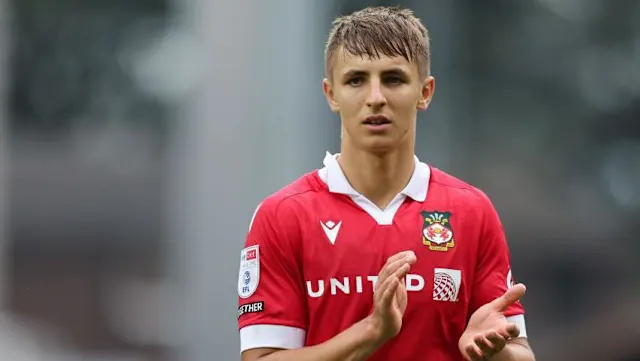
Wrexham AFC have become one of the most talked-about stories in English football, rising rapidly through the divisions while attracting both admiration and criticism. Their trajectory—fuelled by major investment from celebrity owners—has drawn comparisons with the transformation of Chelsea FC under former owner Roman Abramovich in the early 2000s.
Beloved by their supporters but often criticised by rivals, Wrexham’s dramatic ascent from the fifth-tier National League to the EFL Championship has been underpinned by significant financial backing from Hollywood actors Ryan Reynolds and Rob McElhenney.
The Welsh club’s remarkable rise has coincided with a return to the latter stages of domestic cup competition, reaching the fifth round of the FA Cup for the first time in 19 years. Their reward is a high-profile tie against Chelsea, a fixture that represents one of the most significant matches in Wrexham’s 162-year history.
Reynolds and McElhenney purchased Wrexham in 2021 for a nominal fee, committing substantial funds to strengthen the squad and expand the club’s infrastructure. Their financial backing has helped accelerate Wrexham’s climb through the English Football League, although it has also prompted criticism from rival clubs who argue the team are effectively “buying success.”
Such accusations echo the scrutiny Chelsea faced when Abramovich purchased the club in 2003 for £140m and immediately cleared around £80m of debt. In his first summer as owner, the Russian billionaire spent more than £121m on 11 new players, ushering in a new era of spending power in European football.
Many analysts believe Abramovich’s arrival paved the way for other high-profile takeovers, including the Abu Dhabi-backed acquisition of Manchester City and the Qatar-funded purchase of Paris Saint-Germain. These deals eventually prompted governing bodies to introduce stricter financial regulations across domestic leagues and European competitions.
As with Chelsea’s early years under Abramovich, Wrexham’s rise has been driven by significant investment in playing talent.
The club secured key signings to strengthen the squad, most notably striker Paul Mullin, whose 38-goal campaign helped end Wrexham’s 15-year stay in the National League when they won promotion in 2023. The club has also attracted experienced professionals such as Steven Fletcher and James McClean, with competitive wages playing a role in persuading them to join.
More recently, Wrexham broke their transfer record by signing forward Nathan Broadhead from Ipswich Town in a deal worth up to £10m.
Despite the influx of signings, the club’s project still features a homegrown cornerstone in defender Max Cleworth, an academy graduate who progressed from the National League squad to become a regular starter in the Championship—mirroring the central role academy product John Terry once played at Chelsea.
Speaking at the FT Business of Football Summit, Wrexham chief executive Michael Williamson highlighted the scale of squad rebuilding required following promotion.
“You saw in the last transfer window, moving from League One to the Championship, we brought in 13 new players,” Williamson said.
“People say our net spend was £30m, but we didn’t have players to sell. Clubs like Norwich or Ipswich might spend similar amounts but offset that with outgoing transfers.”
Financial investment has extended beyond player recruitment. During Abramovich’s tenure, Chelsea upgraded their training facilities, strengthened their academy and women’s programme, and explored redevelopment plans for Stamford Bridge.
Wrexham are pursuing a comparable strategy. The club currently operates a Category Three academy but aims to achieve Category One status in the future. Their women’s team has also received increased backing, transitioning to semi-professional status and competing for the Welsh league title after defeating rivals Cardiff City Women in the Welsh League Cup.
The club’s stadium redevelopment project is also central to its long-term vision. The historic Stok Cae Ras—one of the oldest international stadiums in the world—currently operates with limited capacity while construction of the new Kop stand continues. Once completed, the redevelopment will increase the stadium’s capacity to more than 18,000 seats.
Williamson suggested further upgrades may be required if Wrexham eventually reach the Premier League.
“If we arrive in the Premier League, we’ll need to adapt other stands to meet broadcast requirements, including new TV gantries and media spaces,” he explained.
Like Chelsea during their rise in the 2000s, Wrexham have experienced a surge in global popularity. The club’s international profile—particularly in the United States—has grown rapidly due to their Hollywood ownership and documentary exposure.
Despite starting from a much smaller base, Wrexham’s fanbase now stretches far beyond Wales. The club has played high-profile friendlies in the United States against Premier League opposition such as Manchester United and AFC Bournemouth, while additional pre-season matches have been scheduled against Leeds United, Liverpool FC and Sunderland AFC.
The club’s commercial expansion has also been reflected in record revenues, with Wrexham generating income levels comparable to several Championship teams even while playing in lower divisions.
According to Dan Weinberg, executive vice-president of programming at CBS Sports, the club’s appeal in the United States has been remarkable.
“You can’t ignore the growth of the Wrexham brand in the US,” Weinberg said. “Their appeal is extraordinary because of what Rob and Ryan have done to grow the club.”
Wrexham’s success has also coincided with a broader trend of celebrity investment in English football. High-profile figures such as Snoop Dogg, Tom Brady and J. J. Watt have all acquired stakes in clubs across the English football pyramid.
For many observers, the parallels with Chelsea’s transformation two decades ago are striking. Abramovich’s investment reshaped the financial landscape of European football—and Wrexham’s modern-day rise suggests a similar model may now be influencing the game once again.
Whether viewed as pioneers or disruptors, both Chelsea in the 2000s and Wrexham in the 2020s have demonstrated how ambitious ownership and strategic investment can rapidly alter the fortunes—and profile—of a football club.