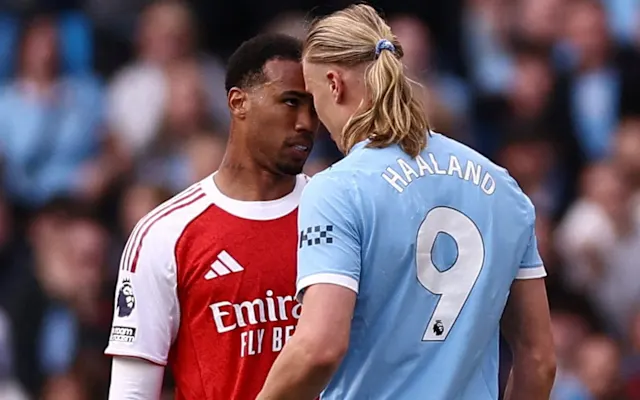
A fiery duel between Erling Haaland and Gabriel Magalhães took centre stage during Manchester City’s 2-1 win over Arsenal—but it’s one controversial moment late in the game that has sparked major debate.
With tensions already simmering, the flashpoint came in the 83rd minute when the pair clashed in an aerial duel. After Haaland initiated contact, the two went head-to-head—literally—before Gabriel appeared to push his forehead into the City striker.
Despite the incident, referee Anthony Taylor issued only yellow cards. But should Gabriel have been sent off?
The key issue revolves around how violent conduct is defined in football’s laws.
While “headbutt” isn’t explicitly mentioned, the rules state a player must use or attempt to use “excessive force or brutality” to warrant a red card.
In Gabriel’s case:
Based on this, referee Anthony Taylor opted for a yellow card, a decision VAR John Brooks did not overturn.
VAR decisions hinge on whether there has been a “clear and obvious error.”
In this instance:
Even if VAR believed a red card might be more appropriate, intervention is unlikely unless the original decision is clearly wrong.
The decision has drawn comparisons to Lisandro Martinez’s red card just days earlier against Leeds United.
The contrast raises a key question: Is a brief hair pull more serious than a head-to-head clash?
Manchester United fans—and many neutrals—would argue not.
One major talking point is Haaland’s reaction—or lack of it.
The Norwegian striker stayed on his feet and did not exaggerate the contact.
That may have worked against Arsenal being punished more severely.
“If I go down like any other guy, it’s a red card,” Haaland admitted post-match.
VAR often looks for visible impact or reaction to confirm serious foul play. Without it, decisions become harder to justify.
This creates a controversial dynamic:
A similar situation occurred in 2020 when Nicolas Pepe was sent off for a near-identical head movement on Ezgjan Alioski—who fell dramatically to the ground.
That reaction played a significant role in the VAR decision.
The Premier League continues to struggle with VAR consistency:
The high threshold for overturning decisions often means logical outcomes are missed, frustrating players, managers, and fans alike.
Had Gabriel been sent off, he would have missed three of Arsenal’s final five matches.
Instead, he remains available for key fixtures against:
Manchester City boss Pep Guardiola will hope that decision does not prove decisive in the title race.