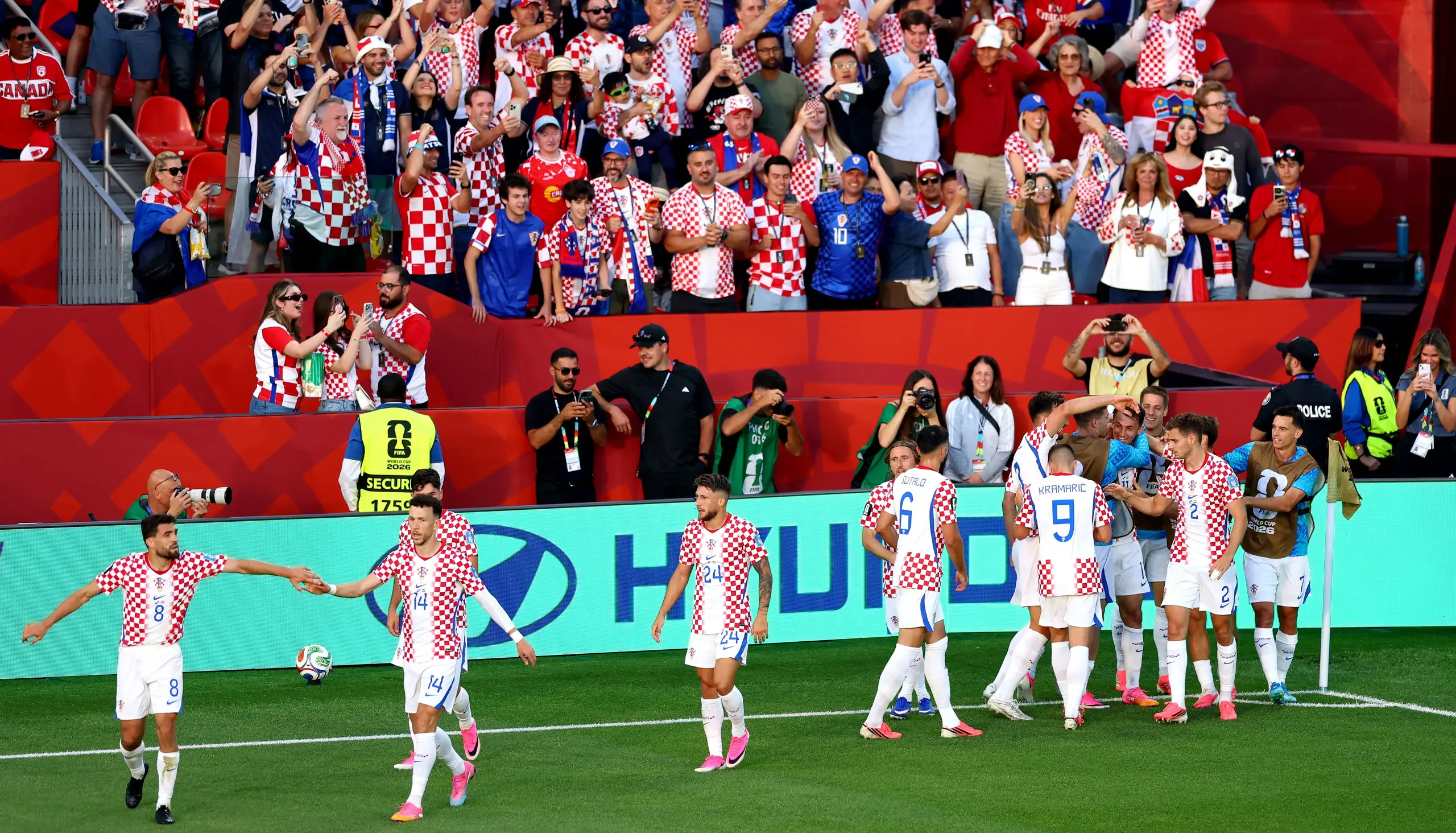
Croatia secured a 1-0 victory over Panama in this FIFA World Cup fixture, with Andrej Budimir's second-half header separating two sides that spent much of the afternoon cancelling each other out. The result was narrow in scoreline but fairly reflective of the underlying numbers: Croatia generated an expected goals figure of 1.66 across the ninety minutes compared to Panama's 0.54, suggesting that while the margin of victory was slender, the Croatians were the more threatening side across the full contest.
The match followed a pattern familiar to encounters of this type at World Cup level. The first half was cautious and structured, with both sides reluctant to commit men forward in numbers and the xG figures for that period — 0.05 for Croatia and 0.06 for Panama — reflecting just how little genuine danger was created before the interval. Panama's low block was disciplined and difficult to break down, and Croatia, for all their possession advantage of 64% in the opening period, struggled to find the spaces that would allow them to create meaningful opportunities.
The second half told a markedly different story. Panama, perhaps recognising the need to change something, opened up slightly, and that shift in the game's dynamic played directly into Croatia's hands. The xG figures for the second period — 1.61 for Croatia against 0.49 for Panama — tell a story of a Croatian side that grew into the match with purpose once the game opened up. Three big chances created in the second half alone underlines that Croatia's attacking play had genuine substance, not just possession for its own sake.
The final scoreline of 1-0 will feel comfortable enough for Croatia, who rarely waste energy on unnecessary embellishment. They are a side built on pragmatism and collective organisation, and this performance, while not always aesthetically engaging, delivered the three points that matter most at this stage of the competition. For Panama, the defeat represents a significant setback, and the manner in which they conceded — from a set-piece situation exploited by a substitute making an immediate impact — will be a particularly painful detail for their coaching staff to digest.
Panama entered this match as the side expected to sit deep and make life difficult for Croatia, and for large parts of the contest they did exactly that. Their defensive structure was compact and disciplined, particularly in the first half, where they limited Croatia to just two shots and conceded next to nothing in terms of expected goals — 0.05 across the opening 45 minutes is a figure that reflects genuine defensive organisation rather than simply good fortune. The back line held its shape, the midfield pressed with energy when required, and Croatia were repeatedly forced to recycle possession rather than progress into dangerous areas.
However, Panama's attacking output was limited throughout. With only six total shots across the entire match and just one big chance — which came in the second half — their threat going forward was minimal. The expected goals figure of 0.54 for the full match, with 0.49 of that coming in the second half, suggests that whatever forward intent they showed was concentrated into a brief spell rather than sustained pressure. The single goalkeeper save required from Croatia's goalkeeper further underlines that Panama rarely tested the opposition in any meaningful way.
The foul count is a telling indicator of Panama's approach. They committed 18 fouls across the match — nine in each half — compared to Croatia's ten. That level of fouling, while not reckless, reflects a side that was willing to use physical means to disrupt Croatia's rhythm and prevent transitions from becoming dangerous. It is a legitimate tactical tool at this level, but it also carries risk, and the accumulation of set-piece situations it inevitably creates can be costly, as the goal itself demonstrated.
Panama's corner kick count of seven — all coming in the second half — is an interesting statistical footnote. It suggests that as the game wore on and they chased an equaliser, they were winning possession in wider areas and creating situations from which they might have threatened. Their 50% possession share in the second period, compared to just 36% in the first, shows they did adapt and push higher up the pitch. The problem was that despite generating more territory in the second half, they could not convert that territorial pressure into genuine goalscoring opportunities of sufficient quality. One big chance does not constitute a sustained attacking threat, and Croatia's defensive structure ultimately held firm.
Croatia's performance was built on control rather than spectacle. Their 58% possession across the full match — rising to 64% in the first half — reflects a side that is comfortable with the ball and understands how to use it to manage a game. The 507 passes completed compared to Panama's 347 further illustrates the extent to which Croatia dictated the tempo, even if the first half did not produce the kind of clear-cut opportunities that their dominance might have suggested it should.
The second half was where Croatia's quality became more apparent. Their xG of 1.61 in the second period, supported by three big chances created, shows that once the game opened up and spaces appeared in Panama's defensive structure, the Croatian attackers were able to exploit them. The fact that they ultimately only scored once from those three big chances will be a minor point of concern — conversion rates from big chances matter in knockout football — but in a group stage context, a 1-0 win is entirely acceptable and the xG differential of 1.12 in their favour across the full match suggests the result was deserved.
Croatia's foul count of just ten across the match reflects a side that was largely in control and did not need to resort to cynical interventions to disrupt the game. They pressed when necessary and sat off when appropriate, demonstrating the kind of game management that comes from a squad with significant international experience. The corner kick count of just two suggests they were not heavily reliant on wide delivery, with their attacking play built more through central combinations and movement.
The one area where Croatia will want to improve is their efficiency in front of goal. Three big chances created and only one converted is a ratio that will not concern them unduly at this stage, but against stronger opposition in the knockout rounds, those missed opportunities could prove more costly. Their goalkeeper was called upon just once, which speaks to the solidity of the defensive unit, and Croatia's overall structure — disciplined, organised, capable of controlling possession without being passive — is well-suited to the demands of tournament football. The substitution of Budimir, who came on at half-time and scored within nine minutes of the second half beginning, also demonstrated that the Croatian bench has genuine quality and that the coaching staff are not afraid to make bold decisions.
The first half of this match was defined by its caution. Both sides approached the opening 45 minutes with a clear defensive priority, and the statistics bear that out emphatically. Croatia had 64% of the ball and completed 310 passes, yet managed only two shots and zero big chances. Panama, with 36% possession and 172 passes, had just one shot and an xG figure of 0.06. Neither goalkeeper was called upon in any meaningful way, and the half ended goalless in a manner that was entirely predictable given the tactical setups on display. Croatia probed and circulated the ball patiently, but Panama's defensive block held firm and refused to be drawn out of position.
The second half began with Croatia making a substitution that would prove decisive. Andrej Budimir entered the field at the interval, and within nine minutes of the restart — on 54 minutes — he had put his side ahead. The goal came from a situation that Panama's coaching staff will have identified as a vulnerability and yet were unable to prevent: a delivery into the box that Budimir met with conviction to score. It was a moment that illustrated the value of having a physical, mobile striker capable of winning aerial duels and finishing cleanly, and it shifted the entire dynamic of the match in Croatia's favour.
Following the goal, Panama were required to push forward and seek an equaliser, which inevitably created more space for Croatia to exploit on the counter. The second half xG figures — 1.61 for Croatia, 0.49 for Panama — reflect this shift in the game's shape. Croatia created three big chances in the second half, suggesting they were able to find the gaps that Panama's higher defensive line and more open shape created. Panama, for their part, did generate one big chance of their own in the second half, a moment that could have changed the narrative of the match entirely, but it went unconverted and Croatia held on.
The final whistle confirmed a 1-0 victory for Croatia that was, on balance, a fair reflection of the contest. Panama had defended well for long periods and showed genuine competitive spirit, particularly in the second half when they pushed for an equaliser. But Croatia's superior xG, their three big chances to Panama's one, and their ability to manage the final stages of the match without undue alarm all point to a side that was the better team across the ninety minutes. The match was not a high-scoring affair, nor was it particularly open, but it was a competitive and tactically interesting contest that Croatia ultimately navigated with composure.
Andrej Budimir's match rating of 7.9 was the highest of any player on the pitch, and the case for his selection as the top performer is straightforward: he came on at half-time, scored the only goal of the match nine minutes into the second half, and directly determined the outcome of a World Cup fixture. That level of impact from a substitute is exactly what tournament squads require from their depth players, and Budimir delivered it with the kind of clinical efficiency that is difficult to argue against regardless of any other statistical context.
The raw numbers for Budimir are modest in volume but significant in weight. He played 46 minutes, accumulated 17 touches, and completed just three of seven attempted passes. On the surface, a pass accuracy of under 50% might appear underwhelming, but it is worth contextualising those figures. Budimir is a centre-forward operating in tight spaces against a compact defensive structure, and the passes he is asked to make are typically short layoffs, flick-ons, and hold-up combinations rather than the kind of simple lateral recycling that inflates pass completion statistics for midfielders. The seven attempted passes in 46 minutes also reflects the reality that his primary function is to occupy defenders, make runs, and arrive in the right place at the right time — all of which he did when it mattered most.
The goal itself — his only contribution to the scoresheet but arguably the most important single action of the entire match — demonstrated the qualities that make Budimir a reliable option at this level. Arriving into the box with the timing and physicality to win the ball and finish, he showed the kind of intelligent movement that defenders find difficult to track, particularly when a delivery is arriving at pace. His 17 touches across 46 minutes suggest he was involved in the game's flow to a reasonable degree for a striker, and his presence in the box clearly caused Panama's defenders problems that they were ultimately unable to resolve.
Beyond the statistics, Budimir's performance carries a broader significance. A substitute scoring within nine minutes of coming on at a World Cup is a statement about squad depth and preparation, and it reflects well on Croatia's coaching staff for identifying the right moment to introduce him. His 7.9 rating places him comfortably above his teammates and opponents alike, and in a match decided by a single goal, the player who scored that goal is the undisputed standout performer. Budimir may not have dominated the match statistically in the way a player who starts and plays 90 minutes might, but his impact on the result was total and unambiguous.
This victory places Croatia in a strong position within their FIFA World Cup group. Three points from their opening fixture is the foundation that successful World Cup campaigns are typically built upon, and Croatia — a side with significant recent tournament pedigree, having reached the final in 2018 and the third-place play-off in 2022 — will know better than most how to build on this kind of result. The win keeps their momentum intact and ensures they approach their remaining group fixtures with the confidence that comes from a positive opening result.
For Panama, this defeat is a significant blow. Making their way in World Cup football at this level requires points, and falling behind in the standings after the first match creates immediate pressure on their subsequent fixtures. Panama have shown in recent years that they are a competitive and well-organised side at the CONCACAF level, but the step up to World Cup competition is considerable, and their inability to create more than one big chance across the full 90 minutes suggests they will need to find greater attacking quality if they are to progress from the group stage.
The xG differential in this match — 1.66 for Croatia against 0.54 for Panama — is a useful indicator of the gap in quality between the two sides. Croatia were not simply fortunate to win; they generated the kind of chances that, over a series of matches, would produce multiple goals. Panama's defensive resilience kept the scoreline tight, but the underlying numbers suggest that Croatia's superiority was real and substantive rather than a product of circumstance. That is an important distinction when assessing group stage dynamics, because it suggests Croatia are capable of performing at a higher level if the game demands it.
In the broader context of the World Cup, Croatia's ability to grind out results in low-scoring matches is well established. Their 2018 and 2022 campaigns were characterised by exactly this kind of pragmatic efficiency — winning games that needed to be won without necessarily producing football that overwhelmed opponents. This match fits neatly into that pattern, and it reinforces the sense that Croatia are a side built for tournament survival: defensively sound, capable of controlling possession, and with the squad depth to introduce match-winning contributions from the bench. Those are precisely the attributes that tend to carry teams deep into World Cup competitions.
Croatia will take significant confidence from this result, not least because of the manner in which the winning goal arrived. A half-time substitution that pays off within nine minutes of the second half is a sign of a coaching staff that reads games well and has the personnel to act on those readings. Budimir's goal was not a fortunate deflection or a moment of individual brilliance from a player who had dominated the match — it was the product of a deliberate tactical decision, well executed, and that kind of controlled intervention is a hallmark of well-prepared tournament sides.
For Panama, the immediate challenge is to regroup and find a way to generate more attacking threat in their subsequent fixtures. Their defensive organisation is clearly a strength — holding Croatia to one goal despite conceding an xG of 1.66 reflects genuine defensive competence — but if they cannot create more than 0.54 xG in a match, their chances of winning games at this level are slim. The coaching staff will need to address the balance between defensive solidity and attacking ambition, because the current configuration appears to prioritise the former at the expense of the latter.
Looking ahead, Croatia's remaining group fixtures will tell us more about where they stand in the broader tournament picture. Their squad has the experience and the tactical flexibility to adapt to different opponents, and the fact that they won this match without necessarily playing at their ceiling is encouraging. There is clearly more quality available if required, and that is a reassuring position for a side that will need to navigate increasingly difficult opposition as the competition progresses. The three points secured here give them room to manage their resources and approach subsequent games with a degree of tactical freedom.
The broader narrative of this match is one of a competitive but ultimately unequal contest between a side with deep World Cup experience and one that is still finding its feet at this level. Panama competed with discipline and commitment, and there were periods — particularly in the first half — where they looked capable of frustrating Croatia for the full 90 minutes. But the quality difference ultimately asserted itself in the second half, and Croatia's ability to introduce a match-winning substitute and then manage the game to its conclusion is precisely the kind of tournament craft that separates the sides that go deep in World Cups from those that exit early. Croatia have made a solid start; Panama face a difficult road ahead.