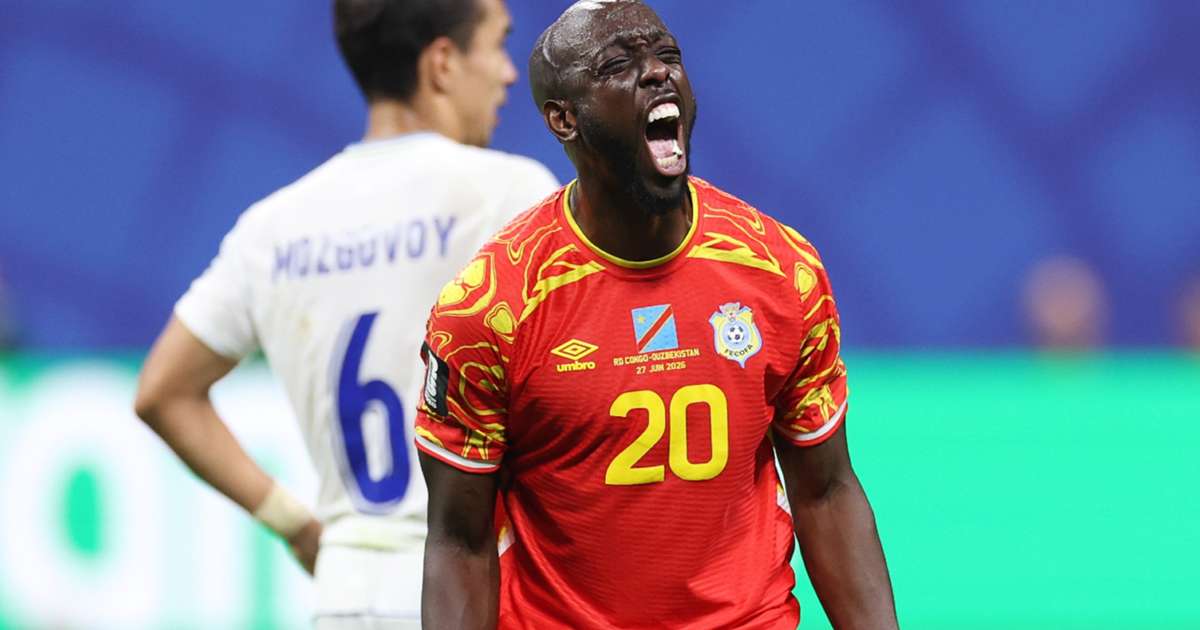
DR Congo recorded a convincing 3-1 victory over Uzbekistan in their FIFA World Cup fixture, a result that, once stripped of its early uncertainty, reflected the gulf in quality and territorial dominance between the two sides over the course of ninety minutes.
Uzbekistan had the audacity to take the lead inside the opening ten minutes through Eldor Shomurodov, but that advantage proved short-lived in terms of the overall narrative, even if it took DR Congo the better part of an hour to turn the match decisively in their favour.
From the moment the Leopards began to assert themselves in the second half, the outcome rarely felt in doubt.
The statistics paint a picture of near-total second-half domination by DR Congo.
Their expected goals figure across the full match stood at 2.21, compared to a meagre 0.20 for Uzbekistan - a disparity that underscores just how little the Central African side were genuinely threatened once they found their rhythm.
Uzbekistan managed only three shots across the entire match, and not a single one of those could be classified as a big chance.
DR Congo, by contrast, created three big chances and registered fifteen shots in total, eleven of which came in the second half alone.
These are not the numbers of a side that scraped through; they are the numbers of a team that controlled a match comprehensively.
Possession told a similar story.
DR Congo held 59% of the ball across the ninety minutes, rising to 64% in the first half when they were still finding their footing.
They completed 464 passes to Uzbekistan's 319, and while the corner count slightly favoured Uzbekistan at three to two, that anomaly is explained largely by DR Congo's tendency to work the ball through central channels rather than relying on wide deliveries.
The Leopards were patient in their build-up, methodical in their pressing, and clinical when the opportunities finally arrived in the second period.
What makes this result particularly significant is the manner in which DR Congo absorbed the early setback and refused to allow Uzbekistan's goal to alter their fundamental approach.
There was no panic, no desperate long-ball response, and no tactical capitulation.
Instead, they continued to move the ball with purpose, gradually suffocating Uzbekistan's ability to play out from defence and creating the conditions for a penalty, a second goal, and then a third in the closing stages.
It was a performance that spoke to both the technical quality and the mental composure of a side that clearly came into this fixture with a clear plan.
DR Congo's performance was built on a foundation of sustained possession and progressive passing, with 464 passes completed across the ninety minutes - a figure that reflects both their technical comfort on the ball and their ability to maintain structure under pressure.
In the first half, they registered 253 passes to Uzbekistan's 138, a ratio that demonstrates how thoroughly they controlled the tempo even before they had scored.
The challenge was converting that control into clear-cut chances, and for large portions of the opening period, they struggled to do so, managing only four shots before the interval with an expected goals figure of just 0.20.
The second half was a different proposition entirely. DR Congo's xG jumped from 0.20 in the first period to 2.01 in the second - a leap that reflects not just increased shot volume but a marked improvement in the quality of those chances.
All three of their big chances came after the break, and they converted two of them directly into goals, with Yoane Wissa adding a penalty and then a late strike, and Fiston Mayele contributing the second goal in between.
The Leopards were more direct, more aggressive in their pressing, and more willing to commit bodies into the final third once they had taken the lead from the spot.
Defensively, DR Congo were largely untroubled in the second half.
Their goalkeeper was called into action only once across the entire match - in the first half - and after Shomurodov's early opener, Uzbekistan never truly threatened to add to their tally.
The Leopards committed only six fouls across the full match, one of which came in the second half, suggesting a disciplined and well-organised defensive structure that rarely needed to resort to cynical interventions to halt Uzbekistan's advances.
Their backline held its shape, their midfield pressed with intelligence, and the result was that Uzbekistan's second-half xG of just 0.14 tells its own story.
The tactical setup that DR Congo employed was clearly designed to exploit Uzbekistan's tendency to concede ground in midfield.
By maintaining high possession percentages and recycling the ball through the middle third, they forced Uzbekistan into a reactive posture that became increasingly untenable as the match wore on.
The fifteen fouls committed by Uzbekistan - compared to DR Congo's six - is a telling indicator of how frequently the Central Africans were able to advance into dangerous positions and draw defensive responses.
It was a performance of tactical intelligence as much as individual quality, and it sets a strong benchmark for what this DR Congo side is capable of at this level.
Uzbekistan's evening began promisingly.
Eldor Shomurodov's goal in the tenth minute gave the Central Asian side an early lead that, at the time, appeared to energise rather than settle them.
In the opening period, they registered two shots, earned three corner kicks, and held 36% of possession - figures that, while not dominant, suggested a team capable of competing on the counter and causing problems from set pieces.
Their expected goals figure of 0.06 in the first half was modest, but the fact that they had scored from limited opportunity indicated a level of efficiency that could have made the match more complicated had they been able to sustain it.
The second half, however, was a sobering experience for Uzbekistan.
They managed just one shot after the interval, their possession dropped slightly to 45%, and their expected goals figure of 0.14 reflected an almost complete inability to generate meaningful attacking play.
The lone second-half shot that required a save from the DR Congo goalkeeper was their only moment of genuine threat, and even that came against the run of play.
Uzbekistan's inability to create big chances - they registered zero across the entire match - is the most damning statistic of their evening, and it speaks to a structural problem in how they approached the second half.
Fouls were a significant issue for Uzbekistan.
They committed fifteen across the match - nine in the first half and six in the second - a figure that suggests both a difficulty in winning the ball cleanly and a tendency to resort to physical intervention when tactical solutions were unavailable.
That foul count was more than double DR Congo's six, and it contributed to the pressure that eventually led to the penalty from which Wissa opened the scoring for the Leopards.
Discipline, or the lack of it, cost Uzbekistan dearly, and the pattern of fouls suggests that their midfield was repeatedly caught out of position and forced to make recovery challenges.
Shomurodov's goal aside, there was little in Uzbekistan's display to suggest they had a coherent plan for how to win the match once DR Congo began to apply sustained pressure.
Their passing volume of 319 - compared to DR Congo's 464 - reflects a side that spent much of the match chasing the game rather than dictating it.
The corner kick count of three to two in their favour is a marginal positive, but corners that do not produce chances are largely statistical noise.
Uzbekistan will need to reflect carefully on their second-half performance, particularly their inability to retain the ball under pressure and their failure to create any situation that genuinely tested DR Congo's defensive organisation.
The match began with a moment that few would have anticipated: Eldor Shomurodov giving Uzbekistan the lead in the tenth minute.
The goal arrived early enough to suggest that Uzbekistan had prepared well for the occasion and were not simply content to sit back and absorb pressure.
Shomurodov's finish demonstrated the kind of composure that has made him a recognised name at club level, and it gave Uzbekistan a platform from which, in theory, they could have built something meaningful.
DR Congo's goalkeeper was called into action once in the first half, and while the early stages were not without their anxious moments for the Leopards, they never appeared structurally unsettled by the deficit.
For the remainder of the first half, DR Congo pressed to find a response but were unable to convert their possession advantage into genuine scoring opportunities.
Their xG of 0.20 in the opening period reflects a side that was moving the ball but not yet penetrating with the necessary incision.
Four shots were registered, none of which troubled the Uzbekistan goalkeeper, and the half-time interval arrived with the score still 1-0 to the Central Asian side.
It was a lead that felt precarious given the territorial dominance DR Congo had established, but it was a lead nonetheless, and Uzbekistan went in at the break with something tangible to defend.
The second half changed the character of the match entirely.
In the 68th minute, DR Congo were awarded a penalty, and Yoane Wissa stepped up to convert it with authority.
The equaliser shifted the psychological weight of the fixture decisively in DR Congo's favour, and Uzbekistan - who had committed fifteen fouls across the match, contributing to the pressure that led to the spot kick - appeared unable to recalibrate their approach in response.
Ten minutes later, in the 78th minute, Fiston Mayele added a second goal for the Leopards, extending their lead and effectively ending Uzbekistan's realistic hopes of recovering a result.
DR Congo's second-half xG of 2.01 reflected the sheer volume and quality of the chances they were creating by this point, with three big chances registered in the period.
The scoring was completed in the 90th minute when Wissa netted his second of the evening, putting the final gloss on a 3-1 victory that, by that stage, was thoroughly deserved.
The late goal was more than a cosmetic addition - it confirmed the scale of DR Congo's second-half dominance and underlined the fact that Uzbekistan had been unable to mount any meaningful resistance once the Leopards took control.
Across the second half, Uzbekistan managed just one shot and zero big chances, while DR Congo registered eleven shots and created three clear opportunities.
The final scoreline of 3-1 accurately reflects the trajectory of a match that began with uncertainty and ended with clarity.
Yoane Wissa was the standout individual of this fixture, and the statistics support that assessment without requiring embellishment.
He scored twice - once from the penalty spot in the 68th minute and once in the 90th minute - and played the full 91 minutes, accumulating 38 touches and completing 17 of his 19 attempted passes for an accuracy rate of approximately 89%.
His rating of 7.6 places him comfortably as the match's top performer, and his contributions went beyond the goals themselves; he was a persistent presence in and around the Uzbekistan penalty area throughout the second half, and his movement created space for colleagues even when he was not directly involved in the build-up play.
The penalty conversion in the 68th minute was the pivotal moment of the match, and it fell to Wissa to deliver it.
Converting a penalty in a World Cup fixture, with the score at 0-1 and the pressure of needing to equalise, requires a particular kind of composure.
Wissa provided exactly that, and the goal immediately altered the dynamic of the contest.
From that point forward, Uzbekistan were chasing the match rather than protecting their lead, and DR Congo's superior quality in possession and in transition became increasingly apparent.
Wissa's role in that transformation was central.
His second goal, in the 90th minute, demonstrated a different quality - the ability to remain sharp and focused late in a match that had already been won.
Some forwards disengage once the result is secured; Wissa's late goal showed an appetite for the game that extended to the final whistle.
With 38 touches across 91 minutes, he was consistently involved in DR Congo's attacking play, and his passing accuracy of 89% - 17 from 19 - reflects a player who was not only making runs and creating chances but also contributing to the team's ball circulation with a level of technical precision that belies the stereotype of the pure goalscorer.
It is worth noting that the top player attribution lists Wissa under Uzbekistan in the raw data, which appears to be a data entry error given that he scored both goals for DR Congo and his contributions were entirely in service of the Leopards' victory.
Setting that aside, the case for Wissa as the match's most influential individual is straightforward.
He scored the equaliser that changed the match, he added a third goal to confirm the victory, and he did so while maintaining a high level of technical engagement throughout.
In a match that was defined by DR Congo's second-half transformation, Wissa was the catalyst and the finisher - the player around whom the Leopards' most dangerous moments were constructed.
A victory of this nature carries considerable weight in the context of the FIFA World Cup, where every point and every goal can prove decisive in determining which sides advance from the group stage.
DR Congo's 3-1 win over Uzbekistan not only secures three points but does so with a goal difference of plus two, a factor that can become critically important in tightly contested groups where sides finish level on points.
The manner of the victory - particularly the second-half dominance reflected in an xG of 2.01 and eleven shots - suggests that DR Congo are capable of performing at a high level against opposition of varying styles.
For Uzbekistan, the defeat is a significant setback in their World Cup campaign.
Conceding three goals while managing only one shot in the second half and generating an xG of just 0.14 after the interval points to structural vulnerabilities that more experienced World Cup sides will look to exploit.
Their early goal gave them a platform, but their inability to build on it or to adapt tactically when DR Congo began to impose themselves raises questions about the depth of their tactical preparation and the quality of their options from the bench.
The broader context of the World Cup group stage means that both sides will be aware that results elsewhere in their group will shape the significance of this fixture in retrospect.
A 3-1 victory is a strong result by any measure, but DR Congo will know that consistency is required across multiple matches if they are to advance.
The xG figures suggest that their attacking threat is genuine - 2.21 across the match, with 2.01 of that coming in the second half - but they will also be conscious that a slow start allowed Uzbekistan to score and could have allowed a more clinical side to build a more commanding lead before the Leopards found their rhythm.
For the World Cup as a competition, this fixture provided evidence that the expanded tournament format continues to bring together sides from diverse footballing cultures whose contrasting styles produce matches with genuine tactical interest.
DR Congo's possession-based approach and Uzbekistan's counter-attacking intent created a contest that had a clear narrative arc - early shock, gradual reassertion, decisive second-half performance - and the statistical profile of the match reflects a result that was ultimately earned through sustained quality rather than fortune.
Both sides will carry lessons from this fixture into their remaining group games, and the data produced here will inform how analysts and coaches assess their respective strengths and weaknesses going forward.
DR Congo take considerable confidence from this result, but the manner in which they conceded in the tenth minute will not be lost on their coaching staff.
Allowing Uzbekistan - a side that generated an xG of just 0.20 across the full match - to score from an early opportunity suggests a degree of defensive vulnerability in the opening stages that more dangerous opponents will look to exploit.
The Leopards were excellent once they found their stride, but the period between the tenth minute and the 68th minute, during which they held the ball but could not score, represents an area that requires attention if they are to progress deep into the tournament.
The form of Yoane Wissa will be a source of significant optimism for DR Congo.
A player who can score twice in a World Cup fixture - including a penalty under pressure - and maintain a passing accuracy of 89% while accumulating 38 touches is a genuine match-winner, and his contribution to the second-half turnaround was decisive.
If the Leopards can get the best out of Wissa consistently, and if Fiston Mayele can continue to add goals as he did with the 78th-minute strike, they have the attacking resources to cause problems for any side in the competition.
The question will be whether the supporting cast can provide the platform those forwards need.
For Uzbekistan, the path forward requires honest reflection.
They showed in the opening ten minutes that they are capable of taking their chances when they arrive, and Shomurodov's goal was a reminder that they have quality in attacking areas.
However, their second-half performance - one shot, zero big chances, an xG of 0.14, and fifteen fouls across the match - paints a picture of a side that struggles to sustain competitive intensity against technically superior opposition.
Their next fixture will demand a significant improvement in their ability to retain possession and to create meaningful attacking sequences, rather than relying on isolated counter-attacking moments.
Narrative implications aside, this is a result that establishes DR Congo as a credible force in their World Cup group and raises questions about Uzbekistan's capacity to compete at this level across a full tournament.
The Leopards will approach their next fixture with momentum, a positive goal difference, and the knowledge that their second-half performance demonstrated genuine World Cup quality.
Uzbekistan, by contrast, face the challenge of rebuilding confidence and finding tactical solutions to problems that were exposed comprehensively in the second half of this match.
Three points for DR Congo, three lessons for Uzbekistan - and a fixture that, in statistical terms, told a very clear story.