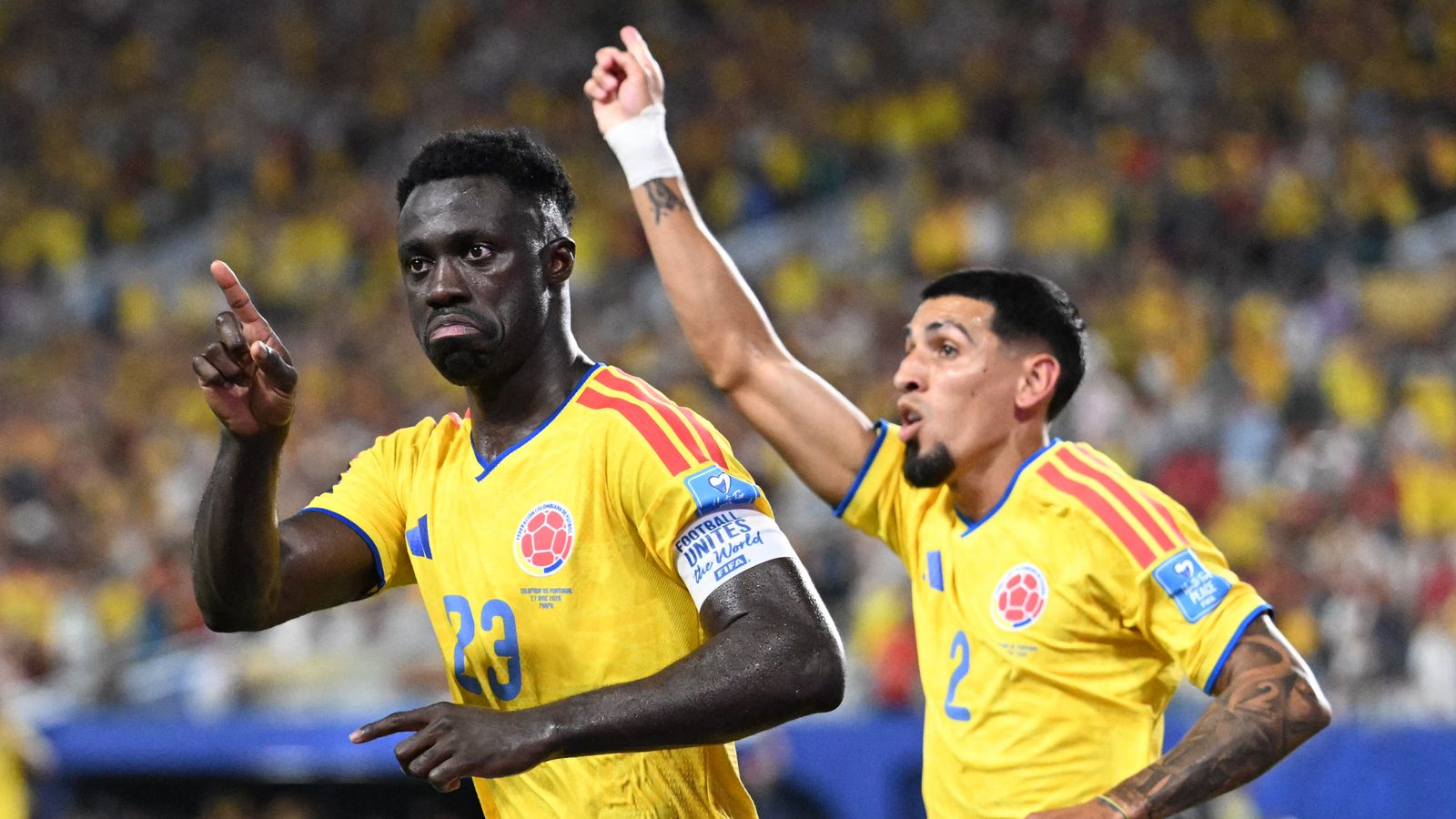
Colombia and Portugal played out a goalless draw in what proved to be a closely contested FIFA World Cup fixture, one that ultimately delivered no goals but offered a considerable amount of tactical substance for those willing to look beyond the scoreline.
The final result - 0-0 - was, in statistical terms, a more flattering outcome for Portugal than the underlying numbers would suggest, given that Colombia generated an expected goals figure of 1.49 across the ninety minutes compared to Portugal's 0.67.
That gap between the two sides' xG totals tells a story of a match in which one team consistently found themselves in more dangerous positions, yet were unable to apply the finishing touch when it mattered most.
Colombia controlled the tempo for large portions of the contest, finishing with 54 per cent possession and completing 523 passes to Portugal's 431.
Their 22 total shots dwarfed Portugal's 12, and they earned four corner kicks to Portugal's two. On the surface, it reads as a dominant display from the South American side.
Yet the Portuguese goalkeeper was forced into six saves across the match - a figure that speaks to both Colombia's volume of attack and Portugal's defensive resilience when pressed.
The Colombians, by contrast, required their own keeper to make only two saves, reflecting how little genuine threat Portugal posed in open play.
The first half set the tone for what would follow.
Colombia took early control, registering 12 shots and generating an xG of 0.89 in the opening 45 minutes alone.
Portugal were not entirely without menace - they produced nine first-half shots of their own and carried an xG of 0.52 - and the period ended with each side having created one big chance apiece.
The Portuguese goalkeeper made three saves before the interval, suggesting Colombia's attacking intent was a consistent thread from the outset rather than something that emerged only when the game demanded it.
The second half told a more one-sided story in terms of the statistics.
Colombia maintained their pressure, adding ten more shots and generating a further 0.60 xG, while Portugal's attacking output collapsed to just three shots and an xG of 0.15.
The Colombian goalkeeper was not called upon to make a single save after the break, which underlines just how thoroughly Portugal's forward line was neutralised.
Colombia's failure to convert that second-half dominance into goals will be the defining frustration of this result - and it is a question that will linger as the tournament progresses.
Colombia entered this match as the side with more to prove in terms of attacking intent, and for long stretches they delivered on that front.
Their 54 per cent possession figure was consistent across both halves - 55 per cent in the first period, 54 per cent in the second - indicating that their control was not a product of chasing the game or sitting on a lead, but rather a deliberate and sustained tactical approach.
With 523 passes completed, they were clearly the side dictating the rhythm of the contest, moving the ball with purpose and working to create overloads in Portugal's defensive structure.
The volume of shots - 22 in total - is a figure that demands attention.
Across the full match, Colombia attempted nearly double the number of shots that Portugal managed, and their expected goals tally of 1.49 reflects genuine quality in the positions they found themselves in.
They created two big chances across the ninety minutes, one in each half, and the fact that neither was converted will be a source of considerable frustration for the coaching staff.
An xG of 1.49 across a World Cup group stage fixture is a respectable return; failing to score from it is not a crisis, but it is an opportunity missed.
Defensively, Colombia were solid without being particularly tested.
Their goalkeeper made just two saves across the entire match - both coming in the first half - and was entirely untroubled in the second period as Portugal's attacking threat evaporated.
The backline managed Portugal's forward movements with relative comfort, and the foul count of 11 - compared to Portugal's six - suggests Colombia were willing to use physicality when necessary, particularly in the second half when eight of those fouls were committed.
That pattern indicates a side that was not above using tactical fouling to disrupt Portugal's transitions when their own attacking moves broke down.
The overriding narrative for Colombia from this match is one of near-misses and missed opportunities.
They were the better side by most measurable metrics, and on another day - with sharper finishing or a touch more composure in the final third - they would have taken all three points.
The xG differential of 0.82 in their favour is not enormous, but it is meaningful, and it points to a side that is functioning well in terms of creating chances.
The challenge for Colombia's management will be to translate that creative output into goals when the stakes are highest, because the tournament will not offer many more chances to leave points on the table.
Portugal's performance in this fixture was defined by a fundamental contradiction: they were outplayed in most statistical categories, yet they left the pitch with a point.
Their 46 per cent possession, 12 total shots, and xG of just 0.67 paint the picture of a side that struggled to impose themselves on the match in the way their reputation might demand.
In the second half in particular, Portugal's attacking contribution was negligible - three shots, an xG of 0.15, and no big chances created - which suggests that their tactical approach after the interval shifted decisively towards containment rather than seeking a winner.
The Portuguese goalkeeper was the standout figure in terms of keeping his side in the contest.
Six saves across the ninety minutes - three in each half - is a substantial workload, and it reflects the sustained pressure that Colombia were able to generate.
That the goalkeeper was called upon so frequently is not simply a testament to Colombia's attacking quality; it also speaks to the defensive shape Portugal were operating in, which invited pressure at times and required individual brilliance to compensate.
Six saves in a goalless draw is, by any measure, a significant individual contribution to a team result.
Portugal's best moments came in the first half, where they managed nine shots and created one big chance.
Their xG of 0.52 in the opening 45 minutes was not negligible, and there were clearly passages of play in which they threatened to take the lead.
The first half's relative balance - both sides with one big chance each, both goalkeepers making three saves - suggests that Portugal were competitive in the early exchanges, even if they were not the dominant force.
The collapse in their attacking output in the second half, however, raises questions about stamina, tactical adjustments by Colombia's coaching staff, or simply Portugal's decision to prioritise not losing over trying to win.
Portugal committed only six fouls across the entire match, a figure that reflects either a disciplined defensive approach or a reluctance to engage in the physical contest that Colombia were clearly willing to embrace.
Their two corner kicks compared to Colombia's four further illustrates the directional flow of the match.
Portugal will take some encouragement from the fact that they kept a clean sheet despite being outplayed, but the underlying numbers offer little comfort for those expecting them to be a genuine force in this competition.
A point earned through defensive solidity rather than competitive balance is a different kind of result, and one that will need to be contextualised carefully as the tournament unfolds.
The match began with Colombia taking an early grip on possession, establishing the territorial dominance that would characterise the full ninety minutes.
In the opening exchanges, they moved the ball with confidence through midfield and began to probe Portugal's defensive lines, testing the shape and looking for gaps between the lines.
Portugal, for their part, were not passive - they pressed when the opportunity arose and attempted to use quick transitions to exploit space behind Colombia's advancing full-backs.
The first half ultimately produced nine shots from Portugal and 12 from Colombia, with both goalkeepers making three saves each and both sides creating one big chance apiece.
The balance of the opening 45 minutes was closer than the overall match statistics would suggest.
With no goals to break up the narrative, the story of the first half was told in the quality of the chances created and the saves required to deny them.
Colombia's xG of 0.89 in the first period indicates they were finding genuine shooting positions, not simply speculative efforts from distance.
Portugal's 0.52 xG in the same period reflects that they, too, had moments of genuine threat - moments that, had they been converted, could have fundamentally altered the dynamic of the contest.
The fact that neither side could find the net before half-time meant the match remained on a knife-edge heading into the interval, with the tactical battle still very much unresolved.
The second half saw the balance shift noticeably in Colombia's favour.
Portugal's attacking output dropped sharply - from nine first-half shots to just three after the break - while Colombia continued to press and probe, adding ten more shots and generating a further 0.60 xG.
Colombia's goalkeeper was not required to make a single save in the second period, which tells its own story about Portugal's inability to threaten on the counter or through set-pieces.
Colombia created one more big chance after the interval, pushing their total to two for the match, but were unable to find the decisive moment that their second-half dominance deserved.
The final whistle brought with it a scoreline that, in isolation, suggests equilibrium - but the full statistical picture tells a different story.
Colombia's 1.49 xG against Portugal's 0.67, their 22 shots against 12, and their six corners against two all point to a match in which one side was consistently the more threatening.
Portugal's six goalkeeper saves - the highest individual contribution of the match in terms of defensive statistics - were ultimately the reason the scoreline remained blank.
In the absence of goals, the match will be remembered as one of missed opportunities for Colombia and effective, if unglamorous, damage limitation from Portugal.
The top-rated player of the match, according to the available data, was J. Rodríguez of Portugal, who earned a rating of 8.1 despite playing only 76 minutes and finishing the match without a goal or an assist.
That rating - the highest of any player on the pitch - reflects the quality and consistency of his involvement in the game rather than any single decisive moment.
In a match that produced no goals and relatively few clear-cut chances, the player who controls the tempo and keeps his side ticking is often the one who stands out, and Rodríguez clearly fulfilled that role from Portugal's midfield.
His passing statistics are the most illuminating aspect of his performance.
Rodríguez completed 65 of 72 attempted passes - an accuracy rate of approximately 90 per cent - which is a high-quality return in a World Cup fixture where the pressure on the ball is constant and the margins for error are small.
He accumulated 85 touches in his 76 minutes on the pitch, making him one of the most involved outfield players in the match.
That level of involvement, combined with the accuracy of his distribution, suggests he was functioning as a key hub in Portugal's midfield, recycling possession efficiently and helping to maintain whatever structural coherence Portugal managed to achieve.
It is worth noting that Rodríguez's influence came in a match where Portugal were, by most metrics, the inferior side.
His 8.1 rating in those circumstances is arguably more significant than it might appear at first glance.
When a team is under pressure, the quality of their midfield play becomes critical - not just in terms of creating chances going forward, but in terms of relieving pressure, managing transitions, and keeping the defensive shape intact.
Rodríguez's 90 per cent passing accuracy suggests he was rarely giving the ball away cheaply, which would have helped Portugal avoid the kind of sustained high-press situations that can unravel a team's defensive structure.
The fact that he was substituted in the 76th minute rather than playing the full 90 raises its own questions - whether it was a precautionary measure, a tactical decision, or a response to fatigue is not clear from the available data.
What is clear is that in the time he was on the pitch, he was Portugal's most influential figure.
In a match where neither side could find the net and the margins were thin throughout, the player who keeps the ball moving, maintains positional discipline, and rarely makes a poor decision is often the one who shapes the outcome most.
Rodríguez, by that measure, was the standout performer of this contest.
A goalless draw in the FIFA World Cup group stage is a result that carries different weight depending on the wider context of each side's campaign.
For both Colombia and Portugal, the point earned here needs to be assessed in relation to their other results in the group, the performances of the teams around them, and the qualification scenarios that will ultimately determine whether this draw proves to be a valuable point or a missed opportunity.
Without the full group standings available, it is difficult to be definitive about the precise implications, but the nature of World Cup group stages means that every dropped point carries potential consequences.
For Colombia, the statistical picture from this match suggests they are a team capable of generating genuine attacking threat in a World Cup environment.
An xG of 1.49 against a side of Portugal's calibre is not a figure to dismiss lightly.
If they can maintain that level of chance creation in subsequent fixtures and improve their conversion rate, they have the tools to progress from the group stage.
The concern will be whether this result represents a pattern of underperformance in front of goal, or simply an off day in terms of finishing.
The answer to that question will likely define their World Cup campaign.
Portugal, meanwhile, take a point from a match in which they were outplayed for significant periods.
In World Cup football, clean sheets have a value that transcends the aesthetic quality of the performance, and Portugal's goalkeeper ensuring they left with a point rather than a defeat is a meaningful contribution to their group stage arithmetic.
However, a team that generates only 0.67 xG against Colombia - a side that, while talented, is not among the very elite of world football - will need to find considerably more attacking potency if they are to compete with stronger opponents as the tournament progresses.
The broader significance of this result in the FIFA World Cup context is that it keeps both sides' campaigns alive and in their own hands, assuming neither has suffered a heavy defeat elsewhere.
The World Cup group stage is a format that rewards consistency and punishes catastrophic results, and a 0-0 draw - while not a platform for momentum - at least avoids the kind of damage that a defeat can inflict on goal difference and confidence.
Both sides will be aware that the next fixture is likely to carry greater urgency, and the tactical and psychological lessons from this match will need to be absorbed quickly.
Colombia will leave this match with a sense of what might have been.
They were the better side across most measurable dimensions - possession, shots, xG, corners, goalkeeper saves required - and yet they take only a single point from a game in which three were available.
The question for their coaching staff is not whether the performance was good enough; on the evidence of the statistics, it broadly was.
The question is whether the players in the final third can be trusted to convert the opportunities that the team's overall structure is generating.
An xG of 1.49 with two big chances and zero goals is a result that demands honest reflection rather than defensive justification.
For Portugal, the conclusion is more complicated.
They earned a point through defensive resilience and individual goalkeeping quality, but the underlying numbers offer little encouragement for those expecting them to challenge deep into the tournament.
Their second-half attacking output - three shots, 0.15 xG, zero big chances - was particularly concerning.
A team of Portugal's resources and historical pedigree at World Cups should be capable of more, and the coaching staff will need to address the reasons for that second-half fade before their next fixture.
Whether it was tactical, physical, or a consequence of Colombia's adjustments at half-time, the pattern needs to be understood and corrected.
Looking ahead, both sides will need to approach their remaining group stage fixtures with a clearer sense of what they are trying to achieve.
Colombia, with their attacking metrics pointing in the right direction, will want to build on the creative platform they established here and find the clinical edge that was missing.
A performance like this, translated into a winning scoreline, would be a significant statement of intent.
Portugal, by contrast, will need to rediscover the attacking fluency that their squad is theoretically capable of producing - six goalkeeper saves in a goalless draw is not a sustainable model for tournament progression.
The narrative thread running through both sides' campaigns from this point forward will be shaped significantly by this result.
Colombia will carry the confidence of knowing they can dominate a high-quality opponent, tempered by the frustration of failing to capitalise.
Portugal will carry the knowledge that they can hold a clean sheet under pressure, but also the awareness that their attacking output needs to improve substantially.
Both are incomplete pictures, and the tournament will provide the canvases on which those pictures are completed.
What this match has established, above all else, is that the gap between the two sides was real but not decisive - and that, in World Cup football, is often where the most interesting stories begin.