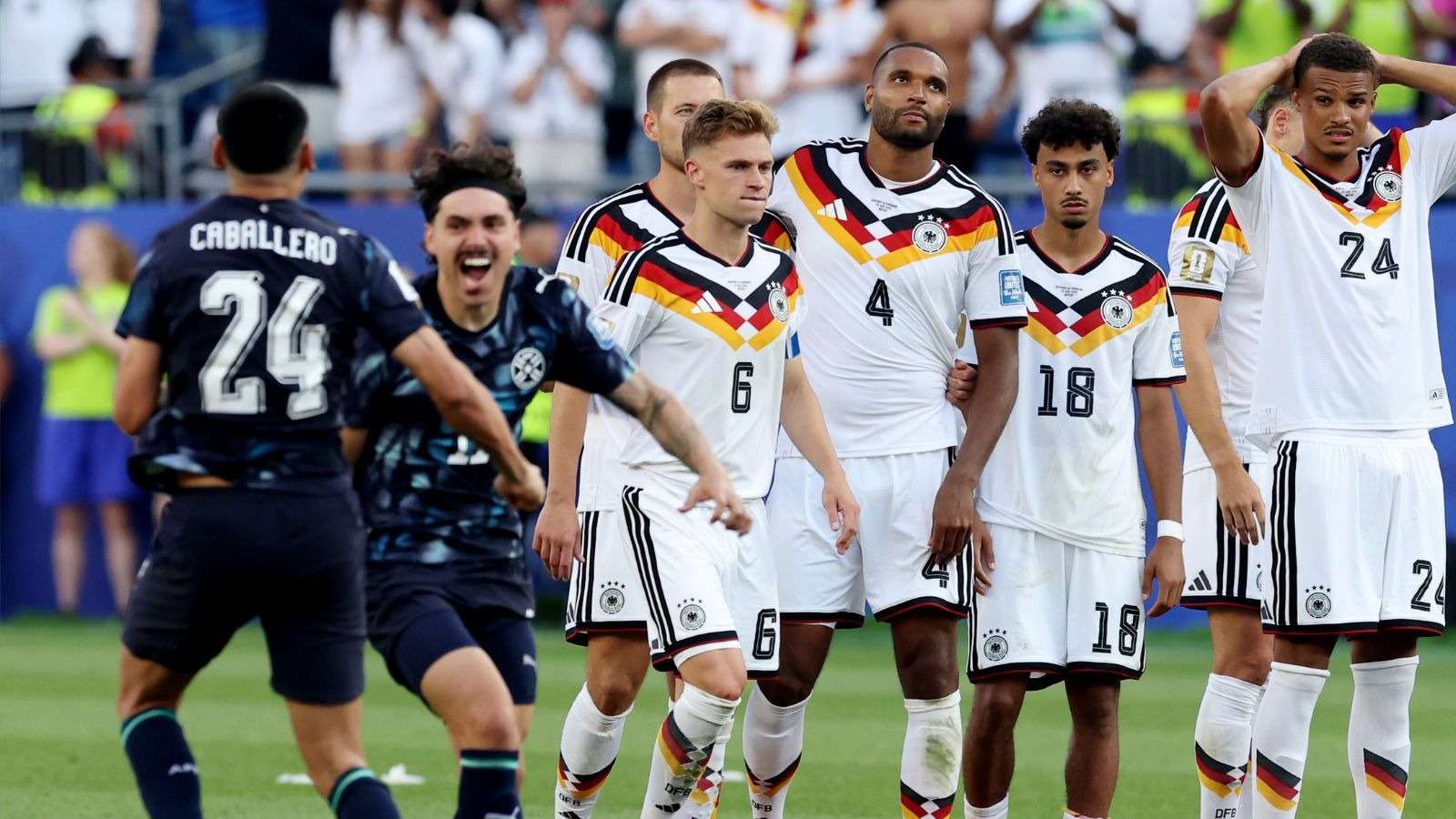
Paraguay produced one of the most remarkable results in recent World Cup history, defeating Germany 5-4 after extra time in a match that, on the surface of the statistics, should never have gone the way it did. Germany controlled the ball for 75 per cent of the contest across 120 minutes, completed 799 passes to Paraguay's 257, and registered 21 shots to their opponents' seven. Yet when the final whistle sounded, it was the South American side celebrating a victory that will be spoken about long after this tournament concludes. Football, as it regularly demonstrates, does not always reward the team that dominates possession.
The match was played across two halves that told very different stories before extra time added yet another layer of complexity. In the first half, despite Germany's overwhelming territorial control — 79 per cent possession and 342 passes — it was Paraguay who generated the more dangerous opportunities, accumulating two big chances to Germany's zero and posting an expected goals figure of 0.20 against the hosts' 0.14. That inversion of the expected order set the tone for everything that followed. Germany moved the ball with efficiency and intent, but Paraguay's defensive shape and willingness to press in transition repeatedly exposed spaces behind the German backline.
The second half saw Germany improve their attacking output, generating one big chance and nine shots, but Paraguay continued to threaten on the counter with four shots of their own and a further big chance. The goalkeeper saves tell a story of their own: Germany's goalkeeper was called upon to make six saves across the full match, while Paraguay's stopper made just two. That disparity reflects how frequently and how dangerously Paraguay were able to convert their limited possession into genuine goal-scoring moments. It is a masterclass in efficiency that coaches at every level will study.
By the time the match reached its conclusion after extra time, the scoreline of 5-4 felt both improbable and entirely fitting. Germany had done everything statistically that a winning team should do — they won the corner count 16-6, committed only 18 fouls across the full match, and kept their passing accuracy high throughout. But Paraguay's clinical edge in front of goal, combined with a goalkeeping performance that was nothing short of outstanding, proved decisive. This is a result that challenges assumptions about how football matches are won and lost at the highest level.
Germany entered this fixture as clear favourites, and for long stretches of the match they played like it. Their 75 per cent possession across 120 minutes was not merely a passive statistic — it reflected a genuine attempt to control the tempo, circulate the ball through midfield, and build pressure through sustained territorial dominance. With 799 passes completed and 16 corners won, Germany created the conditions in which they expected to score goals. The problem was converting that structural superiority into actual goals at the rate the scoreline demanded.
Kai Havertz was Germany's most notable contributor in terms of the scoresheet, netting in the 54th minute to give his side a foothold in the match. His goal came at a moment when Germany were beginning to assert themselves in the second half, and it briefly appeared as though the weight of their possession would tell. Havertz's ability to arrive in the penalty area and finish under pressure is well-documented, and his contribution here was consistent with the high standards he has set at club level. However, the goal was not enough to swing the match definitively in Germany's favour, and Paraguay's response — both immediately and over the course of the remaining minutes — was admirable.
The expected goals figure for Germany across the full match was 1.49, which is a reasonable return given the volume of shots and the number of corners they generated. However, it also reveals that many of Germany's 21 shots were from positions and angles that the model rates as low-probability. Only two of those shots were classified as big chances — a number that feels low given the territorial dominance Germany enjoyed. This points to a structural issue in how Germany translated possession into clear-cut opportunities. Their build-up was patient and technically proficient, but Paraguay's defensive organisation repeatedly denied them the high-quality positions they needed.
Germany's defensive performance also warrants scrutiny. Conceding five goals in a match — including in extra time — while holding 75 per cent of the ball is an outcome that will trouble the coaching staff considerably. The six saves their goalkeeper was forced to make suggest that Paraguay's counter-attacking threat was both frequent and dangerous. Germany's defensive line was caught out on multiple occasions, and the fouls count of 18 over the course of the match indicates that they were regularly forced into reactive defending rather than maintaining the composed structure their possession statistics might suggest. This is a performance that demands honest assessment from within the German camp.
Paraguay's performance in this match was a study in disciplined, purposeful football executed against overwhelming odds. With only 25 per cent of the ball across 120 minutes and 257 passes completed — compared to Germany's 799 — they were always going to be required to defend deeply, absorb pressure, and strike with precision when the opportunity arose. What made their display so impressive was not just that they managed to do this, but that they did it consistently enough to score five goals against one of the most technically accomplished sides in the world.
Julio Enciso's goal in the 42nd minute was the defining moment of the first half and perhaps the moment that set the psychological tone for the entire match. Coming just before the interval, it gave Paraguay an advantage they had arguably earned through their first-half performance, in which they generated two big chances to Germany's zero and posted a higher expected goals figure despite having 21 per cent of the ball. Enciso's ability to find space and finish in those moments is exactly the kind of quality that makes Paraguay dangerous regardless of the possession statistics surrounding them. His goal was not a fluke — it was the product of a well-organised and well-executed attacking transition.
Paraguay's three big chances across the full match, compared to Germany's two, is perhaps the single most telling statistic of the entire contest. It confirms that their attacking threat was not merely speculative — they were consistently getting into positions that the expected goals model rates as genuinely dangerous. With only seven shots, their conversion rate was exceptional, and it reflects a team that was highly selective about when to commit players forward and highly clinical when they did. This is not a style of football that is easy to maintain against a side as technically capable as Germany, and it speaks to the quality of Paraguay's game management.
Defensively, Paraguay were organised and resolute, and their goalkeeper's performance — which is addressed in detail in the top player section — was central to keeping the scoreline manageable. The 12 fouls they committed across the match reflect a willingness to disrupt Germany's rhythm at source, and the six corners they conceded suggest that Germany's wide play was being channelled into areas that Paraguay's defensive structure could handle. The away side's discipline in the face of sustained pressure was commendable, and their ability to remain cohesive as a unit through 120 minutes of physical and tactical demands speaks to the character and organisation within this Paraguay squad.
The match opened with Germany immediately asserting territorial control, as one might expect from a side of their technical quality facing a South American opponent at a World Cup. In the first half, Germany registered five shots and six corners, circulating the ball with the kind of patience that suggests a coaching staff confident in their ability to wear down the opposition through sustained possession. However, the early exchanges quickly revealed that Paraguay had no intention of sitting passively and absorbing pressure without threatening on the break. Their defensive shape was compact but not static, and their willingness to press in certain areas of the pitch created uncertainty in Germany's build-up.
The first half's most significant moment arrived in the 42nd minute, when Julio Enciso scored for Paraguay. The goal came against the run of possession — Germany had the ball for 79 per cent of the first half — but entirely in keeping with the underlying numbers, which showed Paraguay generating two big chances to Germany's zero in that opening period. Enciso's finish gave Paraguay a lead they took into the interval, and the half-time statistics painted a portrait of a match in which the dominant team was being outscored by the more efficient one. Germany's expected goals figure of 0.14 in the first half, against Paraguay's 0.20, confirmed that the scoreline was not as unjust as the possession numbers might suggest.
The second half saw Germany recalibrate, and Kai Havertz's goal in the 54th minute drew them level. Germany improved their attacking output in the second period, generating nine shots and one big chance, and their goalkeeper was required to make three saves as Paraguay continued to threaten. The second half's expected goals figures — 0.58 for Germany, 0.22 for Paraguay — suggest that Germany were beginning to find their range, but Paraguay's counter-attacking threat remained a constant danger. The match ebbed and flowed with goals being exchanged at regular intervals, and by the end of 90 minutes the teams were level, setting up an extra-time period that would ultimately deliver the decisive moments.
Extra time added further goals to a match that had already produced an extraordinary volume of scoring, and it was Paraguay who ultimately found the decisive strike to win 5-4. The period saw Germany's goalkeeper make further saves — he finished the match with six in total — while Paraguay's stopper was called upon twice across the full 120 minutes. The final scoreline of 5-4 to Paraguay is one that will be replayed and analysed extensively, not least because it represents such a stark contrast to what the possession and passing statistics would ordinarily predict. Germany had the ball, the corners, and the shots — Paraguay had the goals when it mattered most.
O. Gill's selection as the match's top-rated player, with a rating of 8.9, is not a sentimental choice — it is the only logical conclusion when you examine what Paraguay's goalkeeper contributed across 120 minutes of football. Gill played every minute of the contest, made six saves, and was fundamental to keeping Germany's total to four goals in a match where the opposition registered 21 shots and generated an expected goals figure of 1.49. Without his interventions, Paraguay's victory would have been considerably more difficult to achieve, if it were achievable at all.
The six saves Gill made across the match represent a significant workload for a goalkeeper in a single game, particularly at World Cup level where the quality of the shots he faced would have been high. Germany's 21 total shots included a variety of attempts from different positions and distances, and the fact that Gill conceded only four — while making six saves — reflects both his technical ability and his composure under sustained pressure. His positioning and decision-making would have been tested repeatedly, particularly during periods when Germany were generating corners and set-piece opportunities from their 16 corners won.
Gill's passing statistics — 12 accurate passes from 45 attempted — tell a complementary story. With 64 touches across 120 minutes, he was regularly involved in Paraguay's build-up play, and the fact that he attempted 45 passes reflects the degree to which Paraguay were relying on him to initiate their transitions from defence to attack. The 12 accurate completions from those 45 attempts is a modest accuracy rate, but it must be contextualised: a goalkeeper playing out against a high-pressing Germany side, attempting to launch counter-attacks with 25 per cent possession, is operating in extremely challenging conditions. Every accurate pass he completed was a potential catalyst for a Paraguay attack.
What elevates Gill's performance beyond the raw numbers is the context in which those saves were made. Paraguay were defending a lead for long stretches of this match, and Germany's pressure — particularly in the second half when their expected goals figure rose to 0.58 — required Gill to be at his best at the moments when his team needed him most. A goalkeeper's rating of 8.9 in a match of this magnitude, against an opponent of Germany's quality, is a genuine reflection of an exceptional individual performance. Gill was not merely competent — he was the single most important reason Paraguay were able to hold on and ultimately win a match that the statistics suggested they should have lost.
A 5-4 victory over Germany in the FIFA World Cup carries implications that extend well beyond the immediate result. Germany are perennial contenders at World Cup level, with a history and pedigree that makes any team capable of defeating them a side that must be taken seriously. For Paraguay, this result represents a statement of intent — not just to the other teams remaining in the competition, but to the broader football world that has historically viewed South American sides outside of Brazil and Argentina as supporting actors rather than genuine contenders.
For Germany, the defeat raises serious questions about their ability to convert possession and territorial dominance into goals at the rate required to win matches at this level. Their expected goals figure of 1.49 across 120 minutes, while not exceptional, should have been sufficient to win the match if their conversion rate had been closer to average. The fact that they conceded five goals while holding 75 per cent of the ball is a tactical and defensive failure that the coaching staff will need to address urgently if Germany are to remain in the tournament. A team that dominates possession as comprehensively as Germany did here cannot afford to be so vulnerable on the counter-attack.
In the broader context of the FIFA World Cup, results of this nature have a habit of reshaping narratives around group standings, knockout round seedings, and the psychological momentum of teams as the competition progresses. Paraguay's victory will have been noted by every other side in the tournament, and the manner of it — clinical, disciplined, efficient — will have given opponents cause for concern. A team that can score five goals against Germany while holding only 25 per cent of the ball is a team capable of defeating almost anyone on their day.
The match also contributes to a broader conversation about how modern football is evolving at the international level. The assumption that possession-based football is inherently superior — that the team with the ball will ultimately prevail — is challenged by results like this one. Paraguay's approach, built on defensive organisation, rapid transitions, and clinical finishing, is a model that several sides in this tournament will be studying closely. The statistics from this match will be referenced in tactical discussions for some time, not as an anomaly, but as evidence that efficiency and structure can overcome technical dominance when executed with the quality that Paraguay demonstrated here.
Germany will leave this match with a great deal to reflect on, and the reflection will not be comfortable. A team of their quality, with their resources and their tactical sophistication, should not be losing 5-4 to any opponent when they hold 75 per cent of the ball and register 21 shots. The coaching staff will need to examine why their big chance count was only two — a figure that suggests their shot selection was poor and their movement in the final third was not creating the high-quality positions that their possession should have generated. The defensive vulnerabilities exposed by Paraguay's counter-attacking will also need to be addressed with some urgency.
For Paraguay, the immediate challenge is managing the physical and psychological demands that come with playing 120 minutes of high-intensity football. Extra time takes a toll, and the recovery time between World Cup fixtures at the group stage can be limited. However, the confidence that this result will generate within the squad is a resource that should not be underestimated. Teams that beat Germany at a World Cup carry a belief into subsequent fixtures that is difficult to manufacture through training alone. Paraguay will approach their next match knowing that they are capable of defeating any opponent in this competition.
O. Gill's performance in this match will define how Paraguay are perceived going forward in the tournament. A goalkeeper playing at this level provides a foundation upon which defensive structures can be built with confidence, and Paraguay's coaching staff will be aware that their style of play — deep defensive organisation combined with rapid counter-attacking — is heavily dependent on the goalkeeper being able to make the saves that keep the team in matches. If Gill continues to perform at the level he demonstrated here, Paraguay will be a genuinely difficult team to eliminate.
The broader narrative implications of this result are significant. Germany's exit from World Cup tournaments in the group stage in recent history has shown that the nation's football establishment is not immune to the kind of shocking results that reshape tournaments. Whether this defeat proves to be a temporary setback or a more damaging blow to their progression in the competition will depend on what comes next. For Paraguay, the question is whether this performance represents a genuine level they can sustain or a peak they reached on a particular day against a particular opponent. The answer to that question will define their World Cup.