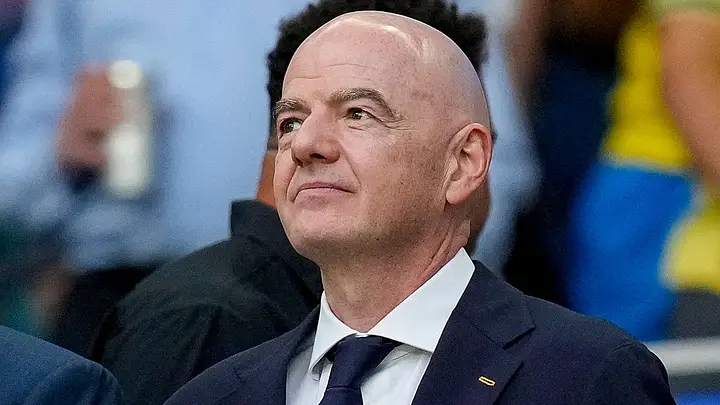
Fifa president Gianni Infantino has confirmed that football's governing body will assess the possibility of expanding the men's World Cup to 64 teams after the conclusion of the 2026 tournament.
The proposal, first raised last year, has gained fresh attention following the successful introduction of the 48-team format at this year's World Cup.
Infantino believes further expansion deserves serious discussion as part of Fifa's commitment to making the competition more inclusive.
"That's definitely an issue that will be examined and discussed in the relevant committees after this World Cup," Infantino told Swiss broadcaster Blue Sport.
"When organising a World Cup, it's important to organise it for the whole world - not just Europe and South America, but the entire global football community."
"Every nation should have the chance to dream of playing in a World Cup."
He added that giving smaller nations greater opportunities encourages the continued growth of the game.
"The quality of teams around the world continues to improve."
"If smaller countries aren't given the opportunity to compete, they lose an important incentive to develop."
Infantino described the inaugural 48-team World Cup as a major success, highlighting the strong performances from African nations.
Nine of the 10 African teams progressed to the knockout stages, compared to just five representatives at the previous tournament.
"That shows how important it is to give more countries the opportunity to participate," he said.
Fifa approved the expansion from 32 to 48 teams in 2017, with the new format debuting at the 2026 finals.
South American governing body CONMEBOL formally proposed increasing the 2030 World Cup to 64 teams in April 2025, although no decision has yet been made.
The centenary edition of the tournament will primarily be hosted by Spain, Portugal and Morocco, while Argentina, Uruguay and Paraguay will stage the opening matches to commemorate the first World Cup, held in Uruguay in 1930.
Despite the proposal, several influential football leaders remain unconvinced.
UEFA president Aleksander Čeferin has labelled the idea "a bad idea" for both the tournament and its qualification process.
Asian Football Confederation president Sheikh Salman bin Ibrahim Al Khalifa warned that further expansion could create "chaos", while Concacaf president Victor Montagliani argued that it "doesn't feel right" and could negatively affect the wider football calendar.
A 64-team World Cup would present significant logistical hurdles.
The current tournament is spread across the United States, Canada and Mexico, while the 2030 edition will span six host nations.
Expanding to 64 teams would increase the competition to 128 matches, placing even greater demands on infrastructure, scheduling and travel.
Questions also remain over how Saudi Arabia, the host of the 2034 World Cup, could stage an event of that scale.
Despite the challenges, expansion offers clear benefits for many Fifa member associations.
A 64-team tournament would allow nearly one-third of Fifa's 211 affiliated nations to qualify, dramatically increasing global representation.
It would also generate additional commercial revenue, enabling Fifa to distribute greater financial support to its member associations and invest further in football development around the world.
While no immediate decision is expected, Fifa has reiterated that it will consider all formal proposals before its council makes a final ruling on the future size of the World Cup.