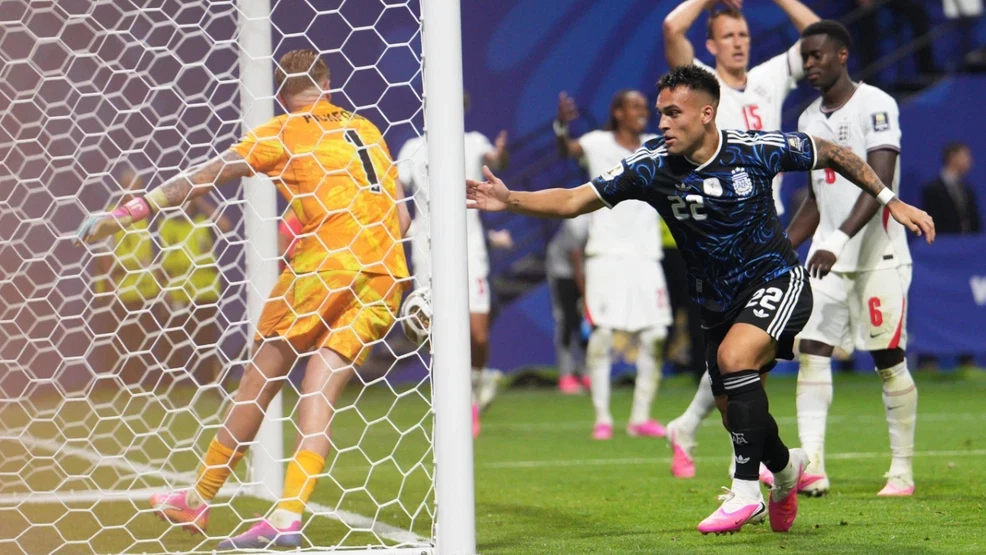
Argentina defeated England 2-1 in a World Championship fixture that, for the better part of an hour, appeared to be heading towards a frustrating stalemate before England broke the deadlock, only to surrender the lead in a chaotic final ten minutes. The scoreline, while tight, does not fully reflect the imbalance between the two sides across the ninety minutes. Argentina dominated possession, territory, and the volume of attacking threat throughout, yet found themselves behind heading into the closing stages before two late goals completed the turnaround.
The statistical picture is unambiguous in terms of who controlled this match. Argentina finished with 64% of the ball across the full ninety minutes, completing 590 passes to England's 324. Their expected goals figure of 1.84 compared to England's 0.53 tells a story of sustained offensive pressure that eventually yielded the result the underlying numbers suggested was coming. England's solitary big chance, compared to Argentina's three, underlines how little the home side were able to threaten in a meaningful way despite taking the lead.
The second half was particularly telling. Once the game opened up after the interval, Argentina shifted into a higher gear entirely. Their possession share climbed to 73% in the second period, they generated an xG of 1.81 from 13 shots, and they earned five corner kicks to England's none. England, by contrast, managed four shots and an xG of just 0.48 in the second half, which in context means their only goal came from a relatively low-probability opportunity. The game was being played almost entirely on Argentina's terms.
What makes this result particularly significant is the manner in which it unfolded. England scored against the run of play at the 55-minute mark through Anthony Gordon and then spent the remainder of the match defending deep, ceding territory and inviting pressure. It was a strategy that held until the 86th minute, when Enzo Fernández equalised, before Lautaro Martínez completed the comeback four minutes into stoppage time. Argentina's persistence was ultimately rewarded, and the final score reflects the balance of play across the ninety minutes far more accurately than the scoreline suggested it might during those final anxious moments.
England's performance in this fixture was defined by two distinct phases: a first half in which they competed reasonably well, and a second half in which they were comprehensively outplayed. In the opening 45 minutes, the possession split was 45-55 in Argentina's favour — respectable by any measure given the quality of the opposition — and the expected goals were almost identical at 0.05 to 0.03. England were organised, compact, and difficult to break down, and they gave very little away in terms of clear openings.
The second half told a very different story. England's pass count dropped to just 126 in the second period compared to 198 in the first, which indicates how completely they retreated into a low defensive block once they scored. Whether that was a deliberate tactical decision or a consequence of Argentina's increased intensity is difficult to say without formation data, but the effect was clear: England stopped competing for the ball and instead attempted to protect what they had. With Argentina completing 339 passes in the second half alone and generating 1.81 xG, that approach was always going to be tested severely.
Anthony Gordon's goal at the 55-minute mark was England's moment of the match. It was their only big chance of the entire game, and they converted it. The goalkeeper was called upon three times in the second half alone — all three saves coming after Gordon's goal — which illustrates how little protection the back line received once England went into a holding pattern. The three saves kept England in the match for longer than the underlying numbers would have predicted, but the volume of pressure Argentina were generating made a second goal feel inevitable.
England's foul count of 11 across the match — seven of which came in the first half — suggests they were willing to be physical and disruptive in the early stages, which helped neutralise Argentina's rhythm. However, as the game wore on and Argentina's technical quality began to tell, those tactical fouls became less effective. The corner kick count of just one for England across the entire match, compared to Argentina's six, is perhaps the starkest indicator of how little England were able to sustain any meaningful attacking presence. They scored, and they held on for longer than the stats suggested they should, but ultimately the pressure told.
Argentina's performance in this match was one of sustained, methodical dominance that never quite translated into goals until the very end. They controlled the ball from the first whistle, finishing with 64% possession and 590 completed passes. Their ability to retain the ball and move it quickly through the lines created a constant sense of pressure, even during the first half when the scoreline remained goalless and the xG figures were low on both sides. The platform was being built even if the end product was not yet arriving.
The second half was where Argentina truly asserted themselves. Their 73% possession share in that period, combined with 13 shots and three big chances, represents a level of attacking dominance that England simply could not sustain defending against for forty-five minutes. Five corners in the second half to England's none further illustrates how completely Argentina pinned their opponents back. The fact that it took until the 86th minute to equalise is a testament partly to England's defensive organisation and partly to Argentina's wastefulness in front of goal — three big chances from which only two goals came.
The goal threat was real and consistent. An xG of 1.84 across the match is a figure that indicates Argentina were creating genuinely good opportunities, not just speculative long-range efforts. Their shot volume of 15 — compared to England's five — reflects a team that was constantly finding ways to get into dangerous positions. The fact that England's goalkeeper made three saves in the second half alone shows how frequently Argentina were testing the opposition between the posts, and it was only a matter of time before one found the net.
Argentina's discipline improved as the match progressed, which is worth noting. They committed 12 fouls in the first half but only three in the second, suggesting a tactical adjustment — possibly recognising that the referee was monitoring their physicality, or simply that they were winning the ball through possession rather than needing to foul to win it back. The late goals from Fernández and Martínez were the culmination of a performance built on patience and persistence. Argentina did not panic when England scored; they continued to do what they had been doing, and the goals came.
The first half of this World Championship encounter was a largely uneventful affair in terms of goalmouth action, though the tactical contours of the match were already beginning to take shape. Argentina had slightly more of the ball — 55% to England's 45% — but neither side was able to generate a big chance. The combined xG across the opening 45 minutes was just 0.08, with Argentina at 0.03 and England at 0.05. Both goalkeepers were largely untroubled, with zero saves required from either side. England were compact and well-organised, while Argentina were patient, moving the ball through their lines without yet finding the penetration they needed.
The match changed shape entirely in the second half, and the pivotal moment came at the 55-minute mark when Anthony Gordon put England ahead. It was a goal that came against the run of play — England had managed just one shot in the first half — and it represented their only big chance of the entire match. The goal was converted from what the xG data suggests was a relatively low-probability position, with England's total second-half xG of 0.48 spread across four shots. Gordon's finish was the defining contribution of England's attacking output for the entire ninety minutes, and it gave the home side a lead they looked capable of defending for a considerable period.
Argentina's response was immediate in terms of intent, even if the equaliser took time to arrive. They pushed possession up to 73% in the second half and began to generate the volume of chances their dominance deserved. England's goalkeeper made three saves in the second half, all coming after Gordon's goal, as Argentina tested the backline repeatedly. The pressure built through corners — five of Argentina's six came in the second half — and through sustained passing sequences that kept England pinned in their own half. The home side were managing the game rather than playing it, and the question was simply whether their defensive organisation would hold.
It did not. Enzo Fernández equalised in the 86th minute, bringing the scores level with just four minutes of normal time remaining. It was a goal that reflected Argentina's sustained pressure and their refusal to change their approach despite the scoreline. Then, in the 90th minute — deep into stoppage time — Lautaro Martínez completed the turnaround to give Argentina a 2-1 lead that they held to the final whistle. Two goals in the space of four minutes ended England's hopes of taking anything from the match. The late nature of the collapse will sting for England, but the underlying statistics suggest Argentina were always the more likely winners.
Leandro Paredes was named the top performer of this match with a rating of 7.3, and the numbers behind that assessment are compelling. The Argentine midfielder completed 68 of 70 attempted passes during his 64 minutes on the pitch — an accuracy rate of 97.1% that is exceptional by any standard. He accumulated 78 touches in that time, making him one of the most involved outfield players on the pitch on a per-minute basis. While he did not contribute a goal or an assist, his role in this Argentina side is not primarily a creative or goalscoring one — it is to control tempo and ensure the ball circulates with precision and purpose.
Paredes' passing accuracy of 97.1% was the foundation upon which Argentina's possession dominance was built. With Argentina completing 590 passes across the match, the midfielder's contribution of 68 accurate passes in just 64 minutes represents a significant share of the team's ball retention. His ability to receive the ball under pressure and recycle it efficiently — almost never giving it away — kept Argentina's passing sequences alive and prevented England from winning the ball back in dangerous areas. This is the kind of work that does not appear on a highlights reel but is central to how a possession-based team functions.
The 78 touches Paredes accumulated in 64 minutes translates to a touch every 49 seconds on average, which underlines how central he was to Argentina's build-up play. In a match where Argentina controlled 64% of possession overall and 73% in the second half, the players facilitating that control are as important as those providing the end product. Paredes was the metronome in midfield — the player who set the tempo, ensured the ball moved quickly through the lines, and gave Argentina's more attacking players the platform to express themselves in the final third.
That he achieved this rating without a goal or assist speaks to the nature of his contribution. Football statistics are increasingly able to capture the value of players like Paredes — those who do the unglamorous but essential work of keeping a team organised and in possession. His 64 minutes were arguably the period in which Argentina were at their most controlled, and it is no coincidence that his involvement coincided with the period in which the foundation for the late comeback was being laid. The goals came after his substitution, but the groundwork had already been done.
This result carries meaningful weight in the context of the World Championship, with Argentina collecting all three points from a fixture that, for much of its duration, looked as though it might yield only one or none. The manner of the victory — coming from behind to win with two goals in the final minutes — does not diminish the quality of the underlying performance. Argentina's xG of 1.84 and their three big chances suggest they deserved to win this match, and the result reflects that even if the timing of the goals adds a layer of fortune to the narrative.
For England, this is a damaging defeat in the context of the competition. They took the lead and were within minutes of a result that would have been difficult to justify given the statistical picture, but ultimately they were unable to hold on. The failure to convert a lead built on a single big chance, when the opposition were generating three of their own, was always a precarious position. The World Championship is an unforgiving competition, and points dropped in circumstances like these can prove decisive when the final standings are calculated.
Argentina's ability to generate 15 shots and an xG of 1.84 against an England side that was organised and defensively committed will be noted by other teams in the competition. Their 64% possession and 590 passes demonstrate a team comfortable controlling matches against quality opposition, and the late comeback shows a mental resilience that is often as important as technical quality at this level. Teams that can find goals in the final minutes of tight matches tend to accumulate points in ways that more dominant but less clinical sides cannot.
The broader implication of this result is that Argentina have demonstrated they can win ugly as well as win well. Their first-half performance was not spectacular — the xG of 0.03 in the opening 45 minutes reflects a side that was building rather than attacking — but they were patient enough to wait for the game to open up, and disciplined enough to keep applying pressure even when England took the lead. That combination of tactical patience and late-game decisiveness is a hallmark of competitive teams in major tournaments, and it will make Argentina a difficult proposition for any side they face in the remainder of the World Championship.
Argentina leave this fixture with three points and a result that, despite the late drama, was broadly deserved based on the balance of play. Their xG of 1.84 compared to England's 0.53 is the clearest indicator of the gulf in attacking threat across the ninety minutes, and the final score of 2-1 is a reasonable reflection of that difference. The two late goals from Fernández and Martínez will be the moments most remembered, but the foundation for this victory was laid across the full match through possession, territory, and the creation of genuine chances.
For England, the lessons from this defeat are clear. They were able to organise themselves sufficiently in the first half to keep Argentina at bay, and their goal at the 55-minute mark showed they are capable of taking their opportunities when they arise. However, the decision to retreat so deeply after scoring — evidenced by the drop in pass count from 198 in the first half to 126 in the second — left them exposed to the sustained pressure Argentina were always going to generate. A more proactive approach in the second half might have offered greater security, or at least made Argentina work harder to build their attacks.
Looking ahead, both sides will need to take stock of what this result means for their World Championship campaign. Argentina will carry confidence from a comeback victory, knowing that their underlying numbers were strong and that their players — Paredes, Fernández, and Martínez among them — are performing at a level that should make them competitive in every remaining fixture. England, by contrast, face the challenge of rebuilding belief after conceding a lead so late in a match they had managed reasonably well for much of its duration. The psychological impact of conceding twice in the final four minutes should not be underestimated.
The narrative thread running through this match — and likely through both sides' campaigns going forward — is the question of clinical finishing and defensive resilience under pressure. Argentina showed they can find goals when they need them, even if it took until the 86th and 90th minutes. England showed they can defend for long periods against quality opposition, but that a single lapse can undo considerable effort. Both of those truths will shape how each side approaches their next fixtures in the World Championship, and this result will serve as a reference point for analysts and coaches alike as the competition progresses.