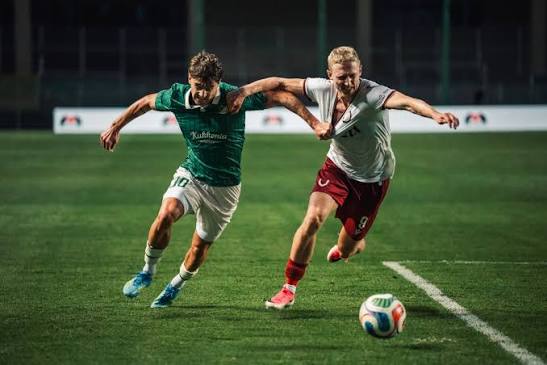
ETO FC Győr and Víkingur Reykjavík played out a 2-2 draw in the UEFA Champions League, a result that, on the surface, appears equitable but conceals a match of two quite distinct halves. The Hungarian side dominated the opening period with 68% possession and four big chances to Víkingur's one, yet the scoreline at the break was level at 2-2 after a frantic closing sequence to the first half. That sequence — three goals in the space of eleven minutes either side of half-time — effectively decided the shape of the contest before the second period had even settled into its rhythm.
From a tactical standpoint, Győr's approach was clear from the outset. The home side sought to control the match through sustained possession, completing 280 passes in the first half alone compared to Víkingur's 136. That ratio — roughly two-to-one — reflects a deliberate strategy of building from the back and suffocating the Icelandic visitors with territorial dominance. With 68% of the ball in the opening 45 minutes, Győr pressed high up the pitch and generated a four-to-one advantage in big chances, suggesting their attacking intent was not merely theoretical but translated into genuine opportunities in the final third.
Víkingur, for their part, arrived in Hungary with the pragmatism one might expect from a side accustomed to competing at this level against better-resourced opponents. Their 32% possession share in the first half was not incidental — it was the natural consequence of a defensive structure designed to absorb pressure and strike on the counter. What made the contest so intriguing is that this strategy ultimately bore fruit. Despite being outpossessed for the entire match, the Icelandic side matched Győr's four big chances across the full 90 minutes and left with a point that felt hard-earned but entirely justified.
The final scoreline of 2-2, with all four goals arriving between the 34th and 55th minutes, means that the second half was a largely goalless affair defined more by tactical adjustment than by attacking ambition. Győr managed just three shots in the second period, generating zero big chances, while Víkingur created three big chances after the break — a complete reversal of the first-half dynamic. That shift in attacking momentum is the central analytical thread of this match, and it tells a story of a home side that ran out of ideas precisely when they needed them most.
ETO FC Győr's performance in this match is one that will frustrate their coaching staff upon review. The statistical foundation was there: 62% overall possession, 510 passes completed, 12 total shots and four big chances across the 90 minutes. In the first half, Győr were the dominant force by almost every measurable metric, and yet they could not convert their superiority into a lead that would have placed real pressure on their opponents. The penalty converted by M. Vitális in the 38th minute gave them the lead, but it came only after Víkingur had already opened the scoring four minutes earlier — meaning Győr were chasing the match even as they controlled it territorially.
The manner in which Győr levelled and then went ahead in the space of seven first-half minutes is worth examining. Vitális's penalty in the 38th minute drew the sides level, and then S. G. Þorkelsson's own goal on the stroke of half-time — technically credited to Győr — gave the home side a 2-1 lead at the break. For a team that had been producing the more structured, possession-based football, going into the dressing room with an advantage was the expected reward. The concern, however, is that neither of those goals came from open play in the conventional sense — one was a set-piece foul converted from the spot, and the other was a defensive error by the opposition.
In the second half, Győr's attacking output collapsed. From nine first-half shots and four big chances, they managed just three shots after the break and created no big chances whatsoever. The home side's 57% possession in the second period — still a majority, but notably lower than the 68% they enjoyed in the first — did not translate into the kind of pressure that might have secured all three points. Their 16 tackles in the second half, compared to just five in the first, suggests they were increasingly forced into a reactive, defensive posture as Víkingur grew into the game.
The Győr goalkeeper was called upon to make zero saves across the entire match, which initially appears to reflect well on the defensive unit. However, when considered alongside the fact that Víkingur created three big chances in the second half alone, the picture becomes more complicated. Either those big chances were converted into the equalising goal — which G. Sigurðsson's 55th-minute strike confirms — or they were squandered by the visitors themselves. The reality is that Győr's defensive structure, while not catastrophically exposed, was sufficiently penetrated by a Víkingur side that had spent much of the match conserving energy and waiting for the right moments to attack with purpose.
Víkingur Reykjavík's performance in this match represents a textbook example of how a well-organised side can compete effectively against a technically superior opponent. Arriving with 38% of the overall possession and 319 completed passes — compared to Győr's 510 — the Icelandic club were never going to win a battle of attrition. Instead, they identified the spaces within Győr's high-possession structure and exploited them with a directness and efficiency that ultimately earned them a point on the road in a UEFA Champions League fixture.
The opening goal, scored by D. Hafsteinsson in the 34th minute, set the tone for Víkingur's approach. Rather than being a side that sat deep for the entirety of the match, they were willing to commit players forward when the opportunity presented itself. Hafsteinsson's goal and assist in this match — both of which will be examined in greater detail in the top player section — demonstrate that Víkingur carried a genuine attacking threat even while operating with a minority share of the ball. Their four big chances across the full match, equalling Győr's total despite having 24% less possession, speaks to the quality of their attacking transitions.
The second-half performance from Víkingur was particularly noteworthy. With three big chances created after the break — compared to zero for the home side — the visitors were the more dangerous attacking force in the second period. G. Sigurðsson's equaliser in the 55th minute, which completed the scoring, came from precisely the kind of incisive forward movement that Víkingur had been building towards throughout the match. Their possession share rose from 32% in the first half to 43% in the second, reflecting a growing confidence and willingness to engage more directly with Győr's structure rather than simply absorbing pressure.
Defensively, Víkingur's goalkeeper was called upon to make one save across the entire match — a remarkably low number given that Győr generated four big chances, all of which came in the first half. That statistic implies that the majority of Győr's big chances were either missed by the attackers themselves or that the definition of 'big chance' encompasses situations where the goalkeeper was not ultimately required. Regardless of the precise interpretation, Víkingur's 18 tackles across the match and their disciplined foul count — nine, matching Győr exactly — suggest a side that pressed their opponents with intelligence rather than recklessness, picking their moments to intervene rather than chasing the ball indiscriminately.
The match's opening exchanges followed a predictable pattern, with Győr establishing the territorial dominance that their home advantage and technical quality suggested they would. The Hungarian side moved the ball through their lines with purpose, completing passes at a high rate and keeping Víkingur pinned into their own half for extended periods. Víkingur, for their part, were content to defend in a compact shape, looking to win the ball quickly and transition through the lines before Győr's defensive structure could reorganise. For the first 33 minutes, neither side had broken the deadlock, but the match's narrative shifted decisively in the 34th minute.
D. Hafsteinsson gave Víkingur the lead in the 34th minute, a goal that arrived against the run of play in terms of possession statistics but was entirely consistent with the visiting side's tactical plan. The strike rewarded Víkingur's patience and demonstrated that their counter-attacking approach was not merely defensive in intent — they had a clear route to goal when the right moment arrived. The goal visibly unsettled Győr, who had been operating with the calm assurance of a side in control. The response from the home crowd and the home bench was immediate, and Győr pushed forward with greater urgency in the minutes that followed.
That urgency produced results. In the 38th minute, just four minutes after falling behind, Győr were awarded a penalty, which M. Vitális converted to level the scores at 1-1. The penalty brought the home side back into the match and restored the sense of equilibrium that the opening half-hour had suggested was the natural state of affairs. However, the match's most consequential moment arrived on the stroke of half-time. In the 45th minute, S. G. Þorkelsson put the ball into his own net, gifting Győr a 2-1 lead that they had not entirely earned through open play but which they were unlikely to relinquish before the break. The own goal was a significant moment — it shifted the psychological momentum of the match entirely, sending the home side into the dressing room with an advantage and leaving Víkingur to regroup.
The second half opened with Győr looking to consolidate their lead, but it was Víkingur who showed the greater attacking intent. The visitors, with nothing to lose and a point to gain at minimum, pushed forward with more ambition than they had shown in the first half. That approach was vindicated in the 55th minute when G. Sigurðsson equalised for Víkingur, making it 2-2 and ensuring that all four goals in the match had arrived within a 21-minute window between the 34th and 55th minutes. After Sigurðsson's goal, both sides had opportunities to find a winner — Víkingur created three big chances in the second half while Győr generated none — but neither could convert, and the match ended with the scores level at 2-2.
D. Hafsteinsson of Víkingur Reykjavík is the standout individual of this match, and the statistics that accompany his performance make a compelling case for that designation. Rated at 8.9 by the match officials and data providers, the midfielder contributed one goal and one assist in 77 minutes of action — a direct involvement in both of Víkingur's goals. In a match where the margins were fine and the scoreline ultimately level, Hafsteinsson's contributions were the difference between Víkingur leaving with nothing and leaving with a point.
His passing statistics are particularly illuminating. Hafsteinsson completed 23 of 26 attempted passes — an accuracy rate of approximately 88.5% — which is a strong return for a midfielder operating in a side that completed just 319 passes in total. That means Hafsteinsson accounted for roughly 7.2% of all Víkingur's passes while also contributing directly to both goals. The combination of high passing accuracy and direct attacking output suggests a player who was not merely circulating the ball safely but was making incisive decisions in the areas of the pitch where mistakes are most costly.
With 37 touches across 77 minutes, Hafsteinsson was involved in the game at a consistent rate without being overloaded or isolated. His assist for Víkingur's second goal — the G. Sigurðsson equaliser in the 55th minute — demonstrates that his influence extended beyond his own goal-scoring moment in the 34th minute. A player who can both score and create in the same match, while maintaining high passing accuracy, is precisely the kind of midfield operator who makes a side difficult to contain. For Győr's defensive unit, tracking Hafsteinsson's movement and cutting off his supply lines was evidently a problem they could not fully solve.
It is also worth noting the context in which Hafsteinsson performed. Víkingur were the away side, operating with a minority share of possession against a team that completed 510 passes to their 319. In that environment, a midfielder's ability to remain composed, make accurate decisions quickly and contribute directly to goals is amplified in significance. Hafsteinsson was not performing in a side that controlled the match — he was performing in a side that was frequently under pressure, and he still managed to produce the kind of output that most midfielders would be satisfied with in far more comfortable circumstances. His 8.9 rating reflects not just the goals and assists, but the overall quality of his decision-making and execution throughout the 77 minutes he was on the pitch.
A 2-2 draw in the UEFA Champions League carries different weight depending on the stage of the competition and the broader context in which the two sides find themselves. For ETO FC Győr, competing in European football's premier club competition represents a significant achievement in itself, and a point at home against Víkingur Reykjavík — a side with their own European experience — is not the kind of result that can be dismissed as a straightforward failure. However, the manner in which the point was secured, or more precisely the manner in which two points were dropped, will be the source of considerable reflection within the Győr camp.
For Víkingur Reykjavík, a point away from home in the UEFA Champions League is a result that carries genuine value. The Icelandic league system — from which Víkingur emerge — operates at a level significantly below the Hungarian top flight in terms of UEFA coefficient rankings, and the ability to travel to Hungary and leave with a draw demonstrates a competitive resilience that goes beyond mere participation. Their four big chances across the match, equalling a Győr side that completed 191 more passes than them, suggests that Víkingur are not simply making up the numbers in this competition.
In the broader UEFA Champions League framework, early-round results such as this one have a compounding effect. Goal difference, head-to-head records and points accumulated in the opening fixtures of any group or qualifying phase can prove decisive when sides are separated at the end of the campaign. Győr's failure to convert their first-half dominance — particularly their four big chances in the opening 45 minutes — into a more comfortable lead means they have left potential points on the table at a stage of the competition where every point carries disproportionate weight.
Víkingur's ability to generate three big chances in the second half without the benefit of a single big chance in the first half is a tactical and physical evolution within a single match that speaks well of their coaching staff's ability to make adjustments. In a competition where the margins between progression and elimination are often determined by fine details, the capacity to adapt mid-match is a quality that should not be underestimated. Both sides will now turn their attention to upcoming fixtures knowing that the 2-2 result here has kept their respective campaigns alive and competitive, with neither side having established a clear advantage over the other.
For ETO FC Győr, the primary takeaway from this match must be the sharp decline in attacking output between the first and second halves. Four big chances and nine shots in the opening 45 minutes gave way to zero big chances and three shots after the break — a deterioration that cannot be attributed solely to Víkingur's tactical adjustments. Győr's coaching staff will need to examine why their attacking structure became so blunt in the second period, and whether the side's reliance on possession as a means of control is actually translating into the kind of sustained pressure that wins matches at this level. A home draw, when leading 2-1 at half-time, represents a missed opportunity.
For Víkingur Reykjavík, the mood will be considerably more positive. Travelling to Hungary, falling behind to an own goal on the stroke of half-time and then equalising within ten minutes of the restart through G. Sigurðsson demonstrates a mental fortitude that is difficult to quantify but easy to recognise. Their second-half performance — three big chances, growing possession share, one save required from the goalkeeper — suggests a side that improves as matches progress, which is a significant asset in knockout or group-stage football where the ability to outlast opponents in the final third of a match is often decisive.
D. Hafsteinsson's performance will be the talking point in Reykjavík. The midfielder's goal, assist and passing accuracy in this match mark him out as the kind of player who can influence fixtures at European level, and his form heading into the next fixture will be closely monitored by both supporters and opponents. For Győr, identifying who in their squad can produce a comparable level of direct attacking contribution — one goal and one assist from a single player — will be a pressing concern, given that their own attacking output across 90 minutes was spread thinly and ultimately insufficient.
Looking ahead, both sides will be eager to build on the positives from this encounter while addressing the areas of weakness that the match exposed. Győr must find a way to sustain their first-half attacking intensity into the second period, and to convert the big chances that their possession-based system creates. Víkingur, meanwhile, will take confidence from the fact that their counter-attacking approach is capable of yielding results against a technically competent side with a significant possession advantage. The 2-2 draw keeps both sides in contention and sets up what should be a meaningful subsequent fixture in this UEFA Champions League campaign, with neither side able to afford further dropped points if they are to advance.