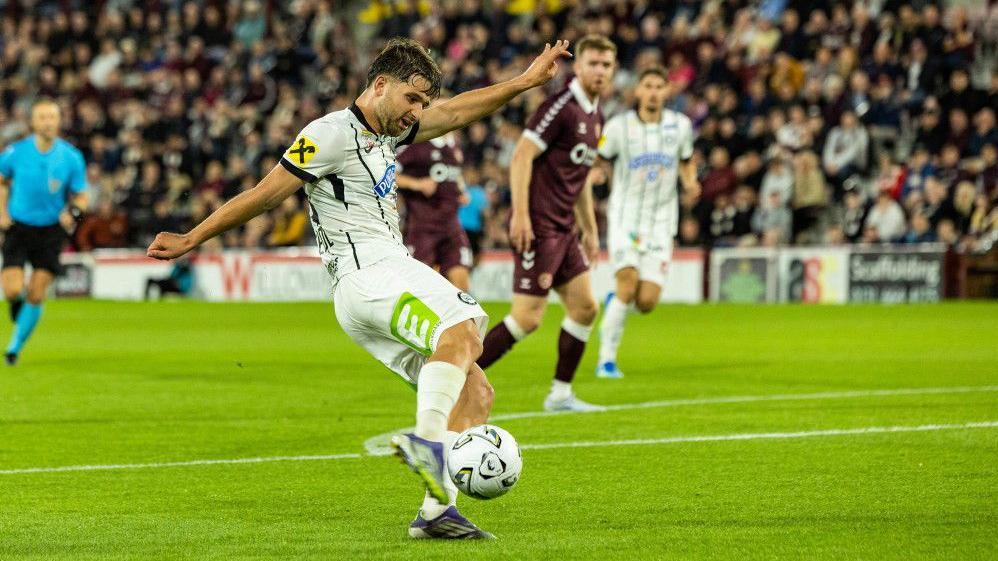
A goalless draw between Heart of Midlothian and SK Sturm Graz in the UEFA Champions League produced a result that, on the face of it, offered something to both sides — and perhaps not quite enough to either. Played at what is one of the more atmospheric club grounds in Scottish football, Tynecastle Park provided the backdrop for a continental occasion that the home support had long been anticipating. European nights under the Edinburgh floodlights carry a particular weight of expectation, and this fixture was no different, with Hearts looking to establish themselves against a side that has become a credible force in Austrian domestic football and has earned its place on the European stage through consistent performances over recent seasons.
Sturm Graz arrived in Edinburgh with their own ambitions intact. The Grazer club, founded in 1909 and one of the most decorated sides in Austrian football history, have experienced a resurgence in recent years and came into this fixture with the confidence of a team that believes it belongs at this level. Their qualification for the UEFA Champions League was no accident — it was the product of sustained investment in coaching, squad building and a clear footballing identity. For them, a point away from home in European competition represents a baseline of respectability, but their ambitions in this competition will stretch well beyond accumulating draws on the road.
The match itself ended 0-0, a scoreline that reflects the competitive tension between two sides who were, above all else, unwilling to be beaten. In European football at this level, particularly in the early stages of group or league-phase competition, the instinct to protect what you have can sometimes override the impulse to create. Whether that was a conscious tactical decision from either dugout, or simply the product of two well-organised defences nullifying attacking threats in real time, is a question that the respective managers will have their own views on. What is clear is that neither goalkeeper was seriously tested enough to be the difference between victory and defeat.
For neutral observers of the UEFA Champions League, a 0-0 draw between two sides outside the traditional European elite carries a certain narrative weight. These are clubs that have fought hard to be in this competition, and every point accumulated is a statement of intent. Hearts, in particular, are a club with a proud history but limited recent experience at this altitude of European competition. To avoid defeat against a well-organised Austrian side is a foundation, even if it is not the result that the Tynecastle faithful would have been dreaming of in the build-up. The question now is what both sides do with this point as the competition unfolds.
Heart of Midlothian's performance in a 0-0 draw against SK Sturm Graz will be assessed through the lens of what the club is trying to build at European level. Hearts have had intermittent exposure to UEFA competition over the years, but sustained participation in the Champions League is a relatively unfamiliar environment for a club whose domestic focus has traditionally consumed the majority of their resources and attention. Managing a European campaign alongside the demands of the Scottish Premiership requires careful squad management, tactical adaptability and a collective belief that the players are capable of competing with sides who may have more continental experience.
Tactically, Hearts would have set up with the knowledge that Sturm Graz are a disciplined, well-drilled outfit who are difficult to break down. The likelihood is that the home side looked to be compact and organised without the ball, attempting to deny their opponents space in behind the defensive line, while seeking to exploit any opportunities on the counter-attack or from set-pieces. European football at this level rewards teams who are difficult to play through, and Hearts will have been aware that conceding an away goal to Sturm Graz could have fundamentally altered the complexion of the tie — or the broader campaign, depending on the competition format.
Without detailed statistical data available from this fixture, it is difficult to quantify precisely how effectively Hearts executed their game plan in possession. What can be said with confidence is that the clean sheet represents a genuine achievement against a side of Sturm Graz's quality. Keeping a well-coached Austrian outfit — one that has developed a coherent attacking identity under their current management structure — scoreless over ninety minutes requires collective defensive discipline, good communication across the backline and a goalkeeper who is alert when called upon. Hearts will take that as a meaningful positive from the evening.
The challenge for Hearts going forward in this competition is to add an attacking dimension to the solidity they demonstrated here. A 0-0 draw earns one point, and in any group or league phase, points accumulate slowly if a side cannot convert their defensive resilience into victories. The home crowd at Tynecastle will have wanted more in an attacking sense — European nights at that ground generate enormous energy, and channelling that atmosphere into goals is something the Hearts management will be focused on as they prepare for subsequent fixtures. The foundation has been laid; now the structure needs to be built upon it.
SK Sturm Graz will view a point away from home in the UEFA Champions League as a professional result, even if the manner of it — a goalless draw in which neither side managed to impose themselves decisively — leaves room for self-reflection. The Austrian side have earned a reputation in recent seasons as a team with a clear identity: organised, physically robust, and capable of executing a coherent tactical plan over the course of ninety minutes. Their presence in the Champions League is a reflection of that consistency, and they will have arrived at Tynecastle with a detailed understanding of what Hearts would attempt to do and how they intended to counter it.
Sturm Graz's tactical approach in away fixtures in European competition tends to prioritise defensive solidity as a starting point, with the aim of making themselves difficult to beat before seeking to impose their own attacking patterns as the game develops. Against Hearts, the expectation would have been that they would look to frustrate the home side in the early stages, absorb any pressure generated by the Tynecastle atmosphere, and then look to exploit spaces as the match opened up. The fact that neither side managed to score suggests that both defensive structures held firm, which is arguably a slightly more frustrating outcome for Sturm Graz, who will have fancied their chances of nicking a goal on the counter-attack.
The Austrian outfit will be aware that their attacking players need to be more productive in European competition if they are to make a genuine impact in the Champions League. Creating chances against well-organised opposition requires patience, movement and the ability to find pockets of space in congested defensive structures — qualities that Sturm Graz possess in their squad but which may not have been fully expressed in this particular fixture. The conditions, the atmosphere and the specific defensive shape that Hearts employed will all have been factors in limiting their effectiveness in the final third.
Nevertheless, the clean sheet kept by the Sturm Graz defence is equally noteworthy. Keeping Hearts scoreless at Tynecastle, where the home side will have had the backing of a passionate and vocal support, requires concentration and defensive organisation over a sustained period. The Graz backline will have needed to manage set-pieces, deal with physical challenges and maintain their shape throughout. That they did so without conceding gives them a platform to build on as the campaign continues. A point on the road in European competition is never something to be dismissed, and Sturm Graz will bank it accordingly before turning their attention to what comes next.
The match between Heart of Midlothian and SK Sturm Graz in the UEFA Champions League concluded 0-0, with no goals scored across the ninety minutes. As a chronological recap, the narrative of the game is therefore defined not by moments of scoring, but by the patterns of play, the opportunities created and squandered, and the overall rhythm of a contest between two sides who were, above all, determined not to lose. In European competition, particularly at this level, that mentality is understandable — a point away from home, or a point earned in a home fixture against credible opposition, carries genuine value in the context of a longer campaign.
The opening exchanges of the match would typically set the tone for what follows, and in a fixture of this nature — a home side looking to establish themselves against experienced European opposition — the early minutes are often characterised by caution. Hearts, playing in front of their own supporters at Tynecastle, would have looked to impose themselves on the game and demonstrate that they were not overawed by the occasion. Sturm Graz, for their part, would have been content to absorb initial pressure, maintain their defensive shape and look to hit on the transition. Neither side managed to break the deadlock in the first half, and the teams went in level at the interval.
The second half followed a similar pattern. As the game progressed and both sides sought to avoid defeat, the spaces between the lines became more contested and the opportunities to create clear-cut chances more limited. In European football, when two well-organised sides meet and neither is willing to take significant risks, the match can settle into a pattern of controlled possession and careful positioning rather than end-to-end attacking play. Without specific statistical data on shots, chances created or possession percentages, it is not possible to quantify precisely how the second half unfolded, but the scoreline tells its own story — neither goalkeeper was beaten, and neither side found the decisive moment that would have separated them.
The final whistle confirmed the 0-0 result, and both sets of players and staff will have processed that outcome through their own particular lens. For Hearts, a clean sheet in European competition against a side of Sturm Graz's calibre is a result that carries genuine merit. For Sturm Graz, a point on the road in the Champions League is a professional outcome, even if the lack of a goal will have been a source of mild frustration for a side with attacking ambitions. The match, ultimately, was decided by what didn't happen — and in the context of a long European campaign, that can sometimes be as significant as what does.
With no top player identified for this fixture and no individual player statistics available, it is not possible to single out a specific performer as the standout individual from the Heart of Midlothian versus SK Sturm Graz match. This is an important caveat to acknowledge clearly, because attributing individual excellence without the supporting data to justify it would be a disservice to the players involved and to the integrity of the analysis. What can be said, however, is that a 0-0 draw in the UEFA Champions League — particularly one involving a Scottish side hosting an Austrian side — requires collective performances of a high standard from multiple individuals across both teams.
In a goalless draw, the players who most influence the outcome are often those in defensive positions — centre-backs who win their aerial duels, full-backs who track runners effectively, midfielders who screen the backline and goalkeepers who make the saves that matter when they are called upon. These contributions are frequently less visible to the casual observer than a goal or an assist, but they are the foundation upon which results like this are built. The fact that neither side scored suggests that the defenders and goalkeepers on both teams performed their roles with a degree of competence that was sufficient to neutralise the attacking threats they faced.
For Hearts, the defensive unit as a collective deserves recognition for keeping Sturm Graz — a side with genuine attacking quality and European experience — at bay for ninety minutes. Tynecastle is a compact ground where the crowd is close to the pitch, and that can work in a home side's favour, but it also means that any defensive lapse is immediately exposed. The Hearts backline will have needed to be alert, organised and physically committed throughout, and the clean sheet they achieved is a testament to their collective effort rather than any individual moment of brilliance.
For Sturm Graz, the same logic applies in reverse — their defensive players kept Hearts scoreless in a match where the home side would have been motivated by the occasion and the support of their crowd. Without individual statistics to analyse — no pass completion rates, no duels won, no distance covered — the most honest assessment is that both defences performed credibly and that the match was ultimately shaped by collective defensive discipline rather than individual attacking inspiration. When detailed player data becomes available, a more precise analysis of individual contributions will be possible, but on the evidence of the scoreline alone, the defenders on both sides have the strongest claim to the evening's most influential performances.
A 0-0 draw in the UEFA Champions League carries different implications depending on where it falls within the competition's structure. For both Heart of Midlothian and SK Sturm Graz, this result adds one point to their respective tallies, and in a competition where the margins between qualification and elimination can be extremely fine, every point accumulated in the early stages of the campaign has the potential to be significant. The Champions League, in its current format, rewards consistency and punishes poor runs of form — a single dropped point can be recovered, but a pattern of draws and defeats quickly becomes difficult to overcome.
For Hearts, participation in the UEFA Champions League represents a significant moment in the club's recent history. Scottish clubs have historically found European competition at the elite level challenging, with the gap in resources, squad depth and continental experience between the Scottish Premiership and the top leagues in Europe creating structural disadvantages that are difficult to overcome. A point from their opening fixture — or from a fixture against Sturm Graz, regardless of where it falls in the campaign — gives them something to build on. It demonstrates that they are capable of competing at this level and that the step up from domestic football has not been too steep to manage.
Sturm Graz, meanwhile, will be assessing this result in the context of their own Champions League ambitions. The Austrian Bundesliga, while competitive domestically, does not carry the same coefficient weight as the top five European leagues, and Sturm Graz will be aware that their route to any meaningful progression in the Champions League will require them to maximise points from fixtures against sides of a similar standing to Hearts, while also looking to cause upsets against stronger opposition. A draw away from home is a functional result, but it is not the kind of outcome that builds momentum or sends a message to the rest of the competition.
In the broader context of the UEFA Champions League, fixtures between clubs from Scotland and Austria are a reminder of the competition's expanding reach and its commitment to including clubs from across the European football landscape. The presence of Hearts and Sturm Graz in the competition reflects the work both clubs have done domestically and the quality of their respective leagues in producing sides capable of competing at the continental level. Whether either club can go beyond the early stages of the competition remains to be seen, but this result — a hard-fought, goalless draw — at least confirms that they are not here simply to make up the numbers.
The 0-0 draw between Heart of Midlothian and SK Sturm Graz in the UEFA Champions League leaves both clubs with work to do as their respective campaigns develop. For Hearts, the immediate priority will be to translate the defensive solidity demonstrated in this fixture into a more complete performance — one that combines the organisation and discipline they showed here with a greater capacity to create and convert attacking opportunities. A clean sheet in European competition is a foundation, but it is not a destination, and the Hearts management will be clear-eyed about the fact that points from draws alone are unlikely to be sufficient to achieve whatever their objectives are in this campaign.
Looking ahead, Hearts will need to assess how this result fits into their broader fixture schedule, balancing the demands of the UEFA Champions League with the ongoing requirements of the Scottish Premiership. Managing player workload, maintaining fitness levels and keeping the squad mentally sharp across two demanding competitions is a challenge that requires careful planning and squad depth. The lessons learned from this fixture — what worked defensively, where the attacking play fell short, how the players responded to the European atmosphere — will inform the preparation for what comes next, and the coaching staff will be thorough in their analysis.
For Sturm Graz, the return journey to Austria with a point represents a professional outcome, but the Austrian side will know that their ambitions in this competition require more than a series of goalless draws. Their attacking players will need to find greater productivity in European fixtures, and the coaching staff will be looking at how to create clearer chances against organised opposition. The tactical lessons from this match — how Hearts set up, where the spaces were and how they might be exploited differently in a future fixture or against different opposition — will be absorbed and acted upon as the campaign continues.
Ultimately, this fixture between Heart of Midlothian and SK Sturm Graz will be remembered as a competitive, well-contested European encounter that neither side managed to win. In the long arc of a Champions League campaign, such results are neither defining nor irrelevant — they are data points in a longer story. Both clubs will take their one point, conduct their analysis and move forward. The UEFA Champions League has a way of providing clarity quickly, with subsequent fixtures bringing fresh opportunities and fresh tests. How Hearts and Sturm Graz respond to those tests will determine whether this draw is looked back on as a solid foundation or a missed opportunity.