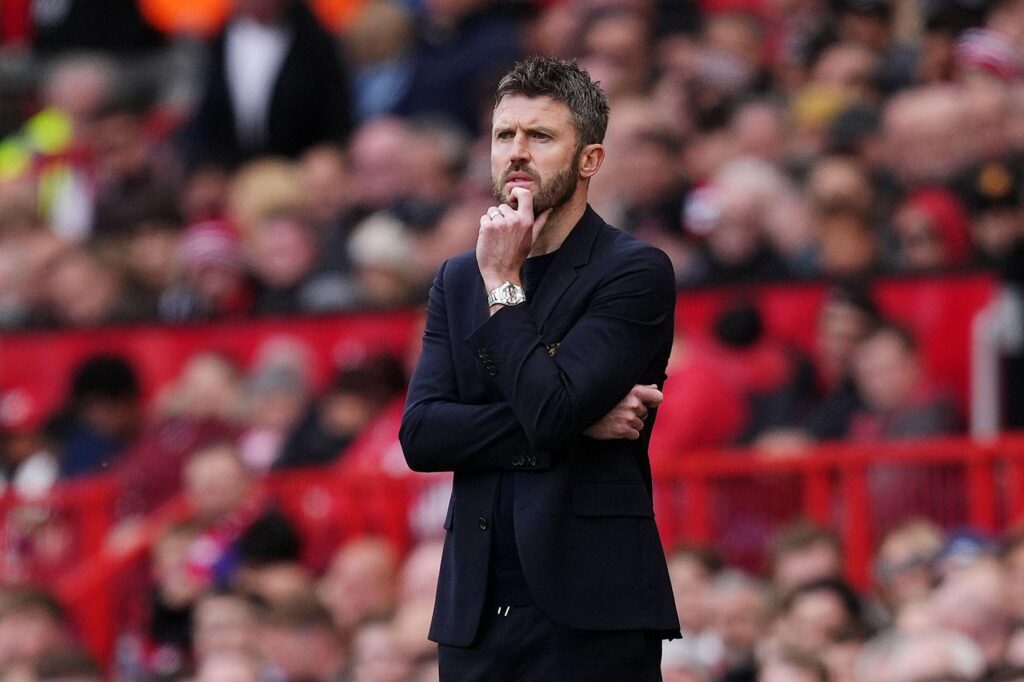
Michael Carrick wants Manchester United to combine the club's traditional attacking identity with greater control as the Red Devils prepare for the new Premier League campaign.
"First and foremost, we want to win," Carrick said when asked how he wants his Manchester United side to play this season.
But winning alone is not enough. Carrick also wants United to entertain, embracing the attacking philosophy long associated with the club.
"We want to be excited - that's why we love this club. I'm fully aware that we need to do it in a certain way," he added.
His approach echoes Sir Alex Ferguson, who said in 2017 that Manchester United had a "duty to entertain".
The idea of a distinct "United DNA" has been debated extensively in recent years. After several managers attempted to introduce slower, possession-heavy football, Carrick appears determined to build a system that combines United's traditional speed and attacking intent with greater tactical control.
Ahead of United's Premier League opener away to Hull City on Saturday at 12:30 BST, pre-season has provided several clues about how Carrick plans to achieve that balance.
One of the clearest tactical changes has come in Manchester United's approach to playing out from defence.
Former manager Ruben Amorim increasingly encouraged goalkeeper Senne Lammens to play long as Premier League opponents adopted more aggressive man-to-man pressing systems. Carrick has reversed that approach, asking his players to accept the risks associated with short passing.
From goal-kicks, United have frequently adopted a 4-2-4 shape, with Lammens operating between the two central defenders. The four attacking players are given considerable freedom, while the back four and two central midfielders generally maintain more structured positions.
Building from the back has been one of United's more encouraging features during pre-season and provides perhaps the clearest indication of Carrick's tactical philosophy.
Under Amorim, United often relied on rehearsed passing patterns when attempting to escape pressure. Carrick's system appears more flexible.
Instead, players are encouraged to form passing triangles and work together in groups of three to bypass opponents. The players involved can change depending on the situation, placing greater responsibility on individuals to read the game and react accordingly.
Third-man runs are another important feature, with players encouraged to move away from their markers and receive possession in space.
Once United beat the initial press, the intention is clear: attack quickly.
Manchester United's midfield recruitment appears designed to support Carrick's approach.
Andrey Santos, Youri Tielemans and Mason Mount have combined effectively during pre-season, helping United progress possession through midfield and into attacking areas.
The system should also suit Kobbie Mainoo, who returned to action with a cameo in Saturday's 4-2 defeat by AC Milan.
However, Carrick's more flexible approach carries risks.
The introduction of Bruno Fernandes, arguably United's standout player last season, against Milan highlighted some of those challenges. Alongside Tielemans and Santos, United struggled to establish enough midfield control to dominate possession.
Their instinct to move the ball forward quickly resulted in turnovers and prevented United from building sustained pressure.
That balance could become one of Carrick's biggest challenges this season.
He wants United to exploit the speed and quality of their attackers by progressing vertically with as few passes as possible, but without sacrificing possession unnecessarily.
Finding the right balance between direct attacking football and controlled possession could ultimately determine the success of Carrick's system.
United's aggressive philosophy is also evident without the ball.
Carrick has regularly deployed another 4-2-4 shape when pressing, with his players initially maintaining their positions before aggressively closing down opponents when the right trigger appears.
The objective is to make United proactive rather than allowing opponents to dictate matches.
Keeping four attackers high and narrow helps block passing routes through central areas. Like many coaches, Carrick appears more comfortable allowing opponents possession in wider positions because central areas are considered more dangerous.
There is also an attacking benefit.
By keeping four forwards high up the pitch, United can immediately threaten on the counter-attack when possession is recovered. Instead of pressing purely as a defensive mechanism, Carrick is using it as a way of creating scoring opportunities.
That approach produced results during the 1-1 pre-season draw with Paris Saint-Germain.
After regaining possession, United created a four-against-four situation in PSG's defensive third before Bryan Mbeumo scored the equaliser.
United's 4-2 defeat by AC Milan demonstrated how Premier League opponents could attempt to exploit Carrick's pressing structure.
Milan used a 5-2-3 formation, with United's two central attackers attempting to prevent passes into the Italian side's midfield before pressing their defenders.
However, Milan's wing-backs dropped deep and provided easy passing options outside United's narrow front four.
That forced United's full-backs to cover significant distances to apply pressure. By the time they reached their opponents, Milan were often able to move possession elsewhere.
With Premier League teams constantly adapting tactically, Carrick will need alternative solutions when opponents find ways around United's initial press.
Carrick's biggest task may be transforming Manchester United into a team capable of controlling matches without sacrificing the counter-attacking threat that proved so effective towards the end of last season.
United's recruitment and pre-season tactics suggest that evolution is already underway.
But previous managers have discovered how difficult the transition can be.
Ole Gunnar Solskjaer and Erik ten Hag both enjoyed encouraging periods before encountering problems as they attempted to make United more dominant in possession while retaining their direct attacking threat.
Carrick now faces the same challenge.
His Manchester United side wants to press aggressively, play through pressure and attack at speed. If Carrick can combine those qualities with greater control in possession, United could develop a clear identity capable of matching the attacking traditions supporters expect at Old Trafford.