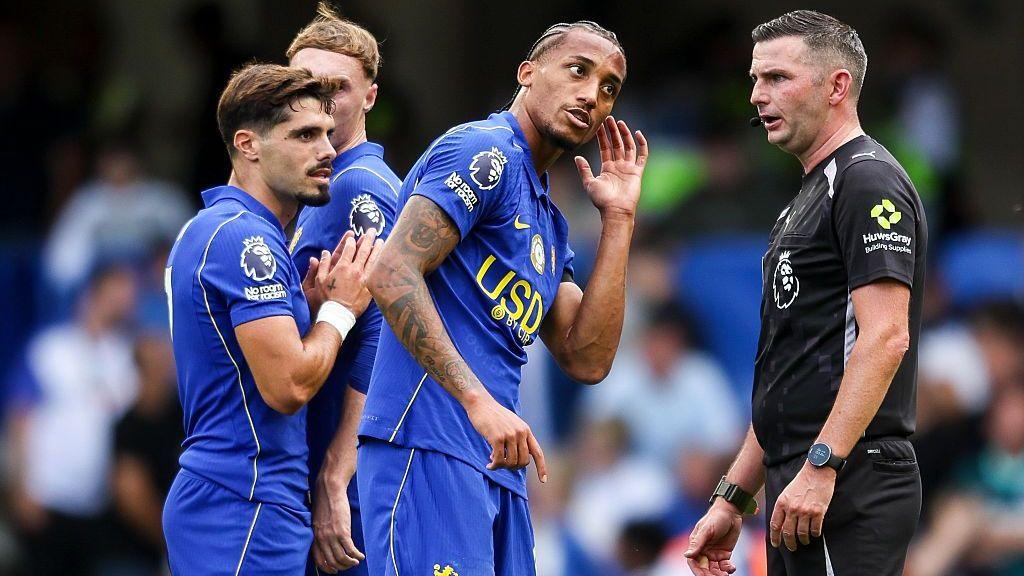
Premier League referee Michael Oliver and his officiating team were forced to work without their usual communication equipment during the second half of Chelsea's dramatic 4-3 victory over Brighton at Stamford Bridge.
When Oliver returned to the pitch after half-time on Sunday, his communications pack was noticeably absent.
For the remaining 45 minutes, the referee, assistant referees, fourth official and VAR team were unable to communicate with each other in the usual way.
It may have been the first time in around 20 years that Premier League officials have been required to oversee a match without their radio headsets.
Microphones and earpieces were first introduced for referees during the 1999-2000 season, although they did not immediately become permanent.
More advanced radio technology was eventually adopted from the 2006-07 campaign.
Technical problems with communication equipment are nothing new.
Matches have previously been delayed while technicians replace batteries or repair equipment worn by officials.
However, the problem at Stamford Bridge was considered impossible to fix during the match, forcing the officials to return to a more traditional method of communication.
BBC Sport understands the issue involved crowd noise not being properly filtered from the system.
Normally, background noise from supporters is suppressed so officials can clearly hear each other.
Instead, Oliver, assistants Stuart Burt and James Mainwaring, and fourth official Tom Bramall struggled to communicate effectively through their headsets.
Removing the communication equipment created another significant challenge involving VAR.
Video assistant referee Andrew Kitchen was unable to speak directly with Oliver, despite communication between the referee and VAR being an important part of the review process.
Normally, the on-field referee can explain what they saw during incidents involving potential penalties, red cards or other major decisions.
The VAR can then consider that explanation while reviewing the available footage.
Kitchen instead relied on a back-up system that allowed messages to be sent directly to Oliver's watch.
He was also still able to communicate with fourth official Bramall by radio.
The unusual situation meant VAR checks had to be handled differently.
Kitchen was required to assess incidents primarily from the available video footage rather than combining that evidence with Oliver's description of what had happened on the pitch.
Despite the technical difficulties, the officials successfully completed the match as Chelsea eventually emerged with a thrilling 4-3 victory.
Modern referees are required to carry an increasing amount of technology and equipment, ranging from communication devices and vanishing spray to RefCam equipment.
For Oliver and his colleagues, however, the second half at Stamford Bridge provided an unexpected return to the traditional style of refereeing many officials would have experienced when beginning their careers in grassroots football.