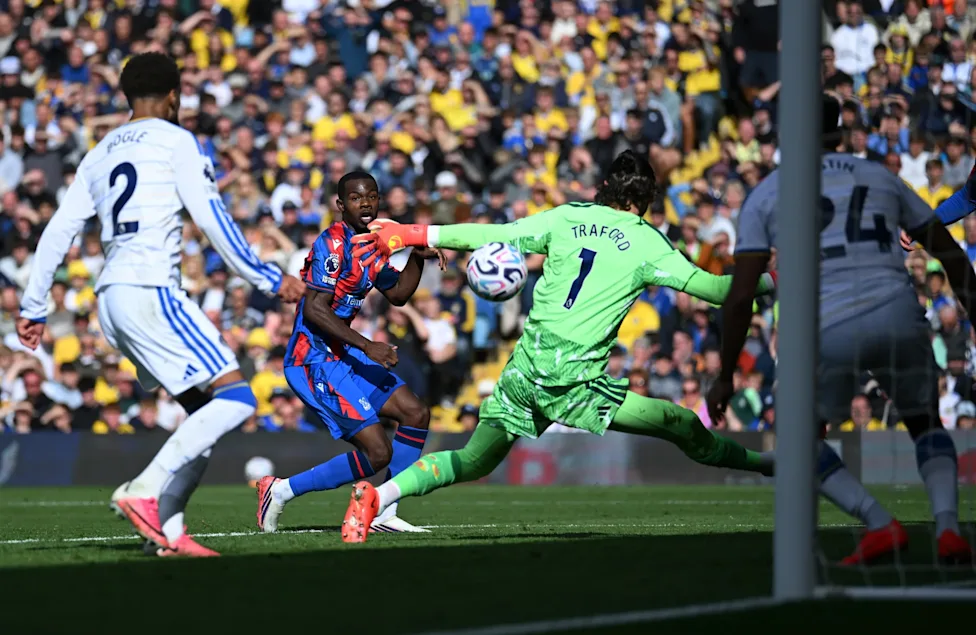
Leeds United and Crystal Palace played out a goalless draw at Elland Road in what proved to be a closely contested Premier League fixture. The final scoreline of 0-0 belied a match that contained genuine moments of attacking intent from both sides, with the goalkeepers ultimately proving decisive in ensuring neither team could find a way through. It was the kind of result that, depending on where each club sits in the table and the trajectory of their respective seasons, could feel either like a point earned or two dropped.
The match was evenly balanced in terms of possession across the full ninety minutes, with Leeds edging it at 51% to 49%, though that marginal difference in ball retention did not translate into a meaningful territorial advantage in the final third where it matters most. Both sides covered similar distances — Leeds 114.5 kilometres to Palace's 113.2 — suggesting a game played at a consistent, demanding tempo throughout. Neither team was content to sit deep and absorb, and the physical output from both sets of players was notable.
Tactically, the first half belonged more emphatically to Leeds, who generated an expected goals figure of 0.54 compared to Crystal Palace's 0.18 in the opening period. Leeds had nine shots in the first half alone, with Crystal Palace managing just five. The home side's greater directness and willingness to commit bodies forward in the opening exchanges created the clearer picture in front of goal during those first forty-five minutes, though the visitors' goalkeeper was not seriously troubled on a consistent basis.
The second half told a rather different story. Crystal Palace shifted the balance, generating an xG of 0.88 against Leeds' 0.77 after the interval, and crucially producing two big chances — the clearest opportunities of the entire match — to Leeds' one. Palace's seven shots in the second period compared to Leeds' four illustrated how the visitors grew into the game as it progressed. That Palace could not convert those big chances, and that Leeds' goalkeeper J. Trafford was in outstanding form throughout, is ultimately the reason the match ended level.
Leeds United will take some encouragement from their first-half display, which was the more proactive and purposeful of the two forty-five-minute periods they produced. The home side's nine shots before the break — compared to just four after it — suggests a team that started with clear intentions and a defined attacking structure, pressing high and looking to exploit Palace's defensive shape in the early stages. An xG of 0.54 in the first half is a reasonable return, and while it did not yield a goal, it reflected a team that was creating the right kinds of positions rather than simply shooting from distance.
Leds covered 55.9 kilometres in the first half and 58.5 in the second, meaning their physical output actually increased after the break, which is a positive indicator of fitness and conditioning. Their sprint count of 125 across the full match — compared to Palace's 108 — underlined the intensity with which Daniel Farke's side approached the fixture. That willingness to press and run channels repeatedly throughout ninety minutes is a hallmark of a well-drilled team, and the numbers back up the visual impression that Leeds worked harder in terms of high-intensity efforts.
The concern for Leeds, however, is the inability to convert the opportunities that were fashioned. One big chance across the entire match is a modest return for a side that registered thirteen shots in total. The xG of 1.31 is encouraging and suggests the quality of positions reached was reasonable, but the final execution was lacking. For a side with ambitions in the Premier League, converting those moments into goals is the difference between a point and three, and it is an area that will require attention as the season progresses.
Defensively, Leeds were tested more severely in the second half, as Crystal Palace's xG of 0.88 after the break demonstrated. The back line held firm, but it did so with significant assistance from J. Trafford in goal, who made five saves across the ninety minutes — three in the first half and two in the second. The defensive structure was not impenetrable, and Palace found ways to work the ball into dangerous areas, particularly after the interval. Leeds' four corner kicks in the first half, compared to none in the second, also reflects how their attacking momentum waned as the match wore on.
Crystal Palace will leave Elland Road with a point and a sense that, particularly in the second half, they were the side more likely to win the match. Their xG of 0.88 after the break, combined with two big chances — the most of either side across the full ninety minutes — tells the story of a team that found its rhythm and began to impose itself on the game as the match developed. The ability to shift the momentum after a relatively subdued first half is a credit to the management and the players' capacity to adapt.
In the opening period, Palace were clearly second best in terms of attacking output. Their xG of just 0.18 in the first half and five shots compared to Leeds' nine reflected a side that was perhaps content to be cautious early on, absorbing Leeds' energy and looking to exploit space on the counter. That approach carried risk — Leeds' greater possession and shot volume in the first half could have produced a goal — but Palace's goalkeeper was equal to the task, making one save in the first period and keeping the sheet clean heading into the break.
The second half saw Palace take the initiative with more purpose and directness. Their seven shots after the interval, combined with three corner kicks compared to none for Leeds, illustrated a team that had taken control of the game's rhythm. The two big chances they created were the most significant attacking moments of the entire match, and on another day — or against a goalkeeper in less commanding form — at least one of them would have found the net. The failure to take those opportunities is the chief frustration for the Palace camp.
Palace's distance covered of 113.2 kilometres and 108 sprints across the ninety minutes suggest a team that worked diligently without quite matching Leeds' intensity in terms of high-speed running. The possession split was perfectly level at 50-50 in the second half, suggesting a genuine contest for control rather than one side dictating terms. Palace's defensive solidity — conceding just two saves to their goalkeeper in the second half — was also commendable, particularly given Leeds' home advantage and the pressure that comes with that context. Overall, a point on the road in the Premier League is rarely unwelcome, even if the second-half performance suggested more was possible.
The match began with Leeds United setting the tempo at Elland Road, pressing with purpose and looking to establish control in the opening exchanges. The home side's first-half dominance in terms of shots — nine to Crystal Palace's five — reflected an organised and proactive approach from the off. Leeds were moving the ball quickly and looking to stretch Palace's defensive shape, though the visitors' backline and goalkeeper managed to absorb the early pressure without being seriously breached. The opening quarter of an hour was played at a high tempo, with both sides covering significant ground and neither willing to concede territory cheaply.
As the first half progressed, Leeds continued to carry the greater threat, building an xG of 0.54 against Palace's 0.18. Crystal Palace's goalkeeper was called into action once before the break, while his counterpart J. Trafford made three saves in the first forty-five minutes — a statistic that underlines the fact that, despite Leeds' greater volume of attempts, Palace were still capable of producing dangerous moments. The half ended goalless, which, given the xG figures, was a fair if slightly frustrating reflection of the attacking output from both sides. Leeds had done enough to deserve a lead but had not been clinical enough to secure one.
The second half saw a marked shift in the balance of play. Crystal Palace emerged with greater intent and began to find space behind Leeds' defensive line more regularly. Palace's xG of 0.88 after the break — compared to Leeds' 0.77 — reflected this change in dynamic, and the two big chances they created were the most threatening moments of the entire match. Both were ultimately dealt with, either by the goalkeeper or by the Leeds defence, but they served as a reminder that Palace possessed the quality to hurt the home side when given the right kind of opportunity.
Leeds' attacking output dropped to just four shots in the second half, a significant reduction from their first-half total of nine. Their one big chance in the second period was not converted, and the home side's inability to reproduce the attacking momentum of the opening forty-five minutes ultimately meant the match drifted towards a goalless conclusion. The final whistle confirmed a 0-0 scoreline that, while reflecting the defensive quality on display from both sides, also highlighted the failure of either team to take the clearest opportunities that presented themselves. It was a match decided not by goals but by saves, blocks and a collective inability to apply the finishing touch.
James Trafford was, by some distance, the standout individual performer in this match. The Leeds United goalkeeper earned a rating of 8.2 — the highest of any player on the pitch — and the statistics that underpin that assessment are compelling. Five saves across the ninety minutes, three of which came in the first half, represent a significant contribution to Leeds' clean sheet. In a match where Crystal Palace created two big chances — the clearest goalscoring opportunities of the entire game — Trafford's ability to make the decisive intervention when required was the defining factor in preventing the home side from losing the match.
Trafford's 47 touches across the ninety minutes reflect an engaged and active goalkeeper, one who was not simply a spectator waiting for the occasional shot but a participant in the game's rhythm. His 24 accurate passes from 36 attempted — a completion rate of approximately 67% — suggests a goalkeeper who is comfortable with the ball at his feet and willing to contribute to build-up play, even if not every distribution found its target. In the modern game, a goalkeeper's ability to act as an additional outfield player in possession is increasingly valued, and Trafford's numbers indicate a player who takes that responsibility seriously.
The three saves Trafford produced in the first half were important in keeping the scoreline level at a point when Leeds were the dominant side but Crystal Palace were still capable of creating danger on the counter. Had Palace converted any of those first-half opportunities, the entire complexion of the match would have changed, and Leeds' attacking momentum in the opening period would have counted for nothing. Trafford's interventions ensured that Leeds' first-half dominance was preserved as a platform rather than undermined by a sucker-punch goal against the run of play.
In the second half, with Crystal Palace growing into the game and generating their two big chances, Trafford's composure and positioning were again crucial. A goalkeeper who concedes in those moments — particularly when the opposition has taken control of the game's rhythm — can be the difference between a point and nothing for his side. Trafford did not concede, and the clean sheet Leeds secured owes more to his individual performance than to any collective defensive excellence. For a young goalkeeper operating at Premier League level, this was a performance that demonstrated both technical quality and the mental fortitude required to perform under pressure at the highest level.
A goalless draw in the Premier League is a result that carries different weight depending on the context each club brings to the fixture. For Leeds United, a side that has earned promotion back to the top flight and is working to establish themselves as a credible Premier League outfit, a home draw against Crystal Palace represents a missed opportunity to claim three points in front of their own supporters. The xG of 1.31 suggests the quality of chances created was sufficient to win the match on another day, and the fact that they did not convert will be a source of frustration for those analysing the data.
For Crystal Palace, the point on the road has a different texture. Away results in the Premier League are always difficult to accumulate, and a clean sheet at Elland Road — a ground with a passionate and vociferous home support — is not nothing. Crystal Palace's second-half performance, in which they generated more xG than Leeds and created the two biggest chances of the match, suggests a team capable of competing at this level and finding ways to impose themselves even when away from home. The failure to convert those chances is the obvious caveat, but the underlying performance data is not without encouragement.
The possession split across the full match — 51% to 49% in Leeds' favour — reflects how evenly matched these two sides are at this level. Neither team was able to establish the kind of dominance that creates clear daylight in the statistics, and the distance covered and sprint counts from both sides suggest a match played at the kind of intensity that the Premier League demands. Both clubs will have noted what the numbers reveal about their respective strengths and weaknesses, and both managers will have plenty of material to work with ahead of their next fixtures.
In the broader context of the Premier League table, a single point from this fixture does little to dramatically alter either club's position, but the cumulative effect of these kinds of results — draws at home for Leeds, draws away for Palace — shapes the narrative of a season over time. Teams that consistently fail to convert draws into wins at home, or that leave points behind in games where the underlying numbers suggest they should have won, often find themselves looking back at such moments as pivotal when the final table is settled. Both clubs will be aware of that reality, and the performance data from this fixture provides a clear roadmap of where improvements are needed.
Leeds United's primary takeaway from this match must be the need for greater clinical efficiency in front of goal. Thirteen shots, an xG of 1.31, and one big chance produced zero goals — a conversion rate that, if it persists over the course of a season, will cost the club dearly in terms of points accumulated. The first-half performance in particular showed the tactical intelligence and physical commitment that Daniel Farke's side are capable of producing, but football ultimately rewards those who score, and Leeds did not do that. The attacking players will need to find a sharper edge in the coming weeks if the promise of the underlying numbers is to be translated into results.
For Crystal Palace, the forward-looking message is more nuanced. The second-half performance demonstrated an ability to grow into matches and generate genuine quality in the final third, as evidenced by the two big chances and the xG of 0.88 after the break. However, big chances that are not taken are ultimately wasted, and the inability to convert the clearest opportunities of the match is a recurring theme that Palace's attacking players will need to address. A team that creates big chances at this rate but does not score will find points harder to come by than the underlying performance merits.
Both clubs now turn their attention to upcoming fixtures that will further define the shape of their respective seasons. Leeds will want to ensure that Elland Road becomes a fortress — a place where home advantage translates into points rather than draws — and the performances they produce at home will be scrutinised closely as the campaign develops. The support base at Elland Road is one of the most demanding in English football, and results like this, where the team performs reasonably well but fails to win, will test patience over time if they become a pattern.
Crystal Palace, meanwhile, will look to build on the momentum of their second-half display and find ways to carry that level of attacking intent into matches from the first whistle rather than the second. The tactical shift between the two halves at Elland Road was notable and suggests a degree of adaptability, but a team that consistently needs half a match to find its best form will inevitably leave points behind. J. Trafford's performance will be the lasting memory of this particular fixture, and rightly so — but the broader narratives for both clubs are ones of potential not yet fully realised, and of opportunities, both statistical and actual, that went begging on a day when neither side could find the decisive moment.