The Women's Super League's growing global appeal has transformed it into one of the strongest competitions in women's football, but the influx of international talent is raising concerns over opportunities for homegrown players.
London City Lionesses provided an early indication of the changing landscape when they beat Manchester United on the opening night of the 2025-26 season with a starting XI containing no English players — the first time a WSL club had done so on the opening day of a campaign.
Two days later, Tottenham started just one British player, Scotland striker Kirsty Hanson, in their victory over West Ham.
The trend highlights the WSL's increasing ability to recruit elite players from around the world. However, questions are growing over whether that success is limiting opportunities for English, Scottish, Welsh and Northern Irish players.
The transformation of the league has been dramatic.
Ten years ago, when Manchester City last won the WSL title, they did so with an entirely British starting XI.
Since then, the WSL has become fully professional, England's success during the 2020s has significantly expanded the audience for women's football, and increased revenues have allowed clubs to recruit internationally.
Transfer spending has also risen sharply.
WSL clubs have increasingly targeted players from countries including Germany and Sweden, while two-time Ballon d'Or winner Alexia Putellas left Barcelona for ambitious London City this summer.
Growing numbers of Japanese and Australian players further demonstrate the league's international appeal.
Birmingham City manager Amy Merricks believes that growth brings both benefits and challenges.
"Our league has grown significantly and attracted world class athletes from all over the world," Merricks said. "Unfortunately that blocks some of the pathways for the youngsters coming through.
"We need [this] talent in our league because our league is growing, but at the same time we have got to try and address this issue."
The numbers illustrate the shift.
Among players starting at least 11 matches — half of a WSL season — the proportion of homegrown players from England, Scotland, Wales and Northern Ireland has steadily declined over the past three seasons to below one-third.
The opening three weeks of 2026-27 have produced an increase, although that can partly be explained by the league expanding from 12 to 14 clubs and the higher proportion of homegrown players at promoted sides Birmingham City, Crystal Palace and Charlton Athletic.
The same downward trend has not been replicated across several other leading European leagues.
During 2025-26, 61% of players who started at least half of France's Premiere Ligue matches were French. In Germany's Frauen Bundesliga, 63% were German, while 69% of qualifying Liga F players were Spanish.
For WSL managers, however, developing domestic talent must be balanced against the immediate pressure to win.
"The club has a responsibility to raise young players, give our own talents possibilities to be in the squad and compete every week," Manchester City boss Andree Jeglertz said.
"But when it comes to team selection, I always need to pick the team that gives us the best chance of winning the game. If that contains eight young and promising English players or zero, I don't care. I just want to win the game."
The debate comes at an important moment for the England national team.
The Lionesses are two-time European champions, but the core of Sarina Wiegman's squad has remained relatively stable across the past three major tournaments.
Seven players who started against Spain in June also started the Euro 2022 final against Germany, while another two starters from the Spain match were substitutes in that 2022 final.
England were beaten 4-0 by Spain in Majorca, costing them automatic qualification for the 2027 Women's World Cup in Brazil. They must instead negotiate two rounds of play-offs, beginning against Greece next month.
Concerns also extend to England's younger age groups.
At the ongoing Women's Under-20 World Cup in Poland, Lydia Bedford's side were eliminated 3-0 by Nigeria in the last 16. England were without several players, including US-based Erica Meg Parkinson and Laila Harbert, who were not released by their clubs.
England also failed to qualify for the tournament in both 2022 and 2024, as did the other home nations.
That contrasts sharply with 2018, when a team featuring Alessia Russo, Lauren Hemp and Georgia Stanway finished third at the Under-20 World Cup before those players became important figures in England's senior success.
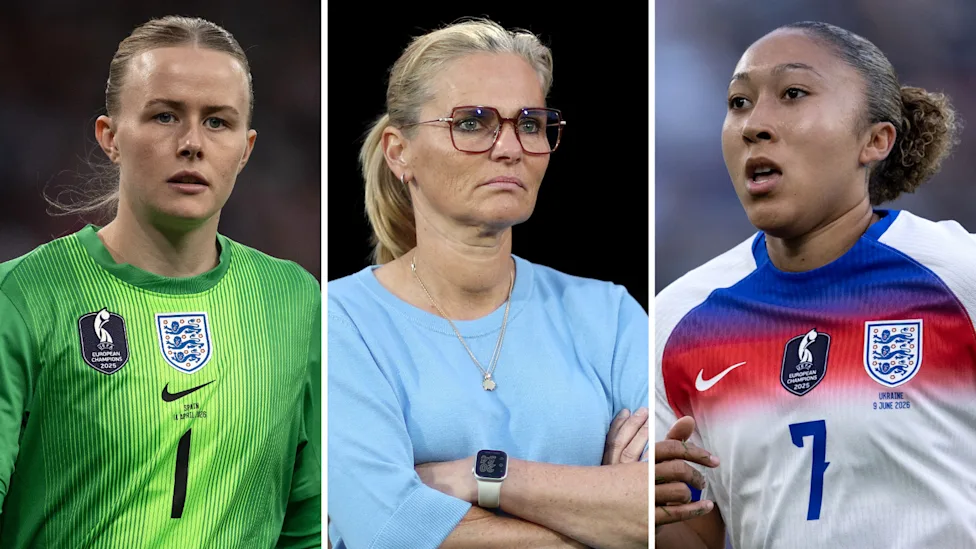
Wiegman has given 21 players their senior debuts since taking charge in September 2021, but Lauren James, Hannah Hampton and Lucia Kendall are the only three to have established themselves as regular starters.
FA regulations currently require WSL clubs to name at least eight homegrown players in their squad lists.
WSL 2 operates with a higher quota that varies according to squad size, but some figures within the game believe stronger measures are needed.
Former England striker Ellen White has called for the existing WSL requirement to be reconsidered.
"We should be updating that quota of eight players, tweaking it to best help and complement our international structure, our homegrown talent," White said.
The Guardian journalist Tom Garry has suggested going further by requiring clubs to field a minimum number of homegrown players.
"I would love to see them go much further - something mandated, a minimum on the pitch at any one time," Garry said. "London City's line-up was alarming.
"It's great for the product over here, but will we see pain in 15 years' time if England are struggling to go deep in major tournaments because we're not developing players?"
Changes are already being planned.
Last month, the FA approved proposals allowing some WSL academy teams to compete in the National League from the 2027-28 season.
The governing body says the reform is designed to strengthen the women's football pyramid, improve standards and create a clearer development pathway for young players by providing more competitive minutes.
Chelsea have confirmed plans to enter an academy team in the third tier, while Manchester City women's managing director Charlotte O'Neill has previously expressed interest in doing the same.
The challenge for English women's football is now balancing two objectives: maintaining the WSL's status as an increasingly international competition while ensuring the next generation of homegrown players receives enough opportunities to develop at the highest level.