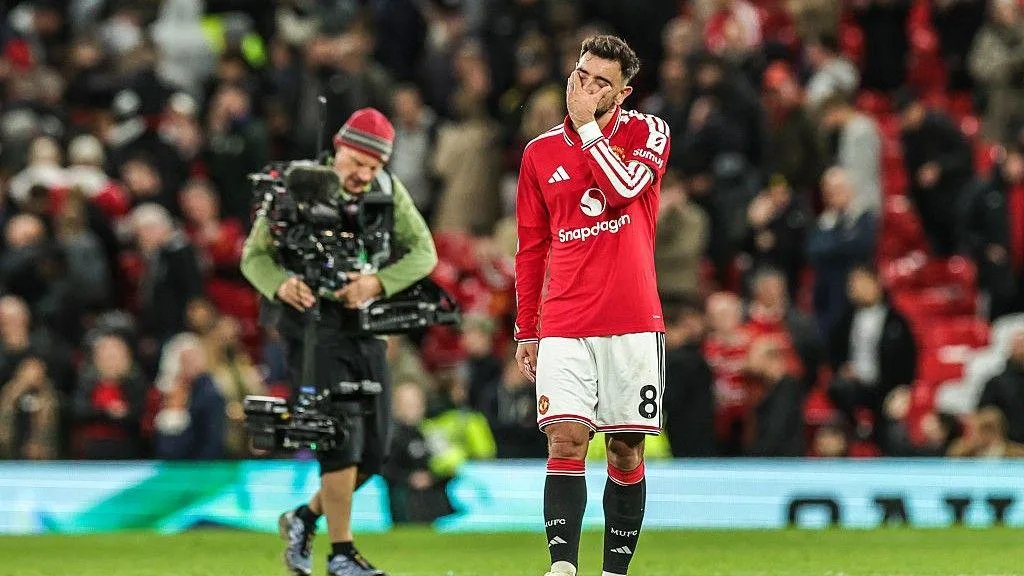
Bruno Fernandes was Manchester United's standout performer last season, but just seven weeks after being crowned PFA Player of the Year, the Portuguese midfielder finds himself at the centre of questions surrounding the club's worst league start in 40 years.
The Manchester United captain enjoyed an exceptional 2025-26 campaign, winning the PFA, Premier League and Football Writers' Player of the Year awards after inspiring his side to an unexpected third-place finish.
Fernandes registered nine goals and 21 assists, breaking the Premier League's single-season assist record previously shared by Thierry Henry and Kevin de Bruyne.
His influence was particularly significant during United's final 11 league matches, when he directly contributed to 12 of their 21 goals.
During the seven-game unbeaten run that secured United's return to the Champions League after a two-year absence, Fernandes was involved in nine of the team's 12 goals.
His performances drew comparisons with Eric Cantona's decisive contributions during Manchester United's 1995-96 title-winning campaign.
However, the remarkable form that defined Fernandes' previous season has yet to materialise in the current campaign.
Despite playing every minute of Manchester United's opening six Premier League matches, Fernandes has managed three goals and one assist.
All four contributions came against Ipswich Town on 30 August, which remains United's only league victory this season.
Interestingly, those numbers represent a stronger statistical start than last season, when Fernandes scored twice and registered no assists in his opening six appearances.
However, the underlying figures suggest a significant decline in his attacking influence.
Fernandes is averaging 3.3 shots per match, his second-highest figure since joining United. Yet only 0.8 of those efforts are hitting the target, matching his second-lowest rate at the club.
His chance creation has also fallen sharply, from 4.0 opportunities per game last season to just 2.5 this term.
Perhaps most concerning is his decline in creating clear goalscoring opportunities.
After averaging one big chance created per match last season, Fernandes has produced only one across six league appearances this campaign.
That opportunity came when his lofted pass released Bryan Mbeumo behind the Ipswich defence.
United's attacking difficulties have contributed to a disappointing return of six points from six matches, their worst start to a league season since the 1986-87 campaign, when Ron Atkinson was eventually replaced by Sir Alex Ferguson.
The question remains whether Fernandes' declining influence is contributing to United's struggles or whether the team's wider problems are limiting his effectiveness.
There have also been questions about the 31-year-old's physical condition.
Fernandes, renowned for his durability and availability, missed Portugal's recent Nations League match against Norway after national team manager Jorge Jesus revealed he had been playing through pain.
However, the midfielder returned for Portugal's final two internationals and previously completed 90 minutes in United's 4-0 Champions League victory over Azerbaijani champions Sabah FK.
Manchester United manager Michael Carrick has played down concerns about his captain's fitness ahead of Tuesday's Champions League clash with Atletico Madrid.
Carrick acknowledged that Fernandes had been managing a physical issue but insisted it was not preventing him from performing.
The United manager said the midfielder was close to full fitness, had trained well and was eager to face Atletico.
Nevertheless, even minor fitness concerns could be significant for a player whose game relies heavily on movement, creativity and quick decision-making.
Beyond Fernandes' individual performances, changes to Manchester United's squad have significantly affected the attacking structure that helped him thrive last season.
During his most productive spell, Fernandes benefited from Benjamin Sesko operating as the central striker and Casemiro providing defensive stability in midfield.
Of Sesko's nine Premier League goals in 2026, four were assisted by Fernandes.
The Portuguese playmaker also created four of Casemiro's final five goals for United from February onwards.
Their understanding allowed Fernandes to operate with greater freedom in advanced positions.
Casemiro's departure to Inter Miami during the summer removed an experienced defensive presence whose positioning and tactical awareness helped protect United during attacking transitions.
Although the Brazilian's exit cannot fully explain the team's current problems, his ability to cover space and anticipate danger allowed Fernandes to take greater creative risks.
Sesko's continued absence has arguably been even more damaging.
The Slovenian striker is sidelined with a shin injury, with no confirmed return date.
United opted against strengthening their attacking options during the summer transfer window, instead prioritising midfield reinforcements.
Carrick initially planned to deploy Bryan Mbeumo as a central striker, but that approach was abandoned after Amad Diallo suffered an ankle injury shortly before the season opener against Hull.
Matheus Cunha subsequently took over the role, although his tendency to drop into deeper positions has created problems.
Cunha frequently moves into areas traditionally occupied by Fernandes, reducing the captain's space and disrupting United's attacking combinations.
The lack of a consistent focal point in attack has made it increasingly difficult for Fernandes to replicate the creativity and influence he demonstrated last season.
Fernandes' frustration was evident during Manchester United's recent encounter with Tottenham, when he took 23 minutes to complete his first pass.
For a player accustomed to controlling matches through his passing and movement, the statistic highlighted how disconnected he has become from United's attacking play.
Carrick has insisted that no player is guaranteed a starting position, although his comments suggest dropping Fernandes is not currently under serious consideration.
The United manager continues to back his captain, expressing confidence that his performances will improve.
"He's a top player, Bruno," Carrick said.
"Sometimes things don't quite go for you. Sometimes you have a spell of that."
Carrick also emphasised Fernandes' exceptional contribution to Manchester United and his belief that the midfielder will rediscover his best form.
With Atletico Madrid awaiting in the Champions League, United face another important test of their attacking organisation and confidence.
Manchester United's disappointing start cannot be attributed to Fernandes alone.
His reduced creative output is concerning, but injuries, tactical adjustments and the departures of important teammates have all contributed to the team's struggles.
Without Sesko stretching opposition defences and Casemiro providing defensive security, Fernandes has been forced to operate in a less balanced system.
His individual performances must improve, particularly his passing accuracy, decision-making and ability to create clear chances.
However, Carrick must also find a tactical solution that restores the freedom Fernandes enjoyed during his record-breaking campaign.
Fernandes remains Manchester United's most influential creative player, but his return to form may depend as much on fixing the team's structure as it does on improving his individual performances.
For United to recover from their worst league start in four decades, both must happen quickly.