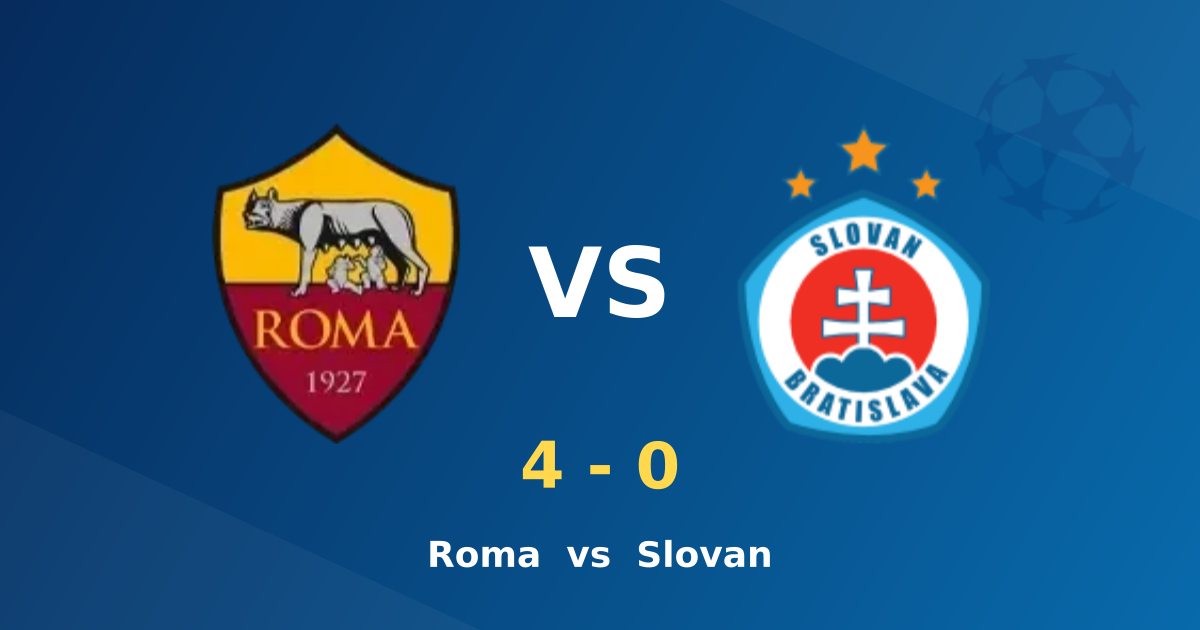
AS Roma produced one of the most commanding performances of the UEFA Champions League 26/27 group stage so far, defeating ŠK Slovan Bratislava 4-0 at home in Round 3 on Tuesday, 20 October 2026. The result was emphatic and, perhaps more tellingly, it was never in serious doubt. Roma controlled virtually every dimension of the contest from the first whistle, and by the time the final scoreline was confirmed, the margin of victory felt entirely proportionate to the quality of football the Italian side had produced over ninety minutes.
The statistical picture reinforces what the scoreline suggests. Roma finished the match with 73 per cent possession, 26 total shots to Slovan's one, and an expected goals figure of 3.14 compared to a near-negligible 0.02 for the visitors. Those numbers do not emerge from a game of two halves or a contest where momentum shifted — they reflect a sustained, systematic dismantling of an opponent who had no answer to Roma's organisation, movement, or quality in the final third. Slovan's goalkeeper was forced into six saves across the ninety minutes; Roma's goalkeeper was not called upon once.
The goals arrived through four different scorers, which speaks to the collective nature of Roma's attacking threat rather than dependence on a single individual. Mario Hermoso opened the scoring in the 21st minute, Nahuel Molina doubled the lead in the 39th, Nicola Pisilli added a third just after the hour, and Donyell Malen converted a penalty in the 58th minute to complete the rout. The spread of goalscorers — a central defender, a full-back, a midfielder, and a forward — underlines how thoroughly Roma dominated positionally and how freely their players were able to arrive in dangerous areas.
For Slovan Bratislava, this was a chastening evening that exposed the gap in quality between a well-organised Serie A club operating with European ambition and a side still finding its footing at this level. With just one shot across the entire match and a combined expected goals figure of 0.02, Slovan were not simply beaten — they were largely unable to mount any meaningful challenge. The occasion may serve as a useful reference point for what is required to compete in the UEFA Champions League at this stage of the competition's evolution.
Roma's performance was built on an exceptionally high level of possession discipline. Their 667 passes across the ninety minutes — 338 in the first half alone — reflect a team that was comfortable dictating the tempo and forcing Slovan to chase the ball for extended periods. The 73 per cent possession figure was not merely the product of Slovan sitting deep; it was the result of Roma's midfield and defensive lines pressing up in coordination, compressing the available space and denying the visitors any opportunity to build through the thirds with any confidence.
Tactically, Roma appeared to operate with a shape that allowed their full-backs to push forward aggressively. Nahuel Molina's goal in the 39th minute was a direct consequence of this approach — a full-back arriving late into the penalty area to convert, which is precisely the kind of movement that requires both the confidence of the player making the run and the trust of a system that allows it. Roma's eight corners across the match — compared to Slovan's one — also demonstrate how frequently they were able to work the ball into wide and advanced positions, creating the kind of sustained pressure that wears down a defensive block.
In attack, Roma generated five big chances across the ninety minutes. That they converted four goals from an xG of 3.14 suggests they were clinical without being extraordinary — they took their opportunities when they arrived, and their movement in the final third consistently created the kind of openings that good sides are expected to take. The penalty, converted by Malen in the 58th minute, added to a tally that had already been secured through open play, which is a sign of a side with multiple mechanisms for finding the net rather than relying on set-pieces or moments of individual brilliance.
Defensively, Roma were impeccable. Their goalkeeper recorded zero saves across the entire match, which is as complete a defensive display as is possible in a competitive European fixture. Slovan managed just one shot in total — that came in the first half — and Roma's backline was sufficiently organised and compact that the visitors never found a way through or around them. Mario Hermoso, who opened the scoring, was also central to Roma's defensive structure, and his ability to contribute at both ends of the pitch illustrates the kind of well-rounded, modern central defender Roma have at their disposal. The clean sheet, combined with the attacking output, makes this one of Roma's more complete European performances in recent memory.
ŠK Slovan Bratislava arrived in Rome as the clear underdogs, and the match unfolded in a way that confirmed that billing comprehensively. From the opening exchanges, Slovan found themselves pinned back by Roma's pressing and positional superiority, and they were rarely able to establish any meaningful foothold in the contest. Their 27 per cent possession figure tells a familiar story for a side facing a dominant home team in the Champions League, but the single shot across the entire ninety minutes suggests something beyond mere tactical caution — it points to an inability to even construct the conditions for a chance at goal.
Slovan's goalkeeper deserves recognition for his efforts across the evening. Six saves over the course of the match, four of which came in the second half as Roma pushed for additional goals, represent a committed individual display in deeply difficult circumstances. Without those interventions, the scoreline could have been considerably more severe, and the xG figure of 3.14 for Roma suggests that the margin of victory, while already significant, was kept within bounds by some solid goalkeeping. That said, a goalkeeper can only do so much when the team in front of him is conceding possession in dangerous areas repeatedly.
Slovan's one shot — recorded in the first half — represents the entirety of their attacking threat across the ninety minutes. In the second half, they managed zero shots, zero corners, and an expected goals figure of 0.00. Those numbers describe a team that had effectively ceased to function as an attacking unit, retreating into damage limitation mode after going two goals behind at the interval. Whether that was a deliberate tactical decision or simply the consequence of Roma's dominance is difficult to determine from the statistics alone, but the outcome was the same — Slovan offered nothing going forward after the break.
It would be reductive to judge Slovan Bratislava solely on this result. Competing in the UEFA Champions League at this level requires a standard of quality that many clubs spend years developing, and the gulf between a top-half Serie A side and a Slovak league champion is significant. Slovan's ten fouls across the match — equal to Roma's — suggest they were at least willing to contest physically and disrupt where they could, but that approach was never going to be sufficient to change the outcome of a match in which they were so thoroughly outclassed in every technical and tactical dimension. The lessons from this evening are clear, and how Slovan respond in their remaining fixtures will define what this campaign ultimately means for the club.
The opening goal arrived in the 21st minute through Mario Hermoso, and it set the tone for what followed. A central defender getting on the scoresheet before the half-hour mark is rarely a coincidence — it typically reflects either a set-piece delivery of real quality or a team that is so dominant in possession that their defensive players are regularly arriving in attacking positions. In this instance, the goal represented Roma's ability to create danger from multiple angles, and Hermoso's finish gave the home side the lead their early pressure had merited. Slovan had shown little in the opening exchanges to suggest they could respond.
The second goal came in the 39th minute through Nahuel Molina, and it effectively ended the contest as a competitive fixture before the interval. Molina's contribution was the product of Roma's attacking full-back system functioning as intended — a player arriving from deep to convert in the penalty area, exploiting the spaces that Slovan's defensive shape had failed to close. Going into the break two goals down and having managed only one shot across the first forty-five minutes, Slovan faced a near-impossible task in the second half. Roma's xG of 1.09 in the first period, against Slovan's 0.02, confirms that the scoreline at half-time was a fair reflection of the play.
The third goal arrived in the 52nd minute through Nicola Pisilli, and it came quickly enough after the restart to extinguish any residual hope Slovan might have carried into the second half. Pisilli's goal — his only direct attacking contribution in terms of goals and assists on the night, though his overall performance was considerably broader than that single statistic — arrived at a moment when Roma were clearly intent on pressing their advantage rather than managing the game conservatively. The speed with which the third goal followed the half-time whistle spoke to a team with the discipline and focus to continue performing at a high level even when the result was already beyond question.
Donyell Malen's penalty in the 58th minute completed the scoring and rounded off what had become a comprehensive victory. The penalty itself — the manner in which it was earned, who stepped up to take it, and the composure with which Malen dispatched it — added a further dimension to Roma's attacking variety on the night. Four goals from four different scorers across a single Champions League fixture is a statement of collective attacking intent, and the fact that the scoring was spread across the 21st, 39th, 52nd, and 58th minutes suggests Roma were not simply fortunate in a brief spell of pressure but were consistently creating and converting throughout the match. The final whistle confirmed a 4-0 result that the statistics emphatically support.
Nicola Pisilli was awarded the top player rating of 9.1 on the night, and the statistics behind that assessment are compelling. The midfielder played the full ninety minutes and completed 77 of his 79 attempted passes — an accuracy rate of 97.5 per cent — across a match in which Roma circulated the ball 667 times in total. His 96 touches across the ninety minutes place him among the most involved players on the pitch, and in a team that dominated possession so thoroughly, his ability to receive the ball under pressure and distribute it accurately was central to the rhythm Roma maintained throughout.
Pisilli's passing accuracy of 97.5 per cent is not a figure that emerges from a player who is simply recycling the ball sideways and avoiding risk. In a match of this nature, where Roma were consistently moving the ball into advanced areas and creating big chances, the midfield engine room needs to be functioning at a high level of precision and decision-making. Pisilli's numbers suggest he was doing exactly that — finding teammates in tight spaces, switching play when appropriate, and maintaining the tempo that kept Slovan pinned back for long stretches of the game.
His goal in the 52nd minute was the defining individual contribution of his evening in terms of the scoreline, but it would be a mistake to reduce his performance to that single moment. A midfielder with 96 touches and near-perfect passing accuracy across a ninety-minute Champions League fixture is influencing the game in ways that do not always appear in the goals and assists column. He was the connective tissue in Roma's midfield — the player through whom moves were built, through whom the defensive line was bypassed, and through whom the attacking players received the ball in positions to create danger.
The 9.1 rating reflects a performance that was consistent rather than spectacular in isolation — there were no outrageous long-range strikes or moments of individual skill that will be replayed repeatedly. Instead, Pisilli's evening was defined by the accumulation of correct decisions made at pace, in a match where Roma's tactical system demanded precision and composure in equal measure. For a midfielder to finish with those passing numbers, that touch count, a goal, and a 9.1 rating in a 4-0 Champions League victory is a performance that merits genuine recognition. It is the kind of display that coaches and analysts point to when explaining what a modern central midfielder is supposed to look like at the highest level.
This result carries meaningful weight in the context of the UEFA Champions League 26/27. Roma's 4-0 victory in Round 3 not only improves their points tally and goal difference but also sends a clear signal about their quality relative to the broader field. A win of this magnitude, achieved with such statistical dominance — 73 per cent possession, 26 shots, five big chances, an xG of 3.14, and a clean sheet — is the kind of result that shifts perceptions within a competition where early momentum can be decisive in determining how a club's campaign develops over subsequent rounds.
For Slovan Bratislava, the result leaves their Champions League campaign in a precarious position. A 4-0 defeat at this stage of the competition, combined with the statistical evidence of how thoroughly they were outclassed, raises serious questions about their ability to accumulate the points needed to progress. Goal difference is a significant factor in the Champions League format, and a four-goal deficit from a single match can be difficult to recover from when the competition's structure rewards consistency across multiple fixtures. Slovan will need to find a significantly improved level of performance in their remaining matches if they are to have any realistic prospect of advancing.
Roma, by contrast, will approach their upcoming fixtures with the confidence that comes from a performance of this quality. The variety of their goalscorers, the defensive solidity of a clean sheet, and the midfield control demonstrated by players like Pisilli all suggest a squad with the depth and tactical coherence to compete consistently in the Champions League. A goal difference that now includes a four-goal swing in a single round is a useful asset in a competition where margins can be tight across the table, and Roma's xG numbers suggest their attacking threat is genuine rather than inflated by a particularly weak opponent.
The broader Champions League picture in the 26/27 season will be shaped by results like this one — matches where the stronger sides assert themselves clearly and begin to pull away from the field in terms of both points and goal difference. Roma's performance against Slovan is the kind of benchmark result that positions them as a credible contender for the knockout rounds, assuming they can maintain this level of output against more competitive opposition in the rounds ahead. The statistical dominance on display — particularly the 0.02 xG conceded, which borders on the negligible — suggests that Roma's defensive organisation is functioning at a level that will trouble more accomplished attacking sides than Slovan Bratislava.
For AS Roma, the primary takeaway from this fixture is the confirmation that their system is functioning cohesively across all phases of the game. The 4-0 victory was built on defensive solidity — zero shots faced in the second half, zero saves required from their goalkeeper across the ninety minutes — combined with a clinical and varied attacking output that saw four different players score. That combination of defensive security and attacking plurality is the hallmark of a well-drilled side, and Roma will carry genuine confidence into their next Champions League fixture knowing that they can produce this level of performance on a European stage.
The individual contributions that stood out — Pisilli's midfield control, Hermoso's goal from defence, Molina's attacking full-back run, Malen's penalty — all point to a squad with quality distributed across the pitch rather than concentrated in one or two positions. That depth is important in the Champions League, where fixture congestion and the physical demands of competing across multiple competitions can expose squads that rely too heavily on a small number of key performers. Roma's ability to spread the goalscoring responsibility across different positions and player types is a genuine competitive asset as the campaign progresses.
For ŠK Slovan Bratislava, the challenge now is to process a heavy defeat without allowing it to undermine the confidence and organisation that will be needed in their remaining fixtures. A 4-0 loss in the Champions League, particularly one as one-sided as this, can be a difficult result to move past psychologically, but the nature of the competition means there is no time for extended reflection — the next fixture arrives quickly, and the points available are just as valuable regardless of what preceded them. Slovan will need to identify the specific areas where they were most exposed — their inability to retain possession, their failure to create any attacking threat — and work to address those deficiencies in a short window.
Looking further ahead, this result has the potential to shape the narratives around both clubs for the remainder of the 26/27 Champions League campaign. Roma will be watched more closely now, with opponents and analysts alike taking note of the statistical dominance they demonstrated against Slovan. That increased scrutiny will bring its own challenges — future opponents will prepare more carefully, press higher, and attempt to disrupt the possession-based rhythm that Roma displayed so effectively on 20 October 2026. How Roma respond to that elevated level of opposition will ultimately determine whether this result represents the beginning of a sustained Champions League challenge or a high point against a limited opponent. The evidence from this fixture, however, suggests the former is well within their capabilities.

