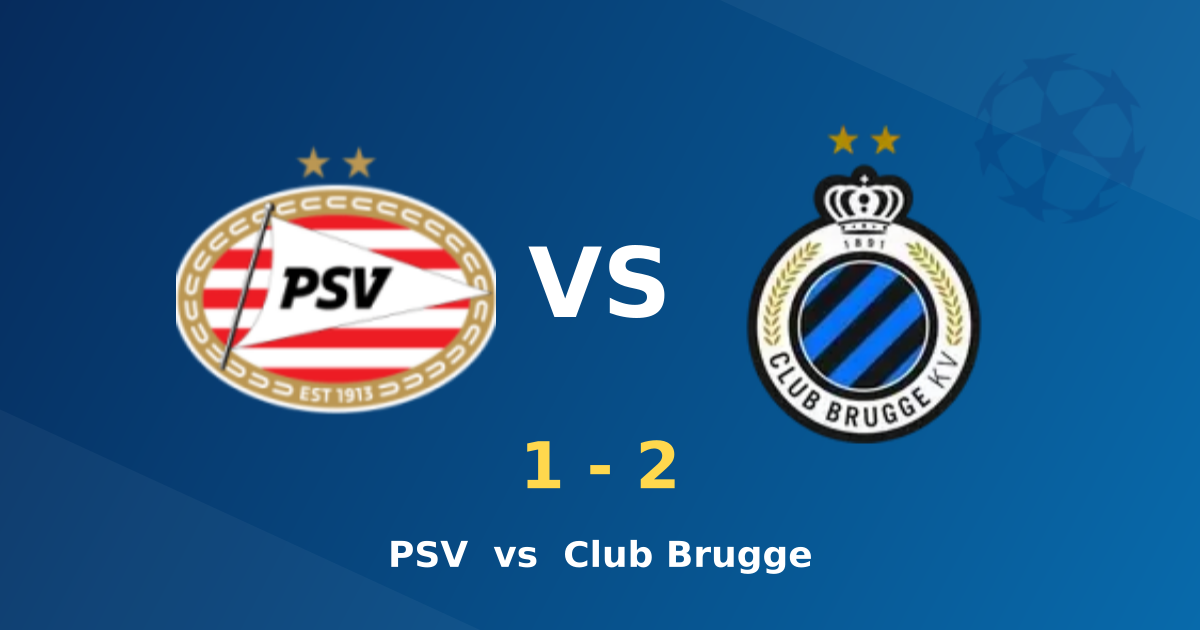
Club Brugge KV produced a composed and disciplined away performance at the Philips Stadion on Wednesday, 4 November 2026, defeating PSV Eindhoven 2-1 in Round 4 of the UEFA Champions League 26/27. It was a result that, on the balance of the full ninety minutes, will feel deeply frustrating for the Dutch side, who generated significantly more volume in attack but were ultimately undone by their inability to convert pressure into goals and by a goalkeeper who was in exceptional form. Brugge came to Eindhoven with a clear plan, executed it with considerable discipline, and left with three points that could prove pivotal to their campaign.
The statistical landscape of the match tells a story of two contrasting halves. In the opening forty-five minutes, the contest was genuinely balanced — PSV held 52% possession to Brugge's 48%, with expected goals almost level at 1.38 for the home side and 1.23 for the visitors. Both teams created big chances, with Brugge actually edging that particular metric three to two in the first half. It was in that opening period that the match's most decisive moment arrived, as Tresoldi put Brugge ahead on 25 minutes, a lead that carried into the interval and shaped the tactical decisions that would follow.
The second half was a markedly different game. PSV, needing to overturn the deficit, pushed forward with considerably more intent and the possession figures shifted dramatically — 74% to 26% in favour of the home side. They mustered 15 shots in the second period alone, against just three from Brugge, and their expected goals figure of 1.28 in that half alone suggests they were creating genuinely dangerous positions. Sano's equaliser on 54 minutes appeared to set up a grandstand finish, but Forbs restored Brugge's advantage on 65 minutes, and from that point the visitors managed the game with intelligence and resilience.
What makes this result particularly noteworthy is the context of PSV's overall statistical superiority across the ninety minutes. They finished with 27 total shots to Brugge's 10, an xG of 2.66 versus 1.69, and eight corners to five. On paper, PSV were the better side by a considerable margin. Yet the scoreboard read 1-2 at full time, and that is the only number that matters in European competition. Brugge's goalkeeper made seven saves across the match — a figure that underlines just how much defensive work the away side had to do and how crucial their shot-stopper was to the final outcome.
PSV Eindhoven entered this fixture at the Philips Stadion with the expectation of controlling proceedings against a Belgian opponent, and for long stretches of the match they did exactly that. Their 62% overall ball possession and 609 total passes across ninety minutes reflect a side that is comfortable dictating the tempo of a game. The problem, as the final score illustrates, is that territory and possession are only valuable when they are converted into goals, and PSV's conversion rate on the night was deeply poor relative to the opportunities they generated.
The first half offered PSV some encouragement despite falling behind. They registered 12 shots and held an xG of 1.38, which indicates they were finding positions of genuine danger. Their two big chances in the first period were not taken, however, and that profligacy proved costly. Brugge's goalkeeper was alert and well-positioned on each occasion, and PSV's forwards were unable to find the decisive touch that might have altered the match's trajectory before the interval. Going into the break a goal down despite creating the better of the chances in certain moments was a position that demanded a strong response.
That response came swiftly in the second half. Sano's equaliser on 54 minutes was the product of PSV's increased urgency and their willingness to commit bodies forward. The home side's second-half xG of 1.28 and 15 shots in the period are figures consistent with a team that pressed hard for a result. They earned eight corners across the match, five of which came in the second half, and their 74% possession in that period represents near-total territorial dominance. Yet for all of that pressure, the single goal from Sano was all they had to show, and Forbs's response just eleven minutes later effectively ended the contest as a genuine contest.
The most damaging statistic for PSV is the goalkeeper saves column. Their goalkeeper was called upon just once across the entire ninety minutes — a figure that speaks to Brugge's conservative, counter-oriented approach — while at the other end, Brugge's goalkeeper made seven saves. PSV created 27 shots and four big chances but managed only one goal. That is a conversion problem that goes beyond individual misfortune; it points to a structural issue in how PSV are finishing their moves in European competition. The eight fouls they conceded also suggest moments of frustration as the match wore on and Brugge's defensive block held firm.
Club Brugge KV arrived at the Philips Stadion as the nominal underdogs and immediately set about organising themselves in a manner that reflected an awareness of that status. Their 38% overall possession share was not accidental — it was a deliberate tactical posture, one designed to allow PSV to have the ball in unthreatening areas while Brugge remained compact, hard to break down, and dangerous on the transition. The fact that they managed 1.69 xG from just 10 total shots across the match is a testament to the quality of the positions they did find when they broke forward.
The first half was Brugge's most active period in terms of attacking intent, and it was also their most productive. With possession more evenly distributed — 48% for the visitors — they were able to play with greater freedom in the attacking third. Their three big chances in the opening forty-five minutes were the highest of any team in either half, and Tresoldi's 25th-minute goal was the reward for that enterprise. The xG of 1.23 in the first half suggests the goal was not a fluke; Brugge were genuinely threatening in that period and their goalkeeper, though tested with five saves in the first half alone, was well protected by a defensive structure that limited PSV to manageable situations.
The second half required a different kind of performance from Brugge, and they delivered it. Reduced to just 26% possession and three total shots, they absorbed an enormous amount of pressure and relied heavily on their goalkeeper and defensive organisation to hold PSV at bay. The 10 fouls they committed in the second half — compared to just two in the first — reflect the physical demands of defending deep against a team with 74% of the ball. These were not reckless fouls; they were the calculated interruptions of a team managing a game under sustained pressure. When Forbs struck on 65 minutes to restore the lead, it was a moment of clinical precision from a side that had been largely penned back.
Forbs's goal was the defining moment of Brugge's second-half performance. Having conceded the equaliser to Sano on 54 minutes, there was a genuine risk that momentum would shift entirely to PSV and that the home side's pressure would eventually tell. Instead, Brugge broke forward with purpose and Forbs delivered the decisive contribution. From that point, the visitors managed the game with composure — their goalkeeper made two further saves in the second half, and the defensive unit held its shape under considerable duress. The five corner kicks Brugge conceded in the second half were all dealt with, and PSV's 15 shots in the period produced nothing further. It was a controlled, professional away performance.
The opening exchanges at the Philips Stadion on 4 November 2026 suggested a competitive and relatively open contest, with both sides finding moments of quality in the early stages. PSV, as expected on home soil, looked to build from deep and use their possession to probe Brugge's defensive structure, while the visitors were content to sit at a medium block and look for opportunities to break. The match's first significant moment arrived on 25 minutes, when N. Tresoldi gave Club Brugge KV the lead. The goal came in a first half where Brugge had actually created the greater number of big chances — three to PSV's two — and the xG figures of 1.23 for the visitors against 1.38 for the home side confirm that both teams were finding dangerous positions. Tresoldi's finish put Brugge in front and immediately shifted the dynamic of the match.
PSV carried the deficit into half-time and emerged for the second period with clear urgency. The shift in their approach was immediate and visible — their possession climbed to 74% in the second half and they began committing more players forward in search of an equaliser. The pressure told on 54 minutes when K. Sano found the net to level the match at 1-1. Sano's goal arrived at a moment when PSV's intensity was at its highest, and it appeared to have unlocked the match entirely. The home side had generated an xG of 1.28 in the second half alone, and with the game level and momentum behind them, a PSV victory looked a plausible outcome.
However, Club Brugge KV responded with considerable composure. Rather than retreating entirely into their defensive shell after conceding the equaliser, they retained enough of an attacking threat to make PSV cautious about committing fully forward. That balance was rewarded on 65 minutes when C. Forbs restored Brugge's lead. The goal came just eleven minutes after Sano's equaliser, at a point when PSV had not yet fully re-established their defensive shape following their own goal. Forbs's contribution was the match's decisive moment — from 1-1 to 2-1 in Brugge's favour, with twenty-five minutes remaining for PSV to find a response.
Those final twenty-five minutes were defined by PSV's inability to find a second goal despite sustained pressure. They continued to generate shots — their total of 15 in the second half is a significant figure — but Brugge's goalkeeper was equal to everything directed at him, finishing with seven saves across the ninety minutes. PSV's four big chances across the match went largely unfulfilled, and their xG of 2.66 stands as a measure of the opportunities they created but could not convert. Brugge's defensive organisation held firm, their fouls were well-timed and effective at breaking up PSV's rhythm, and when the final whistle sounded the scoreline of 1-2 was a fair reflection of a match that PSV dominated in volume but lost in the moments that mattered most.
Y. Sommer's performance in the Club Brugge KV goal on 4 November 2026 was the single most influential individual contribution of the match, and his rating of 9 is entirely justified by the statistics and the context in which he operated. Facing a PSV side that generated 27 total shots and an xG of 2.66, Sommer made seven saves across the ninety minutes — a figure that tells only part of the story. The quality of those saves, the positioning that denied PSV's forwards on multiple occasions, and the composure he showed under sustained second-half pressure all contributed to a performance that was fundamental to Brugge's victory.
Sommer's first-half workload was already considerable. PSV created two big chances in the opening forty-five minutes and registered 12 shots in total, with an xG of 1.38 — a figure that reflects genuine danger rather than speculative efforts from distance. Sommer made five of his seven saves in the first half, a statistic that underlines how active he was during a period when the match was still open and Brugge's defensive shape had not yet fully settled into the deep block that characterised the second half. His ability to deal with those early threats allowed Tresoldi's goal on 25 minutes to stand as the interval lead, which was the foundation upon which the entire result was built.
In the second half, with PSV pushing forward with 74% possession and 15 shots, Sommer made a further two saves. The volume was lower but the stakes were higher — each save in that period came with PSV desperate for an equaliser after Forbs had restored Brugge's lead on 65 minutes. His 73 touches across the match reflect how involved he was in Brugge's build-up play as well as his shot-stopping duties, and his 31 accurate passes from 51 attempted demonstrate that he was functioning as an active participant in Brugge's possession phases rather than simply a last line of defence. For a goalkeeper, that level of passing accuracy under pressure in a Champions League away fixture is notable.
What separates Sommer's performance from a merely solid goalkeeping display is the manner in which he kept PSV's xG of 2.66 from translating into goals. PSV had four big chances across the match — by definition, the highest-probability scoring opportunities — and Sommer's contribution to limiting PSV to a single goal from that volume of opportunity is the clearest measure of his impact. Club Brugge KV's defensive unit deserves credit for their collective organisation, but Sommer was the individual who made the difference on the night. In a match where the margins were fine and the result turned on moments of quality, he was Brugge's most consistent and decisive performer across all ninety minutes.
This result carries meaningful implications for Club Brugge KV's position in the UEFA Champions League 26/27 campaign. A victory away from home against a side of PSV Eindhoven's calibre in the Philips Stadion is not a routine achievement, and the manner of the win — absorbing significant pressure and holding a lead through disciplined defensive work — suggests a Brugge side with the resilience and tactical maturity to compete at this level. Three points from this fixture will have a tangible impact on their standing in the competition, and the quality of the opposition makes the result all the more significant.
For PSV Eindhoven, the defeat is a considerable setback. They dominated the match in virtually every volumetric statistic — possession, shots, passes, corners — and yet leave the Philips Stadion with nothing. In European competition, home defeats of this nature can be damaging not just in terms of points but in terms of confidence and momentum. PSV's inability to convert their 2.66 xG into more than a single goal is a problem that will require attention; four big chances across the match is a generous return, and finishing just one of them is well below what would be expected at this level.
The broader Champions League 26/27 picture is one in which results like this one can shift the balance of power in the standings considerably. The league phase format of the competition means that every point counts across all fixtures, and a team picking up three points away from home in a difficult environment is making a statement about their ambitions for qualification. Brugge's victory demonstrates that they are not merely participating in the competition but actively competing for a strong finishing position, and the manner of their defensive performance in the second half — holding firm against 74% possession and 15 shots — will not have gone unnoticed by other clubs in the competition.
PSV's situation demands a response. A home defeat in Round 4 means they will need to accumulate points in their remaining fixtures to secure their position in the competition. Their statistical output on the night suggests they are creating chances at a level consistent with a competitive Champions League side, but the conversion problem is a real one that cannot be explained away by a single exceptional goalkeeping performance. If PSV continue to generate xG figures above 2.5 without converting them, the gap between their expected and actual points totals will become a defining issue of their 26/27 campaign.
Club Brugge KV will take considerable satisfaction from this result, and rightly so. Winning away from home in the UEFA Champions League 26/27 against a side like PSV Eindhoven — in their own stadium, with 62% of the ball — is a performance that demonstrates genuine European pedigree. The tactical discipline Brugge showed, particularly in the second half when they were reduced to 26% possession and three shots, reflects a coaching staff and a squad that understand how to manage a game under pressure. The seven saves their goalkeeper made were not the product of good fortune; they were the product of a defensive structure that funnelled PSV's attacks into manageable situations while remaining dangerous enough on the break to score twice.
The key takeaway for Brugge as they look ahead is that their counter-attacking model is functioning effectively at the highest level. They created 1.69 xG from just 10 shots — an average of 0.169 xG per shot, which reflects the quality of the positions they found rather than speculative efforts. Forbs and Tresoldi both contributed goals, and the attacking threat they represent on the transition will be a concern for future opponents. If Brugge can maintain the defensive solidity they showed in Eindhoven, they have the tools to make a genuine impact on the competition's later rounds.
For PSV Eindhoven, the immediate priority is to address the conversion issue that cost them on Wednesday evening. Their underlying numbers — 2.66 xG, 27 shots, four big chances — are those of a side that is generating high-quality opportunities consistently. The problem is not the creation; it is the finishing. Whether that is a personnel issue, a structural one, or simply a run of poor individual fortune is a question the coaching staff will need to answer quickly. The Champions League 26/27 does not offer the luxury of time, and further dropped points at home in this competition could prove extremely difficult to recover from.
Looking at the broader narrative implications of this result, Brugge's victory reinforces the idea that the Champions League 26/27 is a competition in which tactical organisation and defensive solidity can overcome statistical dominance. PSV's numbers were superior in almost every category, yet they lost. That is a reminder that European football rewards efficiency and composure above volume, and Club Brugge KV demonstrated both qualities in abundance on 4 November 2026. Both clubs will now turn their attention to their next fixtures knowing that the landscape of Round 4 has been shaped by a result that few would have predicted before kick-off.

