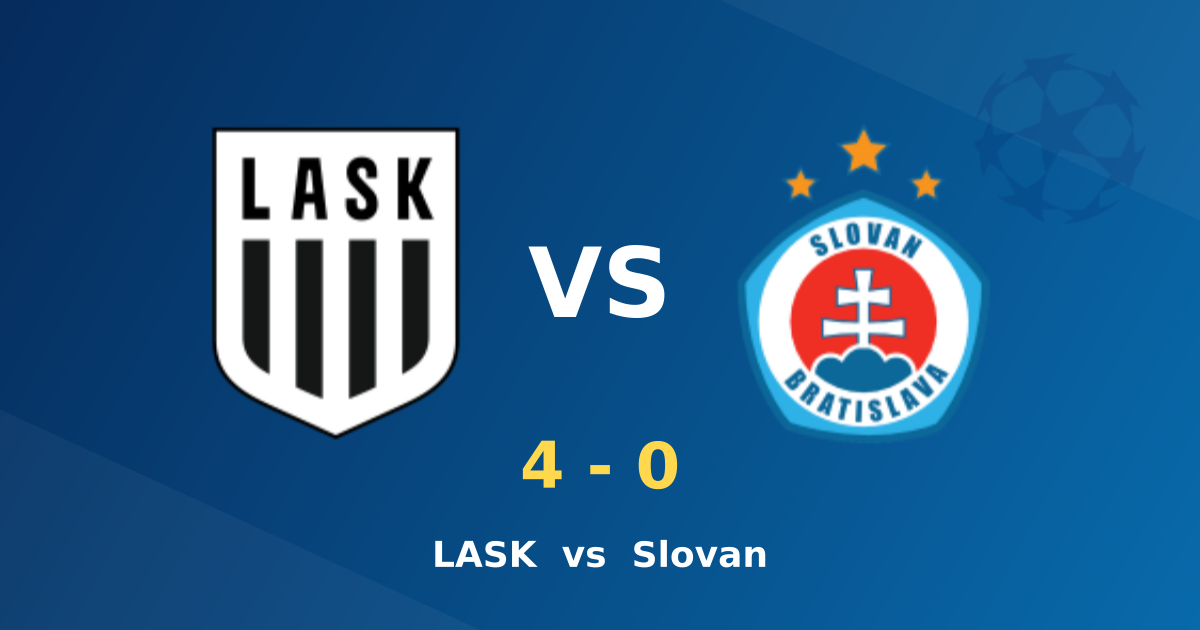
LASK produced one of the most controlled and convincing performances of the UEFA Champions League 26/27 group phase so far, defeating ŠK Slovan Bratislava 4-0 at home in Round 4 on Tuesday, 3 November 2026. The scoreline was emphatic, but the underlying statistics make it clear that the margin of victory was not a distortion of the actual contest — if anything, it was a fair reflection of a match in which the Austrian side were dominant from the first whistle to the last. With an expected goals figure of 4.45 to Slovan's 0.47, this was as one-sided an afternoon as those numbers suggest.
The tactical picture was established early. LASK controlled 60 per cent of possession across the full 90 minutes, a figure that barely shifted between halves — 61 per cent in the first period, 60 per cent in the second — indicating that Slovan were unable to meaningfully alter the dynamic of the match regardless of what adjustments they made. The hosts' pressing was evidently effective, limiting Slovan to just seven total shots across the entire game, compared to LASK's 29. That is a ratio that speaks to a team with a clear and well-executed game plan.
The goals themselves arrived in a concentrated burst around the middle of the match. Kasper Jørgensen opened the scoring in the 19th minute, and by the 48th minute LASK had four goals to their name, with Jørgensen adding a second, Roko Ljubičić getting on the scoresheet, and Seko Adeniran completing the rout. It was a period of football that effectively ended the match as a contest, leaving the final 42 minutes as something of a formality for the home side. Slovan, to their credit, kept the scoreline from extending further, but the damage was already done.
The atmosphere at the ground reflected the home side's comfort throughout. LASK's players covered 120.8 kilometres in total compared to Slovan's 119.5, and the hosts registered 168 sprints to their opponents' 144 — metrics that suggest LASK not only had the ball more but worked harder off it as well. Six big chances created against just two conceded is the kind of differential that defines matches at this level, and LASK took full advantage of the opportunities that fell their way. This was a performance built on structure, intensity, and clinical execution.
LASK's performance on 3 November 2026 was defined by their ability to impose their preferred shape on the match from the outset and sustain it for the full 90 minutes without any meaningful period of defensive crisis. Their 60 per cent possession share was not passive — the distance covered and sprint count both indicate that LASK were active in pressing and transitioning quickly, which repeatedly caught Slovan in vulnerable positions. The hosts' 29 total shots represent an average of roughly one shot every three minutes, a volume that reflects relentless forward intent rather than speculative long-range efforts.
The expected goals figure of 4.45 is particularly telling. It places LASK's performance firmly in the category of matches where the xG not only justifies the scoreline but suggests the result could plausibly have been even more pronounced. Six big chances created means LASK were getting into high-quality positions repeatedly, and the fact that they converted four of those opportunities shows a clinical edge that will concern any future opponents. Their second-half xG alone was 2.93, meaning that even after leading 3-0 at the interval, LASK continued to generate genuine scoring opportunities rather than sitting back and protecting the lead.
In terms of individual contributions, the standout figures were Kasper Jørgensen, Roko Ljubičić, and Seko Adeniran. Jørgensen's brace was the foundation of the victory, with his first goal arriving as early as the 19th minute to set the tone. Ljubičić's goal in the 44th minute — arriving just before the half-time whistle — was a critical moment psychologically, extending the lead to three and ensuring Slovan would need to score four times in the second half just to draw level. Adeniran's goal in the 48th minute, three minutes into the second half, effectively ended any residual hope Slovan might have had of mounting a comeback.
Tactically, LASK's discipline was evident in the foul count as well. They committed just five fouls in the second half and none at all in the first — a remarkable figure that suggests their defensive work was done primarily through positioning and pressing rather than physical intervention. The corner kick count of 8-2 in LASK's favour further illustrates the directional flow of the game. Their goalkeeper was called upon to make five saves across the match, which is a reasonable workload given the scoreline, and suggests that LASK's backline was not entirely untroubled — but the team's overall defensive organisation kept Slovan's xG to just 0.47, a figure that tells its own story about how effectively the hosts neutralised their opponents' attacking threat.
ŠK Slovan Bratislava arrived in Austria for Round 4 of the UEFA Champions League 26/27 and were comprehensively outplayed in a manner that offers little comfort when reviewing the statistics in detail. Their 40 per cent possession share was a reflection of a team that struggled to establish any foothold in midfield, and the seven total shots they managed across 90 minutes — with only two classified as big chances — indicates that their attacking output was severely limited. The xG figure of 0.47 is essentially the baseline noise of a team that had very little meaningful time in dangerous areas.
The first half was particularly difficult for Slovan. They managed just three shots in the opening 45 minutes, with an xG of just 0.13, and conceded three goals in the process. Their two big chances across the full match both came in the second half, which suggests that Slovan may have made some adjustments at the interval to try to get forward more — but by that point they were already three goals behind, and the task was insurmountable. The second-half xG of 0.35 is a marginal improvement but still far below what would be needed to threaten a comeback.
Slovan's foul count is worth noting. They committed six fouls in the first half compared to LASK's zero, which suggests they were frequently caught out of position and forced to make reactive challenges rather than winning the ball through organised pressing. In the second half, they committed three fouls to LASK's five, which represents a more even picture — but by then the match was already decided. The corner kick statistic of 2-8 in LASK's favour is another indicator of how consistently Slovan were pushed back into defensive positions throughout the game.
The goalkeeper for Slovan made five saves across the match, which is a respectable individual performance given the volume of shots LASK generated. However, conceding four goals from 29 shots means that the defensive unit as a whole was unable to provide adequate protection. The two big chances Slovan created in the second half went unconverted, which adds a further layer of frustration to what was already a damaging result. Slovan covered 119.5 kilometres and registered 144 sprints — figures that are not dramatically lower than LASK's — which suggests the issue was not one of effort but rather of quality, organisation, and the ability to compete technically against a side operating at a higher level on this occasion.
The match began with LASK establishing territorial dominance quickly, and it took only 19 minutes for that pressure to translate into a goal. Kasper Jørgensen opened the scoring, giving LASK the lead they had been building towards through their early possession and pressing. The goal was not an isolated moment of fortune — the first-half xG of 1.52 for LASK, accumulated from 12 shots and two big chances, shows that the hosts were creating genuine danger consistently throughout the opening period. Slovan's response was limited to three shots and an xG of just 0.13 in the same 45 minutes, which contextualises how controlled LASK's lead already felt at that stage.
Jørgensen struck again to double LASK's advantage, and the momentum of the match was now firmly with the home side. With two goals from a defender — a player whose primary role is typically at the other end of the pitch — LASK were demonstrating that their threat was coming from multiple directions and that Slovan's defensive organisation was being exposed by runners from deep as well as from the forwards. The 37th minute goal extended the lead to 2-0, and Slovan were now in a position where they needed to score twice in the remaining eight minutes of the first half just to level at the interval — a near-impossible ask given the way the match was unfolding.
Roko Ljubičić added a third goal in the 44th minute, and this was arguably the most damaging moment of the entire match. Arriving on the stroke of half-time, the goal meant that whatever Slovan's coaching staff might have said during the interval, they were doing so knowing their team needed four goals in 45 minutes against a side that had not conceded. The psychological weight of that situation is significant, and it showed in Slovan's second-half performance, which — while marginally more competitive in terms of possession and shot attempts — never carried any genuine belief that a comeback was achievable.
Seko Adeniran completed the scoring in the 48th minute, just three minutes into the second half. The timing was decisive: it came before Slovan had any opportunity to build momentum from the restart, and it immediately reset the psychological state of both teams. LASK were now four goals ahead and in complete control, while Slovan were left to manage the remainder of the match without any realistic objective beyond limiting further damage. The hosts' second-half xG of 2.93 from 17 shots and four big chances shows that LASK continued to press forward even after the match was won, which speaks to the competitive standards they maintained throughout the full 90 minutes. The final scoreline of 4-0 was a precise and accurate summary of the contest.
Kasper Jørgensen was named the top performer of the match with a rating of 8.9, and the statistical case for that distinction is straightforward: a defender who scores twice in a UEFA Champions League fixture, plays all 90 minutes, and contributes 55 touches and 29 accurate passes from 36 attempted is operating at a level that goes well beyond what is typically expected from his position. Jørgensen's goals in the 19th and 37th minutes were the foundation upon which LASK built their victory, and the timing of both strikes was significant in shaping the narrative of the game.
The first goal, arriving in the 19th minute, was the moment that set the match's tone. LASK were already in control of possession and creating chances, but a goal from a defensive player at that stage of the match carries a particular kind of weight — it tells the opposition that the threat is coming from everywhere, not just from the recognised forwards. For Slovan, having to account for a defender arriving into scoring positions adds a layer of defensive complexity that they clearly struggled to manage. The 19th-minute goal gave LASK a platform and gave Slovan a deficit to recover from almost before the match had properly settled.
Jørgensen's second goal in the 37th minute was equally important in context. At 2-0 with eight minutes remaining in the first half, LASK were in a strong position, but a single Slovan goal before the interval could have changed the atmosphere of the match entirely. Instead, Jørgensen's second strike pushed the lead to a point where the half-time score of 3-0 — with Ljubičić's goal arriving seven minutes later — was already beyond reach for the visitors. The cumulative effect of Jørgensen's contributions in that 18-minute window between the 19th and 37th minutes was to effectively decide the match before the halfway point.
Beyond the goals, Jørgensen's overall involvement in the match was substantial. Fifty-five touches across 90 minutes for a defender is a high figure that reflects both his positional activity and LASK's sustained possession. His passing accuracy of 29 from 36 — approximately 81 per cent — is a solid return, particularly given that a player making forward runs and attempting to contribute in the attacking third will naturally attempt riskier passes than a central defender operating purely in their own half. The combination of defensive responsibility, goalscoring contribution, and overall involvement in the build-up makes Jørgensen's 8.9 rating a well-supported assessment of a performance that was genuinely influential at both ends of the pitch.
A 4-0 victory in the UEFA Champions League 26/27 carries significant weight in terms of goal difference, which in a competition structured around a league phase can prove decisive when positions are separated at the end of the round-robin stage. LASK's win over ŠK Slovan Bratislava in Round 4 not only delivers three points but adds four goals to their tally and keeps their defensive record intact — at least for this fixture — which could prove valuable if the standings tighten later in the phase. The expected goals figure of 4.45 also suggests this was not a performance built on luck or defensive errors alone, but on genuine attacking quality.
For Slovan, the result is a setback that goes beyond the immediate three points dropped. A 4-0 defeat affects goal difference substantially, and in a competition where the margin between qualification for the knockout rounds and elimination can come down to a single goal across multiple matches, conceding four in a single game creates a deficit that is difficult to recover from through results elsewhere. Slovan's xG of 0.47 across the full match also raises questions about their capacity to score freely against organised opposition, which is a concern that will need to be addressed in the remaining rounds.
The statistical dominance LASK demonstrated in this fixture — 29 shots to 7, 6 big chances to 2, 4.45 xG to 0.47 — places them among the more convincing performers in the competition at this stage of the 26/27 season. Teams that consistently generate high xG figures and convert them at a reasonable rate tend to accumulate points efficiently across a long group phase, and LASK's performance here suggests they have the attacking infrastructure to do exactly that. Their defensive discipline, evidenced by limiting Slovan to under 0.5 xG, is an equally important part of the picture.
The wider implications for the UEFA Champions League 26/27 standings will depend on results elsewhere in Round 4, but a four-goal margin of victory is the kind of result that shifts perceptions of a team's standing within the competition. LASK will be viewed with greater respect by upcoming opponents, who will need to prepare specifically for the pressing intensity and the threat from multiple positions — including from defenders like Jørgensen — that this performance highlighted. Slovan, meanwhile, will need to regroup and ensure that this result does not define their campaign, though the task of recovering sufficient points and goal difference to reach the knockout rounds has become considerably more challenging.
LASK will take significant confidence from this result as they look ahead to the remaining rounds of the UEFA Champions League 26/27 league phase. A 4-0 win against European opposition, built on a dominant statistical performance and goals from across the team rather than reliance on a single player, is the kind of result that validates a coaching approach and gives a squad belief in their capacity to compete at this level. The involvement of a defender like Jørgensen as a goalscorer also demonstrates a tactical flexibility and attacking depth that will be difficult for opponents to plan against specifically.
The questions for LASK going forward will centre on whether they can reproduce this level of performance consistently. One dominant display, however convincing, does not establish a pattern. The xG figures, the shot volume, and the possession statistics all point to a team that is well-organised and tactically coherent, but the Champions League will provide sterner tests than Slovan offered on this occasion. How LASK respond when they face opponents capable of generating a higher xG and converting more of their opportunities will be the true measure of their credentials in the 26/27 competition.
For ŠK Slovan Bratislava, the priority after this result is damage limitation in the broadest sense — both in terms of the goal difference column and in terms of squad morale. A 4-0 defeat in a major European competition is a result that can unsettle a group if it is not addressed quickly and clearly. The coaching staff will need to identify the specific structural and individual failures that allowed LASK to generate 29 shots and 4.45 xG, and find solutions before the next round. The two big chances Slovan created in the second half suggest there is some attacking threat in the squad, but it needs to be paired with a far more robust defensive structure to produce competitive results going forward.
The narrative coming out of this fixture is ultimately one of LASK asserting themselves as a credible force in the UEFA Champions League 26/27 at the midpoint of the league phase. Four goals, six big chances, and a clean sheet against a European opponent is a statement result, and the manner in which it was achieved — through sustained pressure, organised pressing, and contributions from multiple players across the pitch — suggests it was not accidental. Both clubs will now turn their attention to their next fixtures, with LASK looking to build on this momentum and Slovan seeking to arrest a slide before their campaign becomes unrecoverable.