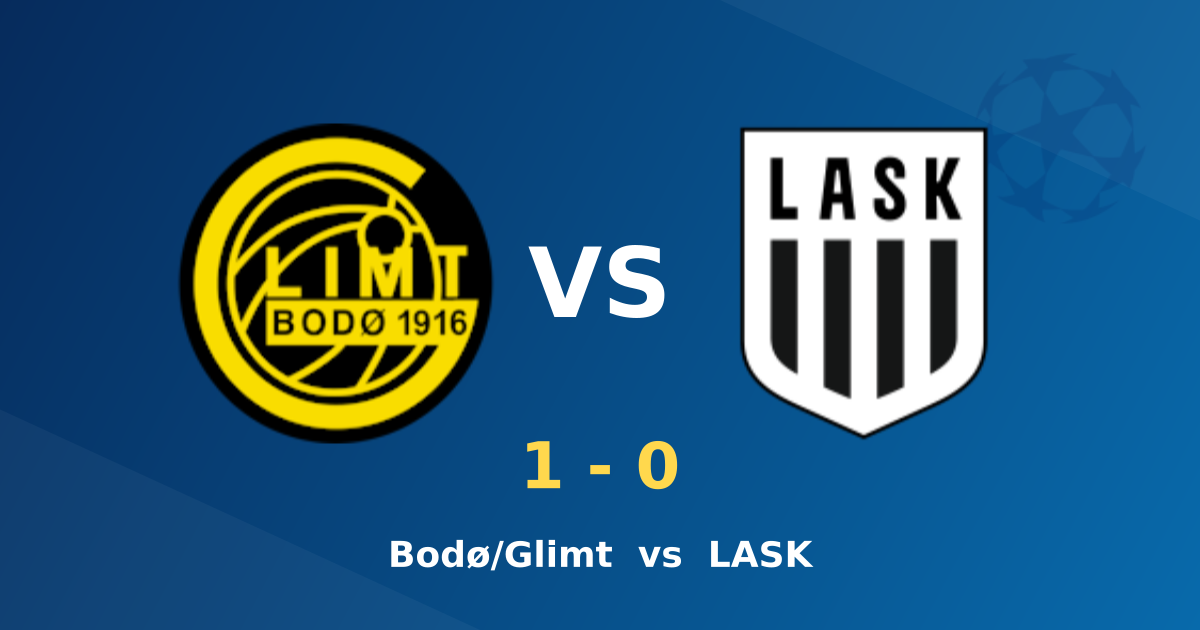
Bodø/Glimt secured a 1-0 victory over LASK at home in the fifth round of the UEFA Champions League 26/27 campaign, with A. Helmersen converting in the 90th minute to settle a match that had been locked in stalemate for the vast majority of its duration. The result confirmed what the underlying numbers had been suggesting for much of the evening: Bodø/Glimt were the dominant side in terms of territory and ball movement, but they required a late intervention to translate that dominance into points. It was a hard-earned three points, and one that carries genuine weight in the context of the competition.
For the best part of 89 minutes, LASK frustrated their Norwegian hosts with a disciplined, compact defensive structure that invited pressure without conceding clear openings. Their willingness to sit deep and absorb the game was evident in the possession figures — Bodø/Glimt held 66 per cent of the ball across the full 90 minutes, rising to 68 per cent in the first half — and yet the Austrians managed to limit the home side to just two big chances across the entire match. LASK were not simply hanging on; they were executing a considered game plan that very nearly earned them a point.
The tactical picture was shaped early and remained consistent throughout. Bodø/Glimt controlled the tempo through the midfield, circulating the ball with patience and looking to exploit wide areas to generate corners and crossing opportunities. Their 799 total passes to LASK's 407 tells a story of a side that was comfortable in possession and intent on wearing down a low-sitting opponent. The four corners Bodø/Glimt earned — all of which came without a single corner being conceded in return — reflect the territorial advantage they maintained, though converting set-piece and transition opportunities into genuine goals proved elusive until the very end.
LASK, for their part, were not entirely passive. They committed to the contest in their own way — racking up 14 fouls across the match, 10 of which came in the second half, and winning 14 tackles to Bodø/Glimt's 11. The foul count tells a story of a side that was prepared to use physicality as a defensive tool, particularly as the game wore on and Bodø/Glimt pressed with increasing urgency. The single goalkeeper save required by LASK's keeper — versus none for Bodø/Glimt's — underlines just how close LASK came to holding out for what would have been a creditable draw in Norway.
Bodø/Glimt's performance on the night was defined by persistence and control rather than invention. They established territorial superiority from the first whistle and never relinquished it, but the challenge they faced was converting that positional advantage into clear-cut chances against a LASK side that defended in organised, disciplined banks. The home side's 10 total shots — four in the first half and six in the second — suggest a team that was probing consistently without finding the right combination to unlock the Austrian defence until the very final moment of the match.
The passing statistics reflect the quality of Bodø/Glimt's ball circulation. Their 799 passes across the full match — 448 in the first half alone — represent a high-tempo, possession-oriented approach that is characteristic of the team's style under their current setup. Maintaining that volume of passing against a side committing 14 fouls and 14 tackles across the game is no trivial feat; it requires players who are comfortable receiving the ball under pressure and who can retain possession when the opposition applies physical duress. Bodø/Glimt's midfield and defensive line clearly had the composure to do exactly that.
The four corners Bodø/Glimt earned — all without conceding any in return — speak to the home side's ability to push LASK back and keep them penned in. While corners themselves are not always a reliable indicator of attacking quality, the fact that LASK could not generate a single corner across the entire match illustrates how thoroughly Bodø/Glimt controlled the defensive and transitional phases of the game. LASK were rarely able to sustain pressure in Bodø/Glimt's half, and when they did manage to advance, the home side's defensive line was well-organised enough to prevent any genuine shooting opportunities in the first half — LASK registered zero shots in the opening 45 minutes.
The decisive moment arrived in the 90th minute when A. Helmersen found the net to end LASK's resistance. The goal was the culmination of a second half in which Bodø/Glimt had generated six shots, earned three corners and forced LASK into 10 fouls — a clear sign that the home side had intensified their efforts as the clock wound down. Helmersen's contribution was the reward for a team that had maintained its structure and its belief throughout a match that could easily have ended goalless. The yellow card Bodø/Glimt received in the second half was a minor blemish on an otherwise composed display, and it did nothing to diminish the significance of the three points secured.
LASK arrived in Norway with a clear tactical mandate: restrict space, limit Bodø/Glimt's big chances and look to frustrate the home side into errors. For the vast majority of the match, they executed that plan with considerable discipline. Conceding just two big chances across 90 minutes against a side that held 66 per cent of possession is a genuine defensive achievement, and it reflects a collective organisation that was difficult to break down through conventional means. The fact that the game remained goalless until the 90th minute is testament to LASK's defensive solidity.
The Austrian side's defensive work rate was evident in their tackling statistics. LASK completed 14 tackles across the match — three more than Bodø/Glimt — with 10 of those coming in the second half as they came under sustained pressure. Their willingness to contest every ball and deny Bodø/Glimt easy transitions was a key component of their defensive approach. The 14 fouls they conceded — heavily weighted towards the second half with 10 — reflect a side that was prepared to use the full range of defensive tools available to them, accepting the risk of set-pieces in exchange for disrupting Bodø/Glimt's rhythm.
Offensively, LASK were limited but not entirely without threat. Their five shots in the second half — after registering none in the first — suggest that they grew into the match as it progressed and were prepared to take more risks as they sensed an opportunity to nick a result. The single big chance they created across the full match was not converted, and the one save their goalkeeper was called upon to make indicates that Bodø/Glimt did manage to test them, albeit not with great frequency. LASK's 407 passes and 34 per cent possession share reflect a side that accepted a secondary role in terms of ball retention and focused its energy on defensive compactness and counter-attacking potential.
Ultimately, LASK's performance will be viewed through the lens of what happened in the 90th minute. They came agonisingly close to earning a point from a match in which they were clearly the inferior side on the ball, and that near-miss will sting. The yellow card they received in the second half, alongside Bodø/Glimt's, added a degree of tension to the closing stages, but LASK's discipline held for long enough to make the game genuinely competitive. X. Mbuyamba was their standout individual — his 70 touches, 46 accurate passes from 51 attempted and consistent defensive interventions made him the cornerstone of everything LASK did well defensively, and his performance deserved more than a defeat.
The match began with Bodø/Glimt asserting themselves in possession immediately, establishing the 68 per cent first-half share that would define the opening 45 minutes. LASK sat in a deep defensive block and invited the home side to come forward, trusting in their defensive organisation to limit the damage. The first half produced four shots from Bodø/Glimt and none from LASK — a statistic that captures the one-sided nature of the territorial battle while also illustrating LASK's success in keeping the home side's efforts to a manageable number. Neither side received a yellow card in the opening period, and the foul count was relatively even at four apiece, suggesting a competitive but controlled first half.
The second half brought a shift in intensity from both sides. Bodø/Glimt increased their shot output to six, earned three additional corners and stepped up the pressure on LASK's backline. LASK responded by becoming more physical — their foul count rose sharply to 10 in the second half, compared to just four in the first, and their tackle count climbed to 10. The five shots LASK managed in the second period represented their only genuine attacking contribution of the evening, and while they created one big chance across the match, it was not taken. Bodø/Glimt's goalkeeper was not called upon to make a single save across the full 90 minutes, which speaks both to LASK's limited attacking output and to Bodø/Glimt's defensive solidity when LASK did venture forward.
As the match entered its final stages, the tension was palpable. LASK had survived wave after wave of Bodø/Glimt pressure and were within sight of a hard-earned draw. The home side's urgency was reflected in the second-half free kick count — Bodø/Glimt were awarded nine free kicks in the second half compared to just one for LASK, a direct consequence of LASK's increasingly physical approach to defending. Both sides received a yellow card in the second half, adding a degree of edge to the closing exchanges. The match appeared to be heading towards a goalless draw that would have reflected the balance of play reasonably accurately, if not the balance of possession.
Then, in the 90th minute, A. Helmersen intervened. The goal arrived at the very end of normal time and settled a contest that had been defined by LASK's defensive resilience and Bodø/Glimt's patient, persistent pressure. Helmersen's strike was the only goal of the match and gave Bodø/Glimt all three points in circumstances that will be remembered as much for the timing as for the manner of the finish. For LASK, conceding so late after investing so much defensively was a painful outcome. For Bodø/Glimt, it was the reward for a performance built on control, patience and the belief that the opportunity would eventually arrive.
X. Mbuyamba was named the top performer of the match with a rating of 7.96, and the statistics that underpin that assessment make a compelling case. The LASK defender played 94 minutes — indicating he was on the pitch for the full duration including added time — and accumulated 70 touches, a figure that reflects both his centrality to LASK's defensive structure and his willingness to be involved in build-up play from the back. In a match where LASK held only 34 per cent of possession, 70 touches represents a significant individual contribution to everything the Austrian side did with the ball.
Mbuyamba's passing accuracy was particularly impressive given the circumstances. He completed 46 of his 51 attempted passes — an accuracy rate of approximately 90 per cent — in a match where LASK were under sustained pressure from a Bodø/Glimt side that completed 799 passes and dominated territory. Maintaining that level of passing accuracy while operating in a defensive block that was being pressed and probed consistently is a mark of technical composure. Mbuyamba was clearly the primary ball-playing outlet from LASK's defensive line, and his ability to retain possession and recycle the ball cleanly helped LASK maintain their shape and avoid the kind of chaotic defending that can unravel under sustained pressure.
Defensively, Mbuyamba was the anchor of a LASK unit that limited Bodø/Glimt to just two big chances across the full 90 minutes. While individual defensive statistics are not available beyond the team totals, his 94 minutes on the pitch and his 70 touches place him at the heart of LASK's defensive effort. In a match where the home side generated 10 shots, earned four corners and dominated the ball entirely, keeping the scoreline level until the 90th minute required consistent, high-quality defending from every member of the LASK backline — and Mbuyamba was evidently the most influential of those defenders.
The irony of Mbuyamba's performance is that it ultimately counted for nothing in terms of the result. He contributed zero goals and zero assists — as expected of a defender in a match where his side barely threatened offensively — but his influence on keeping LASK in the contest for 89 minutes was substantial. A 7.96 rating in a 1-0 defeat tells a story of individual excellence within a collective failure, and it raises the question of what LASK might have achieved had they been able to bring even a fraction of Mbuyamba's composure to the other end of the pitch. His was a performance that deserved a different outcome, and it will serve as a reminder of how close LASK came to earning something from a very difficult away fixture.
This result has meaningful implications for both clubs in the context of the UEFA Champions League 26/27. Bodø/Glimt's victory in Round 5 adds three points to their tally at a stage of the competition where every point carries significant weight. The Norwegian side's ability to grind out a result against a well-organised LASK side — particularly when the winning goal arrived as late as the 90th minute — demonstrates a resilience that will be valued as the competition progresses. Teams that can find ways to win tight matches, especially at home, tend to accumulate the points needed to advance, and Bodø/Glimt have shown here that they possess that quality.
For LASK, the defeat is a difficult one to absorb. Travelling to Norway and holding Bodø/Glimt scoreless until the 90th minute represents a significant defensive effort, and the manner of the loss — conceding so late after being so disciplined for so long — will be particularly hard to process. The points they failed to collect here could prove costly as the round-robin phase of the competition reaches its conclusion. LASK's ability to limit Bodø/Glimt to two big chances and one goalkeeper save suggests they are capable of competing at this level defensively, but their attacking output — five shots across the full match, all in the second half — raises questions about whether they can generate enough to earn positive results.
The possession and passing statistics from this match also contextualise both clubs' broader Champions League profiles. Bodø/Glimt's 799 passes and 66 per cent possession share are figures that reflect a team comfortable on the ball at this level, which is not a given for a side from the Norwegian top flight competing in the Champions League. Their ability to sustain that level of ball circulation across a full 90 minutes against a committed opponent is an indicator of genuine quality, and it suggests that their performances in this competition are built on a coherent tactical identity rather than individual moments.
Looking at the broader competitive landscape, a home win for Bodø/Glimt in Round 5 keeps them in a strong position within their section of the table. Three points from a tight match against a defensively organised side is exactly the kind of result that separates clubs that progress from those that fall short. LASK, meanwhile, must now reassess their position and determine what is still achievable in the remaining rounds. The gap created by this defeat may not be insurmountable, but it narrows the margin for error significantly, and the Austrian side will need to produce a more complete performance — one that combines their defensive solidity with greater attacking ambition — if they are to recover.
Bodø/Glimt take considerable confidence from this result. Winning a match 1-0 with the only goal arriving in the 90th minute is not always the most comfortable of victories, but it is a victory nonetheless, and the manner in which the home side controlled the match — 66 per cent possession, 799 passes, four corners to none, 10 shots to five — suggests that the scoreline, while narrow, is a fair reflection of the balance of play over the course of the evening. The Norwegian side will be encouraged by their ability to maintain pressure and belief throughout a match that could easily have slipped into a frustrating draw, and Helmersen's goal will be remembered as the moment that rewarded that persistence.
Looking ahead, Bodø/Glimt will carry the momentum of this result into their remaining Champions League fixtures. The knowledge that they can control matches at this level — both in terms of possession and territorial dominance — gives them a platform to build upon. Their defensive record in this match was also noteworthy: no saves required from their goalkeeper, just five shots conceded, and a clean sheet maintained. If they can replicate that level of defensive organisation while continuing to create opportunities at the other end, they will be a difficult side to beat in the rounds ahead.
For LASK, the immediate challenge is psychological as much as tactical. Conceding in the 90th minute after executing a defensive game plan with considerable discipline is a difficult experience to process, and the coaching staff will need to ensure that the performance — which had many positive elements — is not entirely overshadowed by the result. The defensive structure LASK demonstrated, particularly in limiting Bodø/Glimt to just two big chances, is a foundation worth building upon. The issue is that their attacking output — zero shots in the first half and five in the second — is not sufficient to trouble opponents at this level on a consistent basis. LASK will need to find a way to add a more credible attacking dimension to their play if they are to take points from their remaining fixtures.
The performances of individuals like X. Mbuyamba offer LASK genuine reasons for optimism even amid the disappointment of the result. A defender who completes 46 of 51 passes at 90 per cent accuracy while accumulating 70 touches in a Champions League match is operating at a high level, and LASK will need players of that quality to step forward in the matches that follow. The UEFA Champions League 26/27 continues to develop its narrative with each passing round, and this result — a late winner for Bodø/Glimt, a near-miss for LASK — adds another layer of intrigue to what promises to be a compelling conclusion to the competition's group phase.